

Pointing out that the implementation of audit conclusions and recommendations is still limited in progress, National Assembly delegates proposed to strengthen sanctions against units that are slow or delay implementation; and to include the rate of implementation of audit recommendations in the criteria for assessing the level of task completion of leaders in order to tighten public financial discipline.
On the morning of December 3, continuing the 10th Session, the National Assembly worked in the hall to listen to the report of the State Auditor General and discuss the results of the implementation of the Resolutions of the 14th and 15th National Assemblies on thematic supervision and questioning.
Focus on auditing "hot" areas that are prone to corruption, waste, and negativity.
State Auditor General Ngo Van Tuan said that based on the tasks assigned in the National Assembly's Resolutions, the State Audit has seriously grasped, disseminated and synchronously deployed solutions for implementation.
Accordingly, the State Audit has promoted administrative reform, innovated methods and ways of organizing audits; powerful application of information technology in all activities, especially the use of artificial intelligence and big data analysis in auditing work; strictly publicize audit results and lists of organizations and individuals that are slow or have not yet implemented audit recommendations; promptly urge and remove difficulties and obstacles in the process of implementing audit recommendations.
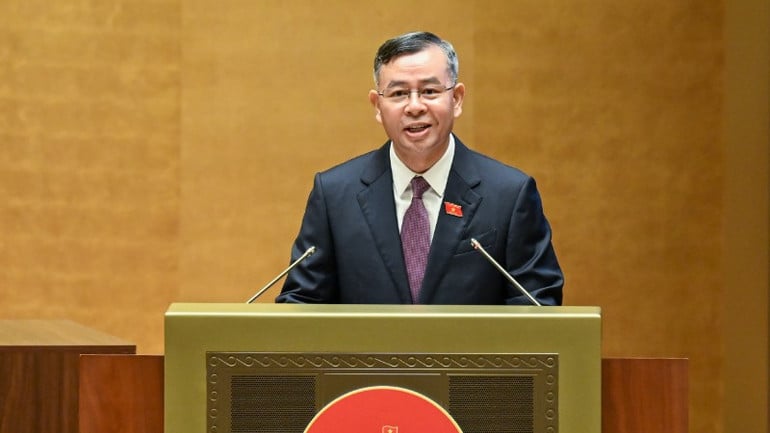
Implementing the Resolutions of the National Assembly, the State Audit has focused on auditing "hot" issues of interest to public opinion and voters, and areas with high potential risks, prone to corruption, waste, and negativity.
Through the audit, the State Audit has pointed out many limitations and inadequacies in the management and use of the budget and public assets.
In regular expenditure, there is still a situation of slow budget allocation, many times, not close to reality; there are cases of allocation when conditions are not met, leading to failure to disburse, having to cancel the budget; in some places, allocation exceeds the norm; funds are used for the wrong purpose...
In development investment expenditure, the State Audit pointed out the situation of capital allocation when conditions were not met, not included in the medium-term public investment plan, allocation beyond implementation capacity, or exceeding actual needs; low disbursement rate, capital plans had to be adjusted and cancelled; many projects were not designed economically; implementation progress was slow, and putting into use was slow, reducing investment efficiency and causing waste of resources.
In the management and use of public assets, the State Audit discovered that houses and land were abandoned, used for the wrong purposes or ineffectively; and that the implementation of plans to rearrange and handle houses and land was slow. Encroachment, land disputes, joint ventures, associations, leasing and lending of assets in violation of regulations still occurred in many places.
Along with that, there are the phenomena of land allocation and land lease not in accordance with regulations; land use without a decision or land lease contract; not declaring and paying land rent, not adjusting land rent price when the stabilization period ends; determining land price and land plot location inappropriately; exemption and reduction of land rent without complete documents, for wrong subjects.
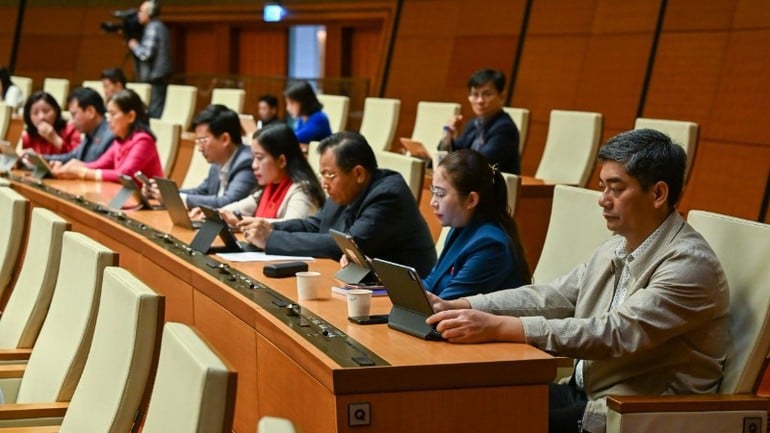
Subject Proposing to include the rate of implementation of audit recommendations in the criteria for evaluating the level of task completion of the head
In a summary report summarizing the audit content, Chairman of the People's Aspirations and Supervision Committee Duong Thanh Binh pointed out that in addition to some achieved results, there are some issues that need attention such as: auditing activities and the implementation of audit conclusions and recommendations face many difficulties and obstacles; the content, methods and quality of auditing have not yet met the requirements of management and use of public finance and assets; the application of information technology, especially high technology, in auditing activities is still limited.
Discussing at the hall, delegate Nguyen Tam Hung ( Ho Chi Minh City Delegation) commented: The State Audit's report comprehensively reflected the implementation of the Resolutions of the 14th and 15th National Assembly on thematic supervision and questioning, showing the great efforts of the State Audit in strengthening discipline, order, finance, budget and preventing and combating corruption and negativity as required by the National Assembly.
However, from the data analysis in the report, delegates found that there are still some limitations that require further improvement of the legal foundation and implementation capacity, such as: many recommendations to amend mechanisms and policies are still slow to be implemented. Some recommendations of the State Audit related to amending and promulgating management documents at the local level are still pending and prolonged, typically the group of recommendations after the Covid-19 audit has only completed 6/28 contents, mostly due to changes in the context and lack of corresponding transitional regulations.
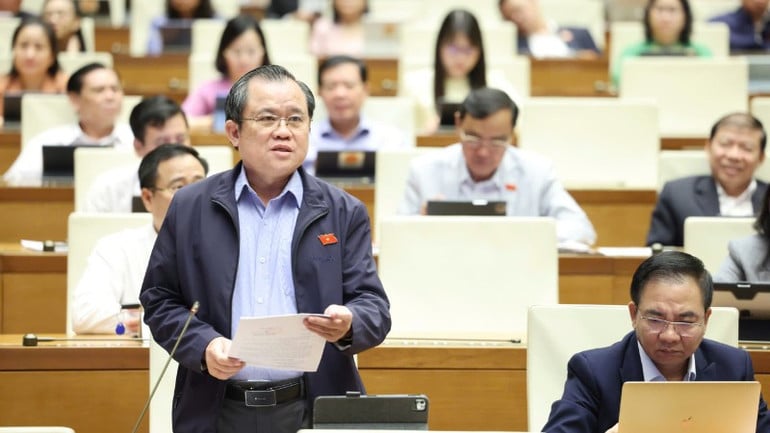
In addition, the report shows that the management and use of land and public assets in many localities still exists widely and repeatedly over many years, showing that the effectiveness of audit recommendations is not yet commensurate and post-audit remedies have not created synchronous and timely changes.
The delegate also pointed out that the implementation of audit conclusions and recommendations is still limited in progress. By September 30, 2025, the implementation rate of audit recommendations of the previous year had only reached 58%, and recommendations on reviewing collective and individual responsibilities had only reached 22.5%. This, according to the delegate, shows that the deterrent effect of audit conclusions is not strong enough, the inter-agency monitoring mechanism is still scattered, and it is especially necessary to strengthen the publicity of organizations and individuals who do not implement recommendations as prescribed in Resolution No. 141 of the National Assembly.
From the above mentioned problems, delegate Tam Hung proposed three key groups of solutions as follows:
Firstly, continue to improve the law on State Audit, especially the Law on State Audit (amended) expected for the period 2027-2030 in the direction of increasing access to data, increasing the binding nature of audit conclusions and especially clearly defining the responsibilities of agencies in implementing recommendations.
Second, the National Assembly needs to require ministries, branches and localities to develop their own plans to overcome audit shortcomings, with detailed roadmaps for each group of recommendations, and to strengthen sanctions against units that are slow to implement, prolonged or unable to explain the reasons. According to delegates, including the rate of implementation of audit recommendations in the criteria for assessing the level of task completion of the head is very necessary and consistent with the requirement to tighten discipline and public finance discipline.
Third, improve the effectiveness of coordination between the State Audit and inspection, investigation and control agencies of the Party and State, especially in sharing databases and handling signs of violations during the audit process.
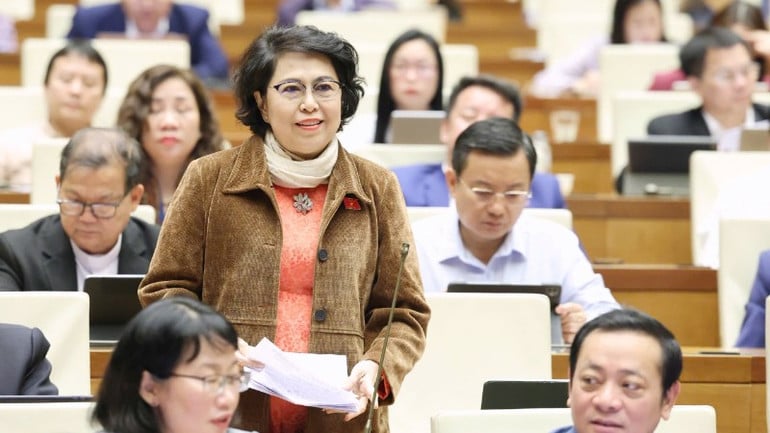
Pointing out the current situation of auditing Covid-19 support sources supported by the people, which is still facing difficulties and confusion due to the lack of precedent, delegate To Thi Bich Chau (Ho Chi Minh City Delegation) proposed to supplement legal regulations on dividing support sources from the people and enterprises in fund sources so that when there is an inspection, examination or audit, it can be fully applied on the legal basis.
Source: https://baolangson.vn/tang-cuong-che-tai-doi-voi-don-vi-cham-thuc-hien-ket-luan-kien-nghi-cua-kiem-toan-5066867.html




















![[Photo] Parade to celebrate the 50th anniversary of Laos' National Day](/_next/image?url=https%3A%2F%2Fvphoto.vietnam.vn%2Fthumb%2F1200x675%2Fvietnam%2Fresource%2FIMAGE%2F2025%2F12%2F02%2F1764691918289_ndo_br_0-jpg.webp&w=3840&q=75)
![[Photo] Worshiping the Tuyet Son statue - a nearly 400-year-old treasure at Keo Pagoda](/_next/image?url=https%3A%2F%2Fvphoto.vietnam.vn%2Fthumb%2F1200x675%2Fvietnam%2Fresource%2FIMAGE%2F2025%2F12%2F02%2F1764679323086_ndo_br_tempimageomw0hi-4884-jpg.webp&w=3840&q=75)





















































![[Infographic] 3 timelines of the "Quang Trung Campaign"](https://vphoto.vietnam.vn/thumb/402x226/vietnam/resource/IMAGE/2025/12/04/1764800248456_fb_ava-2.jpeg)











Comment (0)