

Any commune or ward that lets garbage accumulate and cause pollution for a long time will have to take responsibility before the City People's Committee. There will no longer be a mechanism to push it up to districts like before.
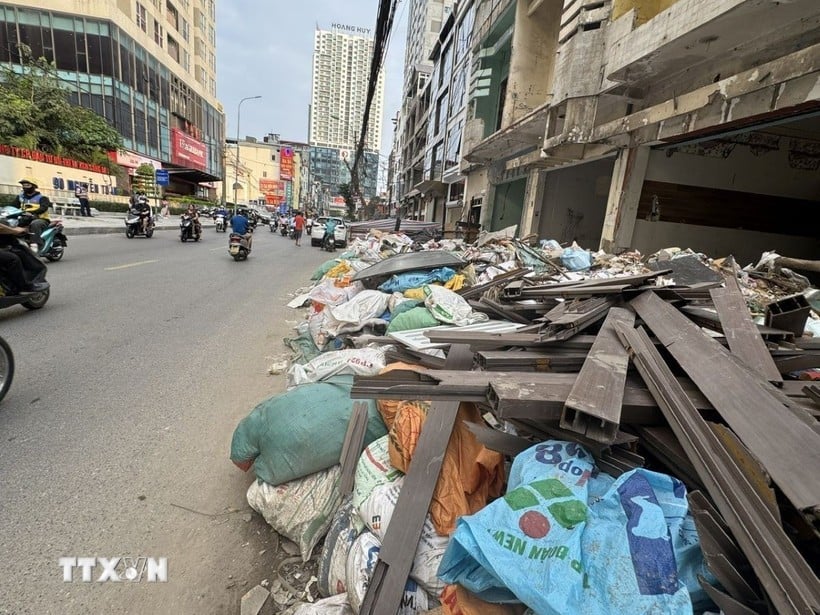
According to Mr. Nguyen Minh Tan, Deputy Director of the Hanoi Department of Agriculture and Environment, from December 1, Hanoi city transferred all environmental sanitation maintenance work to 126 communes and wards.
If previously waste was centrally managed by districts, now each commune and ward has become the investor, taking full responsibility for the quantity, quality and collection progress.
Decentralization is not to divide the work but to tighten responsibility to the waste-generating areas, ensuring work efficiency at the local level. At the same time, the entire volume of environmental sanitation maintenance for the period 2026-2030 has been completed and handed over to the localities as a basis for organizing bidding and ordering. The city will strengthen post-inspection.
Any commune or ward that lets garbage accumulate and cause pollution for a long time will have to take responsibility before the City People's Committee, there will no longer be a mechanism to push it up to districts like before - Mr. Nguyen Minh Tan emphasized.
Specifically, according to Decision No. 69/2025/QD-UBND of the Hanoi People's Committee from December 1, 2025, all 30 environmental sanitation packages previously managed by districts will be transferred in their original state to 126 communes and wards as direct investors. This is not only an adjustment in technical management, but also a repositioning of the role of local authorities in environmental issues.
From just coordination, communes and wards have now become the focal points with comprehensive responsibility, from quality supervision, volume acceptance to payment of expenses.
Implementing the city's direction, the Hanoi Department of Agriculture and Environment has organized the handover of all legal documents, volume documents, payment documents, and technical infrastructure documents of 30 bidding packages to communes and wards. At the same time, technical units have completed the detailed allocation of environmental sanitation maintenance volumes to each specific location.
To ensure there is no "break" during the transition period, the city has temporarily allocated more than VND 211 billion to the budgets of communes and wards to maintain environmental sanitation in December 2025, helping localities not to be passive when receiving new tasks, especially in the context of the year-end increase in household waste.
According to the instructions of the departments and branches, immediately after receiving the volume of environmental sanitation maintenance for the period 2026-2030, communes and wards must urgently prepare estimates, prepare bidding documents, organize contractor selection or place orders in accordance with regulations. If there is a delay, the risk of garbage collection interruption is entirely possible. When the commune or ward is the investor, all existing problems related to garbage, odor, leaked wastewater, unreasonable collection points, etc. will be reported directly by the people to the local authorities.
Despite the change in management model, environmental sanitation work is still maintained regularly and continuously without interruption. In fact, during the handover process, many complicated legal situations have arisen. That is, there is a bid package that is valid until the end of 2026, but must be terminated early to synchronize with the new model; there is a bid package that ends on December 31, 2025, while the commune-level investor has not yet completed the selection of the implementing unit for the following year.
Faced with this reality, departments and branches have issued specific guidance documents on the mechanism for amending, extending, and liquidating contracts in accordance with legal regulations, in the spirit of ensuring continuous service - strict legality - not creating negative loopholes.
According to environmental experts, Hanoi’s decentralization of environmental sanitation this time has created a strong shift in management thinking. If waste was previously managed “centrally” at the district level, it is now “divided” to each commune and ward. Thus, at the commune and ward level, more power is given, which means heavier responsibility./.
Source: https://baolangson.vn/ha-noi-phan-cap-quan-ly-cho-xa-phuong-ky-vong-xoa-diem-den-rac-thai-5066844.html

![[Photo] Cat Ba - Green island paradise](/_next/image?url=https%3A%2F%2Fvphoto.vietnam.vn%2Fthumb%2F1200x675%2Fvietnam%2Fresource%2FIMAGE%2F2025%2F12%2F04%2F1764821844074_ndo_br_1-dcbthienduongxanh638-jpg.webp&w=3840&q=75)

































![[VIMC 40 days of lightning speed] Da Nang Port: Unity - Lightning speed - Breakthrough to the finish line](https://vphoto.vietnam.vn/thumb/402x226/vietnam/resource/IMAGE/2025/12/04/1764833540882_cdn_4-12-25.jpeg)






































Comment (0)