

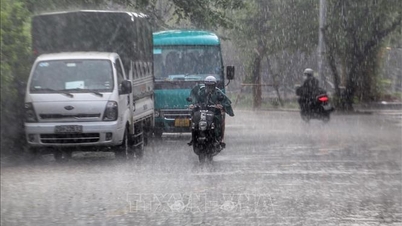
On August 4th, Mr. Vu Anh Tuan, Deputy Head of the Weather Forecasting Department, National Center for Meteorological and Hydrological Forecasting (General Department of Meteorology and Hydrology), stated that the reason for the exceptionally high rainfall in many areas of Southern Vietnam and the Central Highlands in July was due to the strong influence of the tropical convergence zone in the North combined with the strong southwest monsoon, which caused significant rainfall in the southern regions of the country.
Furthermore, with global warming causing increased water evaporation into the atmosphere and stronger convection, extreme rainfall events are also occurring.
"The indirect cause is the impact of the El Nino phenomenon. However, this phenomenon usually affects our country 2-3 months late. El Nino is not like weather ; it is a large-scale phenomenon with long-lasting effects, lasting for many months," Mr. Tuan said.

According to Mr. Tuan, El Nino increases the variability of rainfall in Vietnam, such as in 2015 when Quang Ninh experienced historically heavy rainfall at the end of July; in 2002, heavy rains occurred and caused major floods in the Red River and Thai Binh River areas; major floods occurred in Central Vietnam at the end of September, including a historic flood in the upper reaches of the Ca River (Ha Tinh); and the Mekong Delta experienced prolonged major floods.
Mr. Tuan predicted that from now until the end of August 2023, there is a possibility of 2-3 typhoons or tropical depressions appearing in the East Sea area and directly affecting the Northern and North Central regions of Vietnam.
"From now until August 31st, the tropical convergence zone will continue to be active in combination with the Southwest monsoon, causing strong winds and high waves in the southern seas. Therefore, maritime activities and fishing operations need to take precautions to prevent danger to human lives and property."
"In addition, dangerous weather phenomena such as thunderstorms, tornadoes, lightning, and hailstorms continue to occur nationwide, which can significantly affect production and people's daily lives," Mr. Tuan said.
Mr. Tuan stated that the main cause of the heavy rain was the activity of a low-pressure trough passing through the Northern region, combined with winds at high altitudes, which continuously increased humidity in the western region, thus causing heavy to very heavy rains in recent days.
In the coming period, the low-pressure trough moving into the Northern region is forecast to remain active. Additionally, on the morning of August 4th, the National Center for Meteorological and Hydrological Forecasting observed a strong low-pressure area intensifying over the northeastern border region.
"From now until August 8th, moderate to heavy rain will continue to occur over a wide area in the Northern region, especially in the northern border provinces," Mr. Tuan predicted.
Additionally, from August 5th to 7th, due to the activity of a low-pressure trough, strong thunderstorms and tornadoes are likely to occur in the Northern region.

Regarding the heatwave forecast, Mr. Tuan said that in the Northern region, August will still see hot days interspersed with periods of rain. In particular, the first half of August is likely to see some intensely hot days.
In the central region, the heatwave may last until mid-August. By the end of August, the heatwave in this area will gradually subside.
Source













































































Comment (0)