

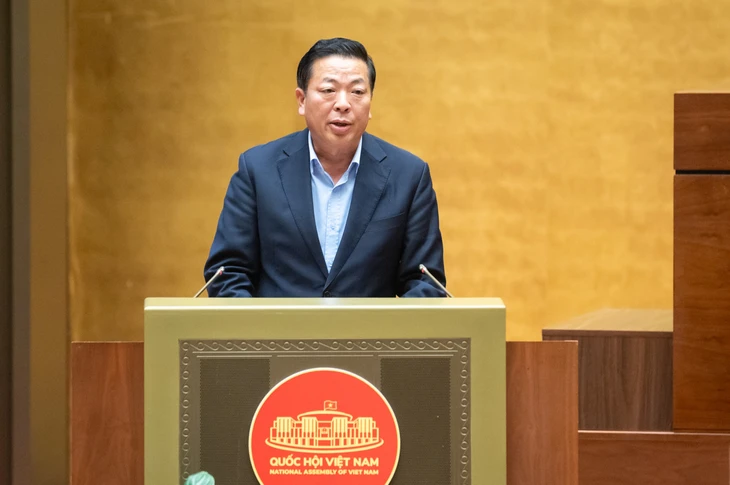
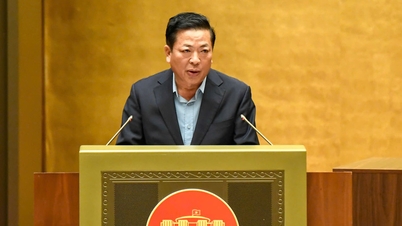
Minister of Construction Tran Hong Minh - Photo: GIA HAN
On the afternoon of December 10th, with 437 out of 439 delegates voting in favor, the National Assembly passed the amended Construction Law. The law will take effect from July 1st, 2026.
One of the key new features of the law is the expansion of the eight categories of construction projects exempt from building permits, including projects under special public investment projects and individual houses under seven stories.
The first group of construction projects exempt from building permits includes state secret projects; urgent and emergency construction projects; projects under special public investment projects or investment projects under special procedures; temporary structures; and structures in national defense and security land areas.
The second group includes projects under public investment, whose investment decisions are made by competent authorities at various levels, such as: the Prime Minister, heads of central agencies, heads of supreme judicial bodies, the State Audit Office, the Office of the President, the Office of the National Assembly, ministries, sectors, socio-political organizations, and chairpersons of People's Committees at all levels.
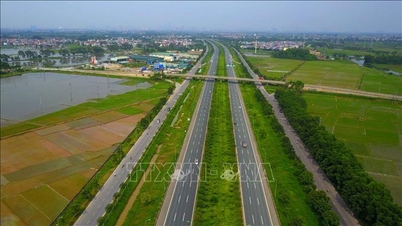
The third category includes linear construction projects spanning two or more provinces; and linear projects outside of areas designated for urban development according to approved plans or approved route options.
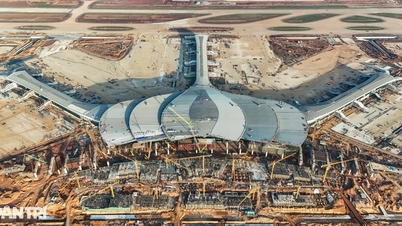
The fourth group consists of offshore structures under offshore construction investment projects for which competent authorities have allocated sea areas for project implementation; airports, airport facilities, and facilities ensuring flight operations outside the airport.
Fifth, advertising structures do not require permits under the Advertising Law; passive telecommunications infrastructure.
Sixth, the project's construction work must have its feasibility study report or adjustments assessed and approved by the relevant professional agency in accordance with regulations.
Seventh, construction projects of level 4; detached houses under 7 floors, with a total floor area of less than 500m² are exempt from permits if they are not located in areas with architectural management regulations such as functional zones, urban areas, rural residential areas, urban development areas according to provincial/city planning, general planning of economic zones, national tourist areas, general planning of communes or areas with existing architectural management regulations.
The eighth category exempt from construction permits includes repair and renovation of interior or exterior structures not adjacent to urban roads that require architectural management. The repairs must not alter the purpose or function, affect the load-bearing structure, and ensure fire safety, environmental protection, and technical infrastructure.
In his explanatory report and response to feedback before the delegates voted to pass the law, Minister of Construction Tran Hong Minh stated that the government's guiding decree will simplify construction permit procedures as much as possible.
According to him, this procedure is conducted entirely online, with an expected issuance time of a maximum of 7-10 days. This helps reduce the time and cost by at least 30% as required by the Government. In addition, the Government will introduce regulations to increase the responsibility of design consultants in ensuring the safety of construction projects.
Allow investors to construct dual-use facilities on national defense land.
Later that same day, the National Assembly also passed the amended Law on Civil Aviation of Vietnam. The law stipulates that investors are allowed to build and upgrade dual-use facilities on national defense land without having to transfer land use rights.
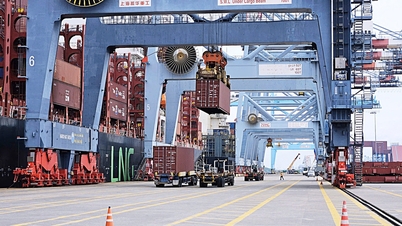
At the same time, investment procedures have been simplified: if a port expansion project is on land already leased from the State, "it is not necessary to go through the procedure of approving the investment policy," in order to shorten the process.
Regarding transportation and compensation liability, the draft law continues to ensure the specificity of the industry and adheres to the principle of prioritizing the application of international treaties.
The law clearly defines the carrier's responsibility in ensuring the accuracy of published information and its obligation to monitor compliance with regulations from aviation authorities.
In cases where a passenger has a confirmed seat on a flight but transportation is delayed, canceled, or denied due to no fault of the passenger, the carrier must promptly notify and apologize to the passenger, while also ensuring food, accommodation, transportation, and bearing all directly related costs commensurate with the waiting time at the airport.
If the delay, cancellation, or refusal of carriage is due to the carrier's fault, in addition to the above obligations, the carrier must also arrange a suitable itinerary for the passenger or refund the unused portion of the ticket as requested by the passenger without charging any additional fees.
In cases where the carrier's fault results in passengers being denied boarding, flights being canceled, or significant delays, the airline must fulfill all the aforementioned obligations and simultaneously pay passengers an advance, non-refundable compensation in cash or equivalent value.
Source: https://tuoitre.vn/thong-qua-luat-xay-dung-8-nhom-cong-trinh-duoc-mien-giay-phep-xay-dung-20251210183315354.htm



























![[Video] The craft of making Dong Ho folk paintings has been inscribed by UNESCO on the List of Crafts in Need of Urgent Safeguarding.](https://vphoto.vietnam.vn/thumb/402x226/vietnam/resource/IMAGE/2025/12/10/1765350246533_tranh-dong-ho-734-jpg.webp)



























































Comment (0)