

Upgrading the ASEAN-China Free Trade Agreement
At the 27th ASEAN-China Summit, leaders highly appreciated the positive and continuous progress in ASEAN-China relations, especially since the two sides established a Comprehensive Strategic Partnership in 2021. China has been ASEAN's largest trading partner for 15 consecutive years, with bilateral trade reaching nearly US$700 billion in 2023, and is the third largest FDI investor in ASEAN with a total capital of US$17.3 billion.
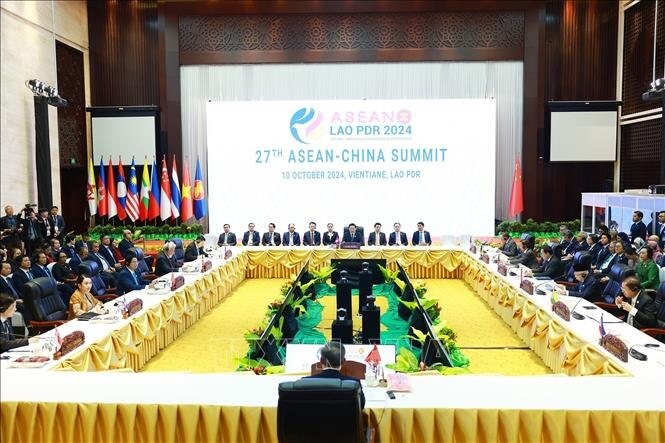 |
| 27th ASEAN-China Summit. Photo: Duong Giang - VNA |
Leaders welcomed the fact that ASEAN and China have essentially completed negotiations to upgrade the ASEAN-China Free Trade Agreement (ACFTA) to version 3.0, creating conditions for enhanced economic , trade, and investment cooperation and strengthening regional supply chains. Leaders also emphasized the need to further expand cooperation in science and technology, innovation, digital transformation, smart agriculture, energy, climate change response, and disaster management.
Chinese Premier Li Qiang affirmed that China will continue to prioritize the development and strengthening of close connectivity between regional economies, effectively implement the ACFTA and the Regional Comprehensive Economic Partnership (RCEP), and promote transportation connectivity and multimodal transport projects to increase trade, services, tourism, and people-to-people exchanges, bringing tangible benefits to countries and making a positive contribution to prosperity and development in the region and the world .
The Chinese Prime Minister also affirmed that China will continue to provide more scholarships for ASEAN students, promote people-to-people exchanges, and enhance mutual understanding and trust, which will serve as an important foundation for the continued sustainable development of relations.
Regarding the South China Sea, ASEAN and Chinese leaders affirmed the importance of ensuring peace, security, and stability in the South China Sea, resolving disputes peacefully, calling for the full implementation of the Declaration on the Conduct of Parties in the South China Sea (DOC), and intensifying efforts to achieve a Code of Conduct in the South China Sea (COC) as soon as possible, making the South China Sea a sea of peace, friendship, and cooperation.
Speaking at the conference, Prime Minister Pham Minh Chinh welcomed the substantive, effective, and extensive development of ASEAN-China relations, which brings positive benefits to all sides. He also emphasized that ASEAN and China are increasingly asserting their role as important driving forces and dynamic centers of development, leading the growth and development of the region and the world.
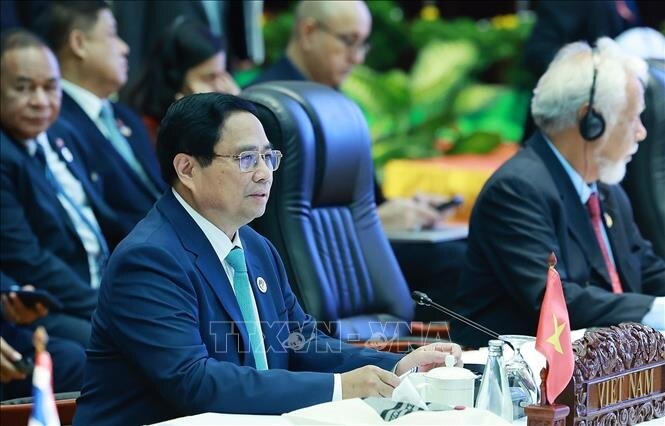 |
| Prime Minister Pham Minh Chinh speaks at the 27th ASEAN-China Summit. Photo: Duong Giang/VNA |
Looking ahead to future relations, the Prime Minister suggested that ASEAN and China, more than ever, need to enhance self-reliance, promote close, comprehensive, and inclusive ties and connections. Accordingly, they need to strengthen strategic connectivity, especially strategic infrastructure and transportation infrastructure, promote new growth drivers, ensure smooth trade connections, strengthen ties with the "Belt and Road" Initiative, accelerate market opening, upgrade border infrastructure, especially soft connectivity in smart customs, and make good use of scientific and technological achievements to promote cooperation in the development of the digital economy and the green economy.
Highly appreciating the ASEAN-China People-to-People Exchange Year 2024 with its many meaningful activities that help people on both sides understand each other better, share more, become closer, trust each other more, and travel more, the Prime Minister suggested that these activities should be further promoted to strengthen people-to-people connections and exchanges, contributing to consolidating a solid social foundation, continuously fostering friendly neighborly relations, cooperation, and the development of the ASEAN-China Comprehensive Strategic Partnership.
Emphasizing the need to promote a vision of peace and security, share responsibility for peace, and preserve a peaceful environment for cooperation and development, the Prime Minister hoped that ASEAN and China would connect their positions and viewpoints, further strengthen political trust, coordinate closely, and make positive and responsible contributions to peace, security, and stability. He also hoped they would enhance dialogue and peacefully resolve disputes in the region, including the South China Sea, making it a sea of peace, stability, cooperation, and sustainable long-term development, and that the COC negotiations would be concluded soon in a substantive and effective manner, in accordance with international law, including the 1982 United Nations Convention on the Law of the Sea.
At the conclusion of the Summit, ASEAN and Chinese leaders adopted joint statements on deepening people-to-people exchanges, essentially completing negotiations to upgrade the ACFTA, developing smart agriculture, promoting the construction of a sustainable and inclusive digital ecosystem, and combating online fraud and gambling.
Vietnam has played a good coordinating role in ASEAN-Korea relations.
The 25th ASEAN-Korea Summit unanimously adopted a Joint Statement establishing a Comprehensive Strategic Partnership between ASEAN and Korea, marking a new milestone in the 35th anniversary of the establishment of relations (1989-2024). The leaders emphasized that the establishment of this Comprehensive Strategic Partnership reflects the high level of close ties and the positive results of extensive cooperation between ASEAN and Korea.
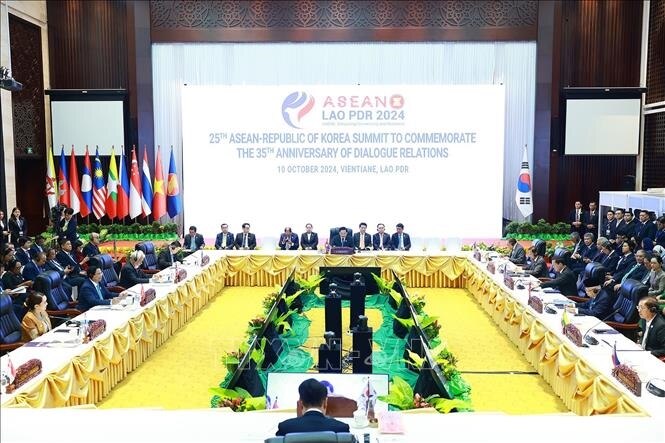 |
| 25th ASEAN-Korea Summit. Photo: Duong Giang/VNA |
South Korea is currently ASEAN's fifth-largest trading partner, with bilateral trade reaching US$196.64 billion, and the sixth-largest foreign direct investment (FDI) investor in ASEAN, with US$11 billion in 2023. ASEAN and South Korean leaders affirmed their commitment to continue working closely together to effectively implement the ASEAN-Korea Solidarity Initiative (KASI) to further deepen bilateral cooperation. In addition to cooperation in responding to non-traditional security challenges, promoting trade, business connectivity, people-to-people exchanges, culture, education, and tourism, both sides agreed to further enhance cooperation in science and technology and innovation, digital transformation, environment, climate change response, and disaster management.
South Korean President Yoon Suk Yeol shared his assessment of the remarkable progress achieved in ASEAN-Korea relations across all fields over the past 35 years, noting a 23-fold increase in total trade volume, an 80-fold increase in investment, and a 37-fold increase in people-to-people exchanges.
The South Korean President affirmed that he would continue to prioritize strengthening solidarity and cooperation with ASEAN countries, effectively responding to and addressing challenges related to security, economy, climate change, etc., while increasing investment in cooperation with ASEAN on smart cities, digital transformation, joint research, and training experts in technology and artificial intelligence, with a plan to train 40,000 students…
Speaking at the conference, Prime Minister Pham Minh Chinh expressed his pleasure at the official establishment of a Comprehensive Strategic Partnership between ASEAN and South Korea on the occasion of the 35th anniversary of their relations, and while Vietnam holds the role of coordinating ASEAN-South Korea relations (2021-2024).
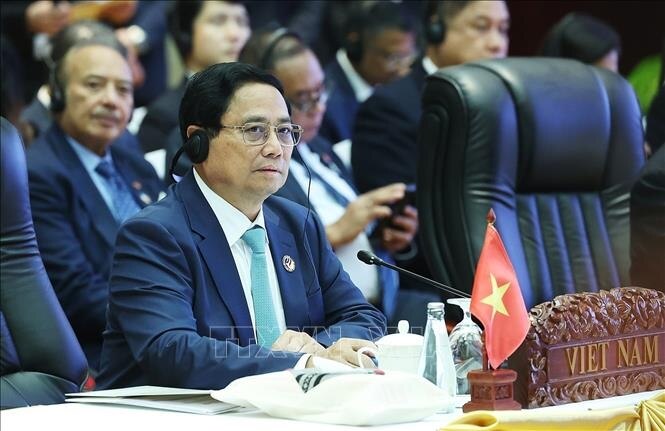 |
| Prime Minister Pham Minh Chinh speaks at the 25th ASEAN-Korea Summit. Photo: Duong Giang/VNA |
The Prime Minister proposed three directions for developing ASEAN-Korea relations commensurate with the new level. First, contributing more responsibly to peace, security, stability, and prosperity in the region, the Prime Minister welcomed Korea's continued active support for ASEAN's common stance on the South China Sea, as well as efforts to build the South China Sea into a sea of peace, stability, cooperation, and sustainable development. ASEAN is ready to coordinate and encourage relevant parties to strengthen dialogue, aiming for long-term peace and stability on the Korean Peninsula, free from nuclear weapons.
Secondly, we need to strongly promote economic cooperation, focusing on connecting economies, cultural cooperation, tourism, and education and training. In particular, trade and investment cooperation should develop in a more balanced and sustainable direction, making better use of the ASEAN-Korea Free Trade Agreement (AKFTA) and the Regional Comprehensive Economic Partnership (RCEP). Simultaneously, we need to promote the signing of joint documents, creating a transparent and favorable cooperation mechanism, opening up larger markets for each other, and boosting cultural, tourism, and education and training exchanges and cooperation.
Thirdly, more decisive action is needed to promote inclusive, comprehensive growth and sustainable development, especially in new growth drivers. Accordingly, we need to jointly open up new strategic horizons of cooperation such as innovation, high technology, renewable energy, digital transformation, green transformation, climate change response, semiconductors and artificial intelligence (AI), cloud computing, the Internet of Things, etc., while continuing to promote the Mekong-Korea Partnership, making positive contributions to sub-regional development efforts, ensuring inclusive growth, narrowing the gap, and achieving equitable and sustainable development in the region.































































Comment (0)