

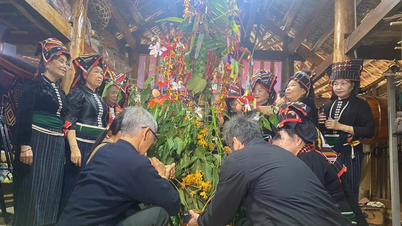
Nghia Do commune, situated along the picturesque Nam Luong river, is home to over 98% of the Tay ethnic minority in Lao Cai province. Through generations, the people here have accumulated a rich and unique cultural heritage, with cuisine holding a special place, embodying the essence of the mountains, soil, and the spirit of the highland people.
Recently, the Ministry of Culture, Sports and Tourism officially inscribed "Folk knowledge of preparing grilled fish, blue-fleshed duck and herbal wine of the Tay people in Nghia Do commune" into the National List of Intangible Cultural Heritage - marking the first culinary heritage of Lao Cai to be honored at the national level.
Nghia Do cuisine is distinguished by its harmonious blend of local ingredients, unique cooking methods, and the philosophy of yin and yang and the five elements in each dish. Each dish is not just for enjoyment, but also tells a story of livelihood, adaptation, and creativity amidst the mountainous natural environment.
Blue Muscovy Duck Dish
Originating from a nomadic lifestyle, often working in fields far from home, the Tay people have created a unique cooking method, utilizing bamboo or reed tubes as rice cooking pots, known as "lam" cooking, which is very convenient.
This cooking method preserves the original flavor of the food while retaining the distinctive aroma of bamboo. As a result, a variety of dishes cooked in bamboo tubes have been created, such as sticky rice cooked in bamboo, fish cooked in bamboo tubes, vegetables cooked in bamboo tubes, and duck cooked in bamboo tubes – all incredibly delicious and irresistible.
For the dish called "duck with blue neck," the Tay people use a breed of green-necked duck found only in Nghia Do. This is a short-necked duck with a plump body, large head, and short legs, yielding firm, fragrant, and fatty meat.
After cleaning and chopping the duck meat, it is marinated with dổi seeds, mắc khén seeds, chives, ginger, lemongrass, chili peppers, and herbs for about 15-20 minutes to allow the meat to absorb the spices evenly. Then, it is wrapped tightly in dong leaves in an elongated shape to fit inside the bamboo tube. Beforehand, the bamboo tube has been washed and soaked in a little spring water to prevent the duck meat from drying out.
After placing the duck meat package into the bamboo tube, the cook will seal the end of the tube with banana leaves and grill it over hot coals for about 40 minutes.
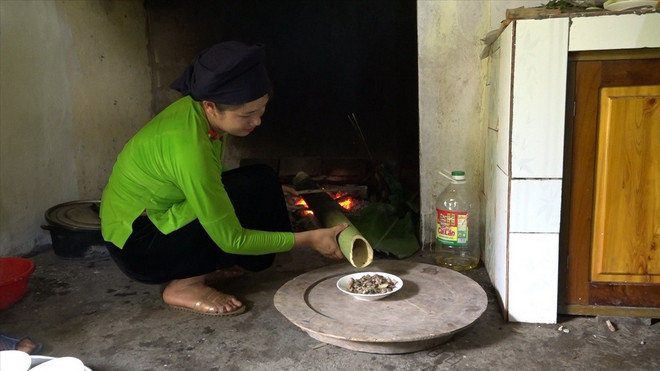
As the bamboo tube slightly charred, the aroma of the marinated duck, blended with the scent of fresh bamboo, filled the air, awakening all the senses—simple yet refined.
Despite being a rustic dish, "blue-skinned duck" still adheres to the philosophy of yin and yang and the five elements in culinary art: meat filleting knife (Metal), bamboo tube container (Wood), clear spring water (Water), cooking over low fire (Fire), and placed on forest soil (Earth).
Grilled Fish with Two Flames
If the blue-fleshed duck is the "dish of the forest," then grilled fish cooked over two fires is the "flavor of the stream." To make delicious grilled fish, the Tay people choose natural fish from rivers, streams, and ponds, usually carp, catfish, or grass carp weighing over 1.5 kg, with firm and fragrant meat.
Fresh fish is gutted, washed, split lengthwise, and sliced into thick pieces. It is then marinated with dổi seeds, mắc khén seeds, salt, ginger leaves, lemongrass, and various herbs from the garden. All ingredients are ground into a paste and then marinated with the fish for about 20 minutes to allow the flavors to penetrate evenly.
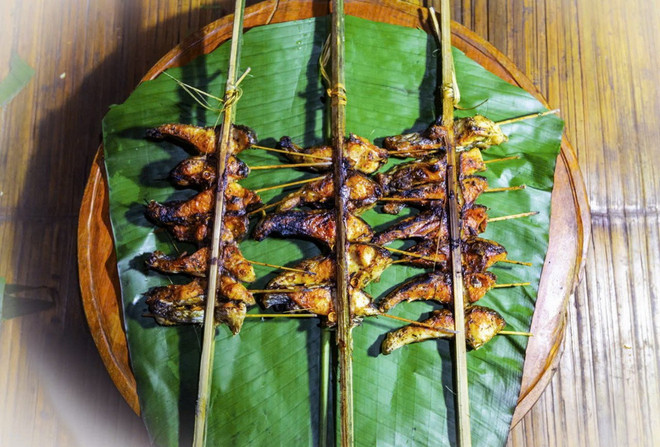
The cook will use small bamboo skewers, sharpened at one end, to skewer the fish fillets lengthwise, creating a flat surface. Then, using bamboo strips, they will clamp the skewers together to form a large fish tongs for grilling.
What sets this dish apart from other grilled fish dishes is the double grilling. First, the fish skewers are placed near the fire, not too close and with not too much charcoal, to firm up the fish. Just before serving, they are grilled a second time, closer to the fire, to ensure the fish is cooked through, golden brown, and fragrant. This process preserves the fish's sweet flavor, blended with the distinctive aroma of charcoal and forest spices.
On the Tay people's dinner table, grilled fish cooked over two fires is often served with five-colored sticky rice, bitter soup, and braised meat – creating a vibrant symphony of flavors that is both rustic and sophisticated.
Leaf-fermented wine
The Tay people in Nghia Do have a saying: "Good wine comes from yeast, good health comes from medicine." This simple saying encapsulates a philosophy of living in harmony with nature. Leaf yeast is both the secret to creating the intoxicating flavor of glutinous rice wine and a treasure trove of folk medicine knowledge preserved through generations.
To make authentic leaf yeast, the Tay people use 15-17 types of leaves, roots, and bark from forest trees such as betel leaves, vối bark, dổi seeds, guava leaves, bitter sugarcane roots, perilla, rau răm, wild chili... and especially the leaves of the "Ta có" tree - the soul of the leaf yeast. Each type has its own function: creating aroma, helping the fermentation process to proceed evenly, or mellowing the harsh taste of the wine, enhancing the flavor of meat, and removing the fishy smell of fish.
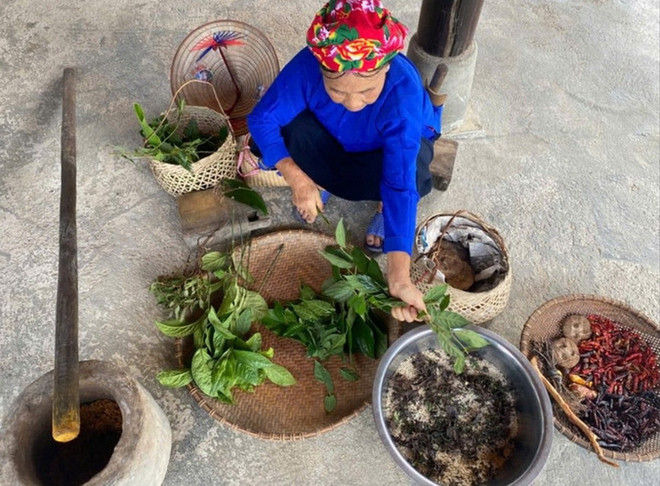
The ingredients are washed, pounded into a paste, mixed with cooled boiled water, filtered to obtain the liquid, and then mixed with rice flour. The mixture is molded into small yeast cakes, left to ferment, and then dried in the sun.
Each batch of yeast is made by hand, and there's no room for rushing, because harvesting it in the wrong season or using it on the wrong day will ruin the yeast and make the wine bitter. Especially, if someone who has attended a funeral makes the yeast, it will not work.
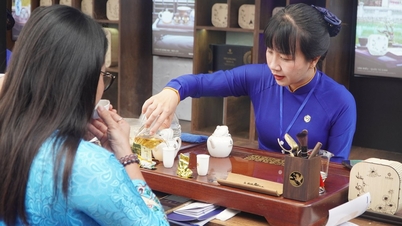
When brewing rice wine, the Tay people mix leaf yeast with steamed glutinous rice, sealing it in earthenware jars for 1-1.5 months to allow the rice to ripen evenly before distilling the wine. Traditionally, the Tay people often use turtle shells, tortoise shells, or wood shaped like turtle shells to guide the condensed wine through.
Good quality rice wine made with fermented leaves should be cloudy white, intensely fragrant, and not cause headaches when drunk. It's not just a beverage; it's also a symbol of kinship and hospitality – always present at weddings, harvest celebrations, or when honored guests visit. Opening the jar of wine is like a warm invitation, a sharing of affection and kindness.
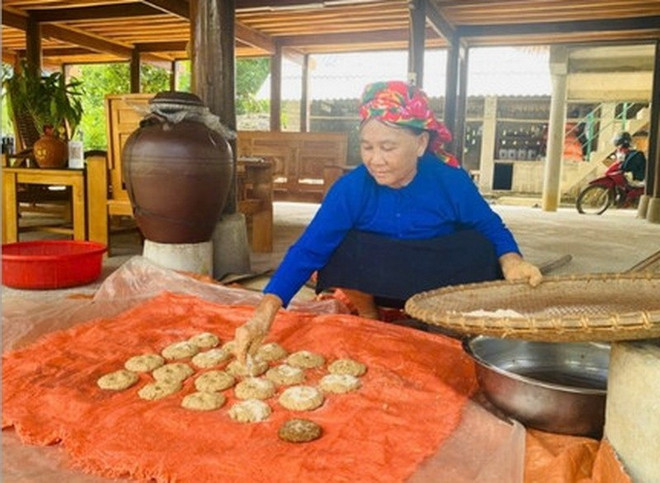
In particular, leaf yeast is not only used for brewing alcohol but also for fermenting meat and fish, creating a unique, tangy, and rich flavor. Anyone who has tasted it once will find it hard to forget that rustic yet refined taste – like the lingering aftertaste of a glass of leaf-fermented rice wine from the Tay ethnic villages.
Preserving cultural heritage through each dish.
For the Tay people in Nghia Do, cuisine is not just about delicious food, but also about storytelling: stories of the forest, the streams, and the people's efforts to adapt and preserve their identity amidst modern life. Each dish is a slice of life, containing the knowledge, experience, and soul of the ethnic community that created it.
The national recognition of these three indigenous dishes has further increased the pride of the Tay ethnic people in their culinary heritage. These dishes are like the "cultural genetic code" of the Tay people – a convergence of indigenous knowledge, skillful hands, and a belief in the harmony between humans and nature.
Source: https://www.vietnamplus.vn/thuong-thuc-3-mon-am-thuc-cua-nguoi-tay-duoc-cong-nhan-la-di-san-quoc-gia-post1071883.vnp

![[Photo] Prime Minister Pham Minh Chinh holds a phone call with the CEO of Russia's Rosatom Corporation.](/_next/image?url=https%3A%2F%2Fvphoto.vietnam.vn%2Fthumb%2F1200x675%2Fvietnam%2Fresource%2FIMAGE%2F2025%2F12%2F11%2F1765464552365_dsc-5295-jpg.webp&w=3840&q=75)
![[Photo] Closing Ceremony of the 10th Session of the 15th National Assembly](/_next/image?url=https%3A%2F%2Fvphoto.vietnam.vn%2Fthumb%2F1200x675%2Fvietnam%2Fresource%2FIMAGE%2F2025%2F12%2F11%2F1765448959967_image-1437-jpg.webp&w=3840&q=75)


































![[OFFICIAL] MISA GROUP ANNOUNCES ITS PIONEERING BRAND POSITIONING IN BUILDING AGENTIC AI FOR BUSINESSES, HOUSEHOLDS, AND THE GOVERNMENT](https://vphoto.vietnam.vn/thumb/402x226/vietnam/resource/IMAGE/2025/12/11/1765444754256_agentic-ai_postfb-scaled.png)













































Comment (0)