

In particular, the district has been planned as a satellite city and an airport… This is a potential and advantage for Phu Xuyen to boost local economic development.
Many industrial clusters have been built.
Chairman of the Phu Xuyen District People's Committee, Le Van Binh, shared that the Phu Xuyen District regional planning is linked to the development of industry, services, small-scale handicrafts, agriculture , and urbanization; leveraging the strengths and potential of its location as a transportation hub… to become a district with attractive development and diversity at the southern gateway of the capital.
Phu Xuyen is located within the cultural development axis of Southern Hanoi, as outlined in the Hanoi Capital City Planning for the period 2021-2030, with a vision to 2050. The cultural values of traditional crafts and heritage are being promoted as driving forces for the district's development. Simultaneously, competitive development models are being developed, such as: traditional craft village economy, craft village tourism , and tourism along the Red River.
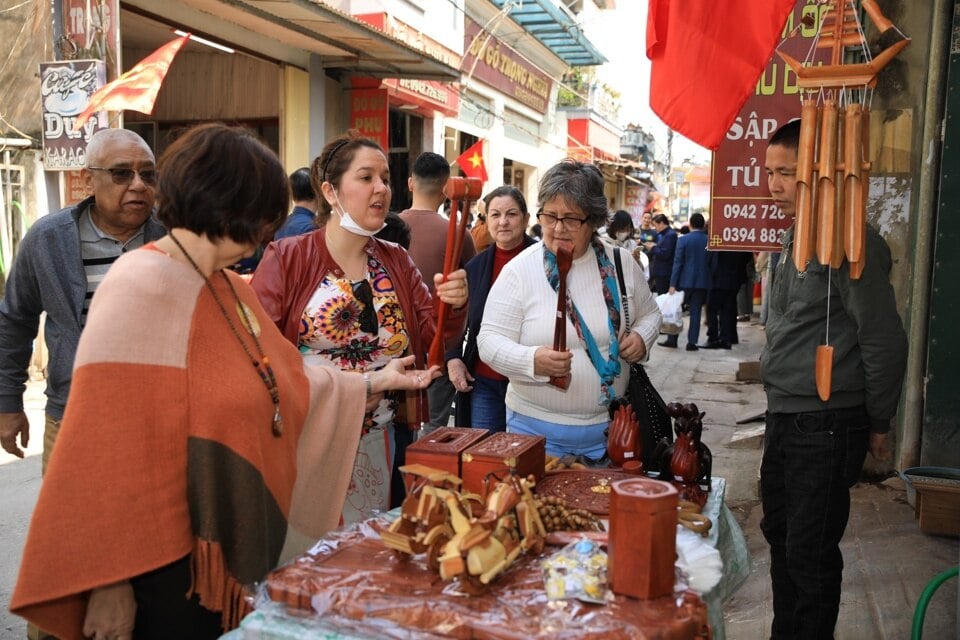
Phu Xuyen also aims to develop green industrial clusters, models of community centers supporting efficient production and business; build development complexes to leverage integrated strengths, with the craft village economy and industrial clusters as the driving force for rural economic development; and develop agriculture towards large-scale production, ecological agriculture, with key products being OCOP products.
At the same time, Phu Xuyen is focusing its efforts on building connecting transportation infrastructure and irrigation systems to ensure production, aiming to become a district with urban-industrial, service-craft village-agricultural functions, and a "Smart-Creative-Ecological-Cultural Growth Pole" of the Capital.
Phu Xuyen is also considered a transportation hub connecting the southern provinces of Hanoi and is planned as a satellite city of the city; it is a center for economic, industrial, and service development, a transshipment center for goods, and a logistics service center associated with the southern airport of the capital, with the orientation to develop into an airport city, reaching the scale of a city in the period 2040-2050.
Currently, the entire district has 120 out of 345 historical relics that have been classified, including 38 relics classified at the national level and 82 relics classified at the city level. Some ancient relics with typical architecture include: Gie Ha communal house (Phu Yen commune), Da Chat communal house (Dai Xuyen commune), Co Che communal house (Phuc Tien commune), temple dedicated to the founder of the inlay craft (Chuyen My commune)...
According to Nguyen Huu Khoa, Head of the Urban Management Department of Phu Xuyen District, the district has a planned South Hanoi supporting industrial park with 500 hectares by 2030, which is currently attracting many large enterprises to invest. At the same time, the district is also developing the Phu Xuyen Industrial Cluster, covering 204 hectares in the communes of Nam Phong, Phuc Tien, Nam Trieu, and Phu Xuyen town.
According to the Approved Planning for the Development of Industrial Clusters in Hanoi City until 2020, with consideration to 2030, as stipulated in Decision No. 1292/QD-UBND dated March 14, 2018, of the Hanoi People's Committee, Phu Xuyen district has 11 craft village industrial clusters in the communes of Dai Thang, Phu Tuc, Phu Yen, Van Tu, Hong Minh, Son Ha, Phuong Duc, Hoang Long, etc.
Previously, from 2018 to 2020, Phu Xuyen was allowed by the Hanoi People's Committee to establish four craft village industrial clusters, including: Phu Tuc (5.94ha), Phu Yen (10.5ha), Dai Thang (7.37ha), and Van Tu (7ha). These projects are currently in the process of completing construction and are preparing to become operational.
The district has a satellite town planned according to Decision No. 3996/QD-UBND dated August 13, 2015 of the Hanoi People's Committee approving the General Planning of Phu Xuyen Satellite Town until 2030, scale 1/10,000; and Decision No. 5517/QD-UBND dated October 20, 2015 of the Hanoi People's Committee approving the General Planning for the construction of Phu Xuyen District, Hanoi City until 2030, scale 1/10,000.
Many connecting transportation routes
According to Le Van Binh, Chairman of the People's Committee of Phu Xuyen District, Phu Xuyen has been receiving attention and guidance from the city government for the investment and construction of a series of roads, including the eastern access road of the Phap Van - Cau Gie expressway, connecting residential clusters east of the expressway, promoting the economy and ensuring safety for the expressway.
In addition, the western access road of the North-South railway through Phu Xuyen district aims to connect residential clusters west of the railway, promote the local economy, and ensure a safe corridor for the railway. The section of the route passing through the satellite city is implemented according to the satellite city zoning plan.
The Southern Economic Axis Road is a route connecting the entire western area of the district with the center of the Capital, as shown in Decision No. 2016/QD-UBND of the Hanoi People's Committee approving the red line boundary dossier at a scale of 1/500 for the Southern Economic Axis Road (formerly the Southern Axis Road of Ha Tay province), segment from KM18+561.5 – KM41+500, with a width of 40m passing through the communes of Hong Minh, Tri Trung, Phu Tuc, Hoang Long, and Chau Can.
According to the General Planning for the Construction of Phu Xuyen District, Hanoi City, until 2030, the road ends at the intersection with National Highway (NH) 1A. However, the Phu Xuyen District Regional Planning project proposes extending the road to the Red River dike, creating a southern economic route for the district and strengthening East-West connectivity. The eastern section of NH 1A has a width of 30m.
Additionally, there is a southern economic route connecting the communes of Tri Trung, Hoang Long, Chuyen My, and Van Tu, intersecting with National Highway 1A at the N6 junction, spanning 13.36 km and 30 m wide. Furthermore, there is a 15.4 km long, 30 m wide road connecting the communes of Nam Tien, Nam Trieu, Khai Thai, Tri Thuy, and Minh Tan with Phu Xuyen port and Ha Nam province.
The Do Xa – Quan Son route is of significant importance, creating momentum for socio-economic development in the southern part of Hanoi in particular and transit transport from the Northwest region through the Capital area in general. The route starts at the Van Diem port area, has 6 lanes, and is 36.5 – 62.0m wide, with sections passing through urban and residential areas.
In parallel, there is also Route 429 connecting the districts of Thuong Tin, Phu Xuyen, Thanh Oai, and My Duc, linking to National Highway 1A and the Southern arterial route. The total length of the route through the district is 9.6km, currently under construction for upgrading and expansion to 4 lanes, 25m wide, with sidewalks on both sides like urban roads, and a 13m safety corridor on each side.
In addition, the district also has roads 428A and 429B connecting Phu Xuyen with Ung Hoa district and Ha Nam province. These are East-West arterial routes connecting National Highways 1, 5B, and 38, the Southern arterial route, the Do Xa - Quan Son route, and the Huu Hong dike. The roads run through the district for 18.4 km with 4 lanes, 25 m wide, and with sidewalks on both sides of the road in densely populated residential areas, similar to urban roads.
The road connecting the Southern Economic Route, starting in Hoang Long commune and ending in the Phu Xuyen satellite town, is 12.9 km long and 30-40 m wide. In total, the district has 23 roads, with a width of 18-24.0 m and classified as level IV-V for flat terrain. The total length of the transportation system that has been, is being, and will be upgraded or newly constructed is 102.3 km.
“These are the factors and conditions that create inherent potential and advantages that will help Phu Xuyen district make positive changes to promote socio-economic development and improve the lives of local people in the coming time…” – affirmed Le Van Binh, Chairman of the People's Committee of Phu Xuyen district.
The Phu Xuyen satellite town includes Phu Xuyen town, Phu Minh, Phuong Duc, Dai Thang, Quang Trung, Son Ha, Nam Trieu, Nam Phong, Nam Tien, Phuc Tien communes, and a part of Thuong Tin district. This is one of five satellite towns to be formed in Phu Xuyen and will essentially maintain the development orientation according to the Hanoi Capital City Master Plan until 2045, with a vision to 2065.
Source: https://kinhtedothi.vn/tiem-nang-va-loi-the-phat-trien-kinh-te-o-huyen-phu-xuyen.html




![[Photo] Closing Ceremony of the 10th Session of the 15th National Assembly](/_next/image?url=https%3A%2F%2Fvphoto.vietnam.vn%2Fthumb%2F1200x675%2Fvietnam%2Fresource%2FIMAGE%2F2025%2F12%2F11%2F1765448959967_image-1437-jpg.webp&w=3840&q=75)

















![[OFFICIAL] MISA GROUP ANNOUNCES ITS PIONEERING BRAND POSITIONING IN BUILDING AGENTIC AI FOR BUSINESSES, HOUSEHOLDS, AND THE GOVERNMENT](https://vphoto.vietnam.vn/thumb/402x226/vietnam/resource/IMAGE/2025/12/11/1765444754256_agentic-ai_postfb-scaled.png)
























































Comment (0)