

The trend of Chinese people sending their children to study abroad is showing signs of recovery, even as many families' assets are declining. In addition, study destinations have also changed.
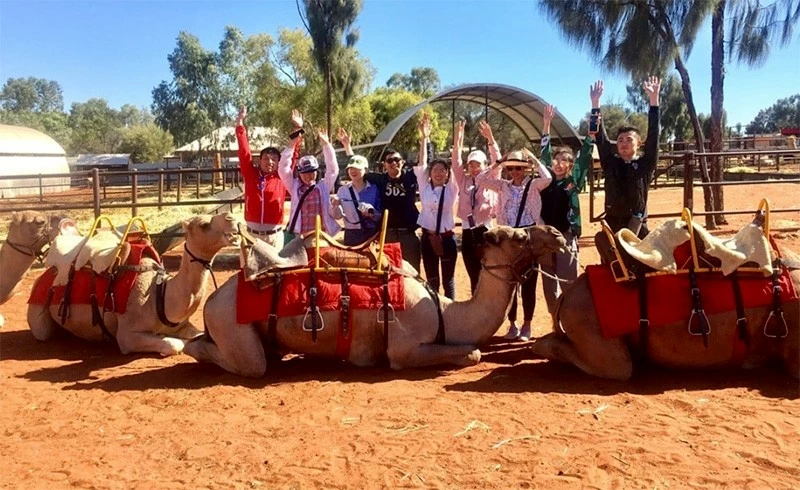 |
| Chinese students participate in a study tour in Australia. Photo: Weibo |
July has been the busiest month in recent years for Kent Cai, as this young man from Zhejiang chooses to travel to overseas cities such as Kuala Lumpur, Osaka, Macau, Jakarta, and Sydney, where he has organized a total of six study tours abroad for more than 150 Chinese university students.
After China lifted travel restrictions in early 2023, more and more families and students were willing to spend money on study trips abroad, a trend that had flourished before the Covid-19 pandemic.
Cai, the founder of Ningbo New Way, an organization that arranges customized exchange programs and study tours in Zhejiang Province, said: “Last year, many public schools and parents were still worried, so 2024 is really the first time since the pandemic that many mainland students are willing to go abroad for study tours.”
According to a report published last year by Beijing-based consulting firm Guanyan Tianxia, the size of China's educational tourism market was projected to be 147.3 billion yuan (US$20.3 billion) in 2023, compared to 152.3 billion yuan in 2019.
Also this month, a report by iiMedia Research predicted that the market size of this industry will reach 179.1 billion yuan this year and surpass 300 billion yuan annually by 2028. The report also stated that two-thirds of surveyed parents are very willing to let their children participate in such tours.
According to the same report, related posts on Chinese social media have attracted billions of views this year, clearly indicating that study tours are in huge demand among mainland Chinese citizens.
Data shows that in 2023, China had approximately 189 million primary and secondary school students and 48 million university students. Many public middle schools in first and second-tier cities have opened various educational field trips for students, ranging from domestic destinations costing around 10,000 yuan to international destinations costing over 40,000 yuan.
Field trips give students the opportunity to interact with the world , gain a deeper understanding of different cultures, and experience a sense of independence without the loving care of their parents.
Cai explained that, although the assets and income of Chinese families in general have declined, studying abroad remains important for many middle-class and wealthy families in China.
However, changes in visa policies and global inflation trends have made the United States less attractive as it once was. Instead, Chinese students are increasingly exploring more options in Asia and other Western countries such as the UK and Australia.
He said, "Compared to the pre-pandemic period, the current trend shows that more and more students and parents are interested in Asia because they are paying more attention to the region when planning their future studies and careers." According to Cai, tours to Japan and Malaysia are increasingly popular, with prices ranging from 10,000 to 30,000 yuan.
“Students can network with their peers at local universities and visit local businesses,” he said . “Students are very interested in the overseas expansion of Chinese companies, and Asia is currently a major investment hub for Chinese companies. Study tours can help them apply to universities in Asia or compete for jobs at Asian companies in the future, and more and more Chinese parents are encouraging their children to start engaging in the Southeast Asian market.”
Other industry insiders point out that the UK has become a preferred destination for high-end overseas study, while the US is seen as a shrinking market.
“The cost and difficulty of obtaining visas for study tours to the United States are becoming very high,” said Cherry Ma, an international education and immigration consultant in Sichuan. “Aside from high-net-income families, most middle-class Chinese parents feel they cannot afford – and therefore are less interested in – such trips to the United States.”
“Rising tuition fees at American universities are also discouraging many Chinese parents, and the opportunities for their children to stay and work in the US after graduation are diminishing. High visa rejection rates and the need to bring students to Beijing to process visas are also reducing opportunities for Chinese students to participate in study tours in the United States.”
Xie Weishi, from Guangzhou, said her daughter recently participated in a 15-day educational tour to the United Kingdom. Stops included several major universities, the British Museum, and Westminster Abbey, and the itinerary emphasized British politics, with visits to Westminster Palace.
“In the primary and secondary school student market, most parents trust and pay for overseas study tours, which are recommended and arranged by the public schools their children attend,” Xie said. “As far as I know, most of these routes are to the UK this summer. Even in the most open [Chinese] cities like Guangzhou or Shanghai, public schools haven’t opened study tours to the United States yet.”
Source: https://baoquocte.vn/trao-luu-du-hoc-nuoc-ngoai-hoi-sinh-manh-me-o-trung-quoc-dau-la-diem-den-hap-dan-280559.html





















![[Image] Vietnam's colorful journey of innovation](/_next/image?url=https%3A%2F%2Fvphoto.vietnam.vn%2Fthumb%2F1200x675%2Fvietnam%2Fresource%2FIMAGE%2F2025%2F12%2F14%2F1765703036409_image-1.jpeg&w=3840&q=75)























































Comment (0)