

The smart headset project, named RespirAI, won second prize in the 5th "Technology Startup Competition for Students – InTE-UD" in 2025, organized recently by the Youth Union and Student Association of Da Nang University in collaboration with the Department of Science and Technology of Da Nang City.
RespirAI was developed by students Vo Hoang, Thien Quoc, Quoc Hung, Hoang Long (Da Nang University of Technology - Da Nang University) and Van Anh (University of Economics - Da Nang University). The group began their research in September 2025, stemming from observations of difficulties in monitoring and diagnosing respiratory diseases in Vietnam.

A group of students who developed an "AI stethoscope" to monitor respiratory illnesses won second prize in the 5th "Technology Startup Competition for Students - InTE-UD" in 2025.
According to team leader Vo Hoang, Vietnam has a relatively high incidence of respiratory diseases, especially chronic obstructive pulmonary disease (COPD), pneumonia, and asthma in children. Meanwhile, many people in rural and remote areas have limited access to specialized medical facilities. Lung diseases often progress silently and are difficult to detect early without regular monitoring.
"Based on that reality, we aim to create a compact, smart device so that patients can proactively monitor their lung health, while also assisting doctors in the diagnostic process, saving time and costs for medical examinations and treatment ," Vo Hoang shared.
RespirAI has a design similar to a traditional stethoscope, making it accessible to both doctors and users. However, the device incorporates a specialized sound-sensing system, strategically placed at key examination sites such as the apex, mid-lung, and hypopulmonary regions.
Student Hoang Long said that the biggest difference of RespirAI lies in its ability to digitize lung sounds. "The captured lung sounds will be processed through an AI system to automatically filter noise, analyze in real time, and identify abnormalities based on a pre-trained machine learning model," the student said.
The analysis results go beyond simply "listening" and are displayed visually in graph form, including respiratory rate charts and indicators predicting the probability of symptoms such as wheezing, crackles, or normal status.
Based on this, the system provides suggestions for common respiratory diseases such as COPD or pneumonia, serving as reference data to support doctors in making clinical decisions. In addition, RespirAI is designed to integrate IoT connectivity, enabling remote data transmission. This opens up the possibility of monitoring disease progression at home and supporting remote diagnosis, contributing to reduced travel costs and less pressure on higher-level healthcare facilities.
The arduous journey from data to prototype.
Compared to some existing electronic stethoscope devices on the market, RespirAI is developed by the team with a focus on automated analysis using AI and displaying easily understandable information through software. Another advantage is its lower expected cost, making it suitable for deployment at primary healthcare facilities, and its potential to be expanded into electronic medical records for monitoring diseases at different stages.
"During the implementation process, the team faced unique challenges specific to the field of AI-based biomedical research, especially the data problem. Accessing specialized data sources required strict adherence to principles of confidentiality and research ethics, as well as multi-faceted collaboration," Thien Quoc shared, explaining why the data collection and standardization process was so elaborate and lengthy.
Simultaneously, the integration of hardware, signal processing algorithms, and AI models also places high demands on design synchronization. The team must continuously review, adjust, and optimize components to ensure the system operates according to the research objectives.
Thanks to the expert guidance from their supervising lecturers and their serious and persistent work ethic, the team gradually perfected the research prototype. To date, RespirAI has developed a test version with core functions such as signal acquisition, noise processing, and AI-based analysis, laying the foundation for further research and development in the field of respiratory healthcare.
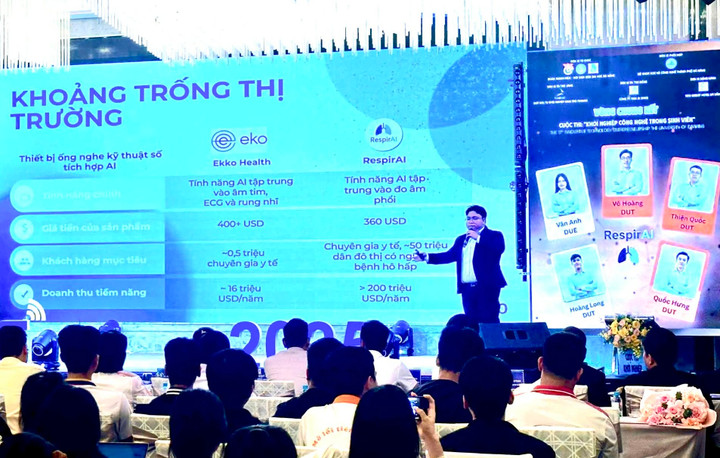
The advantage of the RespirAI stethoscope is its (expected) lower price compared to some existing electronic stethoscopes on the market.
According to the planned roadmap, the team will gradually implement evaluation and testing activities in appropriate professional environments, based on compliance with current regulations and relevant standards. The team aims for commercialization following a cautious roadmap, in line with legal requirements and practical implementation conditions.
Evaluating the project, Master's student Nguyen Quang Tan from the University of Technology (Da Nang University) stated that RespirAI has practical significance in the context of increasingly common respiratory diseases, especially after the COVID-19 pandemic. The application of smart sensors and AI can support doctors in remote medical examinations and treatment in the trend of digital healthcare.
In the future, the team may expand the features to include measuring respiratory parameters and airflow, thereby providing a more comprehensive assessment of patients' lung conditions. The key factor remains building a standardized, sufficiently large, and reliable database for the AI algorithm to be effective in real-world environments.
"This is the right direction for smart healthcare. The team needs to continue to collaborate closely with healthcare facilities and specialists to refine the system in a sustainable way," Professor Tan assessed.

Source: https://vtcnews.vn/sinh-vien-tao-ong-nghe-ai-ho-tro-theo-doi-phat-hien-som-benh-ho-hap-tai-nha-ar992892.html


































































































Comment (0)