

Approximately 7 million Vietnamese people suffer from gastroesophageal reflux disease (GERD), with 60% not receiving timely treatment, increasing the risk of dangerous complications such as esophageal stricture and cancer.
Statistics from the Vietnam Internal Medicine Association, shared by Dr. Nguyen Phuc Minh, Head of the Department of Gastrointestinal Surgery at Binh Dan Hospital, at a scientific conference on updating treatment for gastroesophageal reflux disease (GERD) on May 6th, estimate that approximately 5-10% of the population suffers from this disease.
Gastroesophageal reflux disease (GERD) is a condition where stomach contents and food reflux, causing symptoms or complications. The disease occurs due to changes in the gastroesophageal valve, preventing it from closing properly, causing stomach contents, including acid and bile, to reflux into the esophagus.
According to Dr. Minh, the hospital receives approximately 2,000-2,500 patients daily, of which about 200 have reflux symptoms. Most patients have previously sought treatment at other medical facilities and have been taking medication for extended periods, yet their symptoms still recur. Many cases admitted to the hospital have severe complications such as inflammation and esophageal stricture, rendering patients unable to eat or drink.
"In people with this condition, stomach acid, which is acidic, refluxes into the esophagus, causing prolonged esophagitis, leading to inflammatory esophageal stricture," the doctor explained. The disease also increases the risk of developing esophageal adenocarcinoma. In addition, chronic gastroesophageal reflux can lead to Barrett's esophagus, which can potentially develop into cancer.
If left untreated, people with gastroesophageal reflux disease (GERD) may suffer from symptoms for life. The disease causes many discomforts such as sore throat, heartburn, bad breath, difficulty swallowing, vomiting of food or acidic liquids, chest pain or epigastric pain, laryngitis, persistent cough, shortness of breath, and chest tightness.
The condition is more likely to occur in overweight or obese individuals, those experiencing prolonged stress, peptic ulcers, unhealthy eating habits, and certain medications. In some cases, treatment is very complex, and patients often only seek treatment from a gastroenterologist when reflux has reached a moderate or severe level, significantly impacting their quality of life.
Regarding treatment, patients are typically prescribed proton pump inhibitors (PPIs) for about 8 weeks. Afterward, the doctor will reassess the patient to decide whether to continue medication or proceed with surgery. Patients require a thorough examination to assess abnormalities in the gastroesophageal sphincter, measure esophageal motility pressure and esophageal pH for diagnosis before deciding on surgery.
On this occasion, two patients with persistent gastroesophageal reflux disease accompanied by hiatal hernia underwent reconstructive surgery using the new Omega 300 AP technique, performed by Professor Ninh Nguyen, Head of the Surgery Department at Irvine University Hospital (USA), along with doctors from Binh Dan Hospital. This is an advanced method currently being used to treat gastroesophageal reflux disease in the United States.
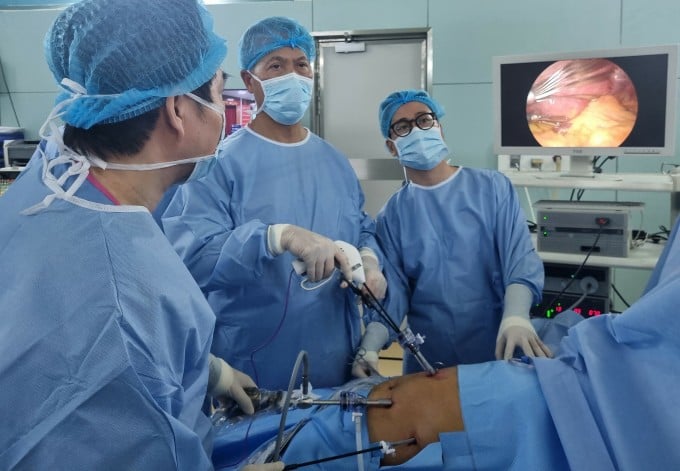
Professor Ninh Nguyen and doctors from Binh Dan Hospital performed surgery to create a valve to prevent gastroesophageal reflux disease (GERD) on the afternoon of May 6th. Photo: Tran Nhung
Doctors advise everyone to maintain a healthy weight, avoid lying down immediately after eating, and refrain from strenuous activity, allowing time for rest. Avoid foods that increase stomach acid, gas, and fluid production. Sleep with your head and shoulders elevated, and lie on your left side.
Le Phuong
Source link




![[Photo] Closing Ceremony of the 10th Session of the 15th National Assembly](/_next/image?url=https%3A%2F%2Fvphoto.vietnam.vn%2Fthumb%2F1200x675%2Fvietnam%2Fresource%2FIMAGE%2F2025%2F12%2F11%2F1765448959967_image-1437-jpg.webp&w=3840&q=75)
![[Photo] Prime Minister Pham Minh Chinh holds a phone call with the CEO of Russia's Rosatom Corporation.](/_next/image?url=https%3A%2F%2Fvphoto.vietnam.vn%2Fthumb%2F1200x675%2Fvietnam%2Fresource%2FIMAGE%2F2025%2F12%2F11%2F1765464552365_dsc-5295-jpg.webp&w=3840&q=75)












































![[OFFICIAL] MISA GROUP ANNOUNCES ITS PIONEERING BRAND POSITIONING IN BUILDING AGENTIC AI FOR BUSINESSES, HOUSEHOLDS, AND THE GOVERNMENT](https://vphoto.vietnam.vn/thumb/402x226/vietnam/resource/IMAGE/2025/12/11/1765444754256_agentic-ai_postfb-scaled.png)














































Comment (0)