

The Minister of Finance stated that the amendments to the law aim to contribute to overcoming the consequences of storms and floods, quickly restoring production and business activities, especially in the agricultural sector, and removing "bottlenecks" in VAT refunds .
In terms of practical basis, the report states that in November 2024, the National Assembly enacted the Value Added Tax Law, which will take effect from July 1, 2025.
During implementation, associations and businesses have raised concerns regarding VAT policies for agriculture, animal feed, and tax refund conditions. Businesses stated that they have to pay a 5% input VAT on agricultural products traded at the commercial stage.

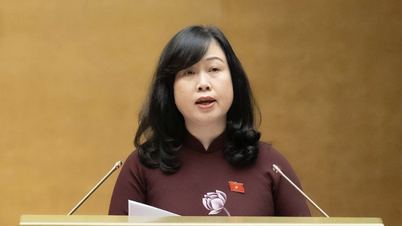
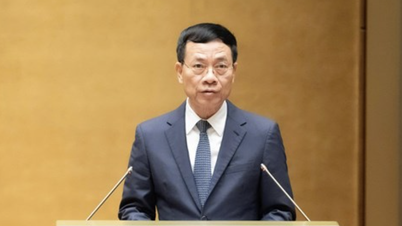
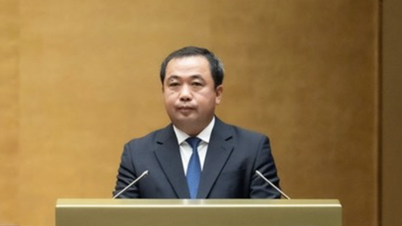
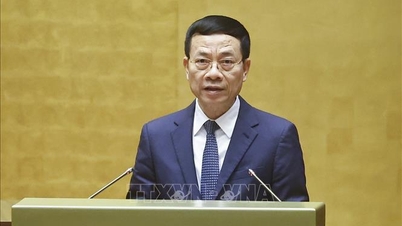
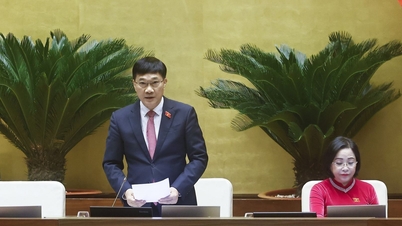
Minister of Finance Nguyen Van Thang presents the proposal. Photo: National Assembly
VAT collected and then refunded for items whose production output is mostly for export (such as catfish, pepper, coffee, etc.) leads to waste of time and capital stagnation for businesses while credit institutions do not disburse this tax when providing working capital, causing financial pressure and reducing business efficiency.
Businesses also argue that current legal regulations have led to discrimination between domestically produced agricultural and aquatic products and imported agricultural and aquatic products because imported agricultural and aquatic products are not subject to VAT when imported into Vietnam.
Furthermore, because animal feed is exempt from input VAT, it cannot be deducted or refunded. This leads to increased costs and higher selling prices for animal feed manufacturers, ultimately impacting livestock farmers. In addition, this regulation is not fair and may reduce competitiveness with imported animal feed products, as these are not subject to VAT.
According to current regulations, buyers are only eligible for a VAT refund after the seller has declared and paid the tax. Therefore, businesses exporting goods are entitled to a VAT input refund, but this is delayed because they have to wait to verify that the seller has declared and paid the tax.
Unprocessed agricultural and livestock products are not subject to tax.
The government proposes amending and supplementing Clause 1, Article 5 of the current law (regarding tax-exempt items): "Products of crops, planted forests, livestock, aquaculture, and fisheries that have not been processed into other products or have only undergone basic processing, produced and sold by organizations and individuals themselves, and at the import stage; enterprises, cooperatives, and cooperative unions that purchase unprocessed crops, planted forests, livestock, aquaculture, and fisheries products that have only undergone basic processing and sell them to other enterprises, cooperatives, and cooperative unions are not subject to VAT as prescribed by the Minister of Finance."

A seafood processing plant. Photo: Hoang Ha
The government also proposed adding regulations on tax deductions, stipulating that input VAT on goods and services not subject to VAT be fully deductible.
The government argues that the above proposal will not affect state budget revenue, will help reduce procedures for calculating, declaring, paying, and deducting taxes; and will still ensure the principle of VAT, which is that input VAT on goods and services used for the production and business of goods and services subject to VAT is fully deductible, and these products, when sold to the end consumer, are still subject to a 5% VAT.
According to the government's proposal, this regulation contributes to supporting the export of agricultural, forestry, and aquatic products by eliminating the need for businesses to advance funds to pay taxes and then go through the tax refund process. It also simplifies procedures, avoids wasting time and opportunity costs for businesses, and reduces fraud in invoice trading and VAT refunds.
In addition, the Government also proposed removing the content regarding unprocessed agricultural products, planted forests, livestock, and aquaculture products that have not been processed into other products or have only undergone basic processing and are used as animal feed or medicinal materials, from the VAT tax rate stipulated for agricultural products, planted forests, livestock, and aquaculture products.
Source: https://vietnamnet.vn/trinh-quoc-hoi-xem-xet-bo-sung-nhieu-quy-dinh-ve-thue-vat-2470339.html



































































Comment (0)