

 |
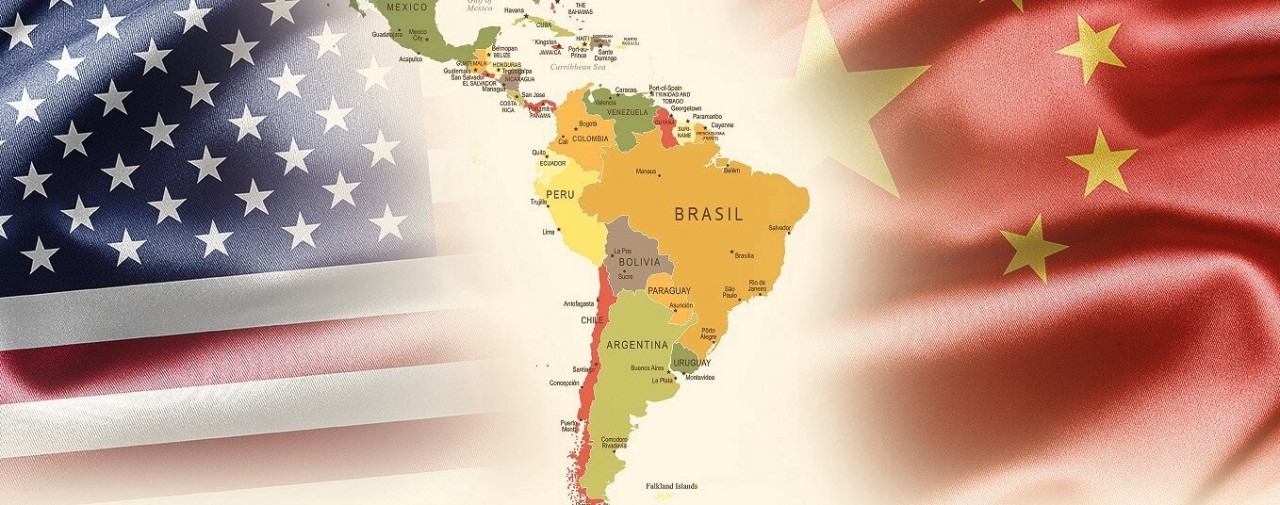
| China plans to expand its influence, unafraid to encroach on America's 'backyard'; should Washington be worried? (Source: asiapowerwatch) |
According to General Richardson, China is making relentless progress toward replacing the United States as the leading nation in the Latin American and Caribbean region.
The challenge is right "behind America's back".
In fact, while China's presence in the region has increased significantly over the past decade, it is unlikely that Beijing will replace the United States as the dominant political , economic, and military power in Latin America in the near future.
Economically , China has penetrated South America and the Caribbean – a region where American power was once unchallenged.
Since the late 1990s, China's interest in South America and the Caribbean has been steadily increasing, even exploding year after year. To sustain its unprecedented economic growth, Beijing has sought oil and other raw materials globally. In 2000, the Asian nation's trade with the region totaled just $12 billion, but this figure had risen to $314.8 billion by 2021.
In 2023, China became the largest trading partner for nine countries in the region: Argentina, Brazil, Bolivia, Cuba, Chile, Peru, Paraguay, Uruguay, and Venezuela.
For a long time, Latin America and the Caribbean have been considered "America's backyard," so despite impressive trade growth between China and the region, Washington remains the largest trading partner there. In 2020, US trade with the region totaled $758.2 billion, more than double that of China; however, 71% of this trade was with Mexico.
In 2021, Chinese foreign direct investment in Latin America and the Caribbean totaled $130 billion. Prior to the Covid-19 pandemic, China was the largest lender in the region. Its development banks issued $66.5 billion in loans – primarily for infrastructure projects, giving Chinese companies better access to the region's abundant natural resources. A small portion of these loans was provided under the Belt and Road Initiative (BRI).
Was Washington worried?
Although China's economic footprint in the region has increased significantly, the United States and the European Union (EU) remain the largest foreign investors, accounting for 36% and 34% of total investment respectively.
Time seemed to be against its side, as China faced an economic downturn due to the Covid-19 pandemic, and its lending to the region became restricted. And as countries in Latin America plunged into financial crisis, Western institutions like the International Monetary Fund, rather than China, became the primary providers of loans for the region's structural adjustments.
Coupled with China's relatively modest economic potential for the region, its political and diplomatic influence also remains unclear. For example, although Beijing has been Brazil's largest trading partner for over a decade, there are still occasional debates about the role of this economy within both the left-wing and right-wing governments of Brasília.
Or in Panama, following relentless pressure from the US, several infrastructure contracts worth billions of dollars initially awarded to Chinese companies were canceled and redirected to South Korean and Japanese companies.
During his congressional hearing, General Richardson also warned about China's increased support for regimes opposed to the U.S. in the region, including Venezuela, Cuba, and Nicaragua. However, in reality, with the exception of Venezuela, Chinese investment and trade with these countries are relatively small compared to their presence in most other countries in the region.
In the case of Cuba and Nicaragua, and for China, the economic situation and US sanctions make these economies less attractive compared to other partners in the region.
Of course, in terms of defense and security, the US still holds a firm foothold with dozens of bases and other facilities, and is undoubtedly the ultimate guarantor of security for the region. However, challenges on the economic front are increasing.
Currently, in this region, no other major power—including the Russian Federation—can challenge the economic dominance of the United States. Aside from Cuba, Russian trade and aid to the region are negligible, and its diplomatic influence is limited.
The problem is that, while most countries in the region want to maintain close ties with the US, they also want to benefit from China's massive investment and trade flows.
Prior to the pandemic, total trade between China and Latin America reached $314.8 billion. Foreign direct investment (FDI) from the Northeast Asian nation into the region was approximately $130 billion, and net development loans from the China Development Bank and the Export-Import Bank of China amounted to around $66.5 billion.
Using the year 2000 as a baseline, figures for all three types of investment have increased exponentially.
However, as FDI and trade flows slowed slightly during the pandemic, China's development lending to the region dropped to 0% in 2020. With only two years of operation in Latin America and the Caribbean, the BRI accounted for only a few million dollars of the $43.5 billion disbursed by Chinese policy banks between 2015 and 2019.
Analysts believe that, despite China's growing presence and the increasing importance of the world's second-largest economy in the Southern Hemisphere, Beijing's rapid development of such a strong image and presence in Latin America and the Caribbean is largely due to the United States' neglect of the region.
Therefore, the United States can no longer simply view this region as its secure "backyard." Perhaps it's time for Washington to begin considering Latin America as its "front yard."
Source

![[Photo] Prime Minister Pham Minh Chinh holds a phone call with the CEO of Russia's Rosatom Corporation.](/_next/image?url=https%3A%2F%2Fvphoto.vietnam.vn%2Fthumb%2F1200x675%2Fvietnam%2Fresource%2FIMAGE%2F2025%2F12%2F11%2F1765464552365_dsc-5295-jpg.webp&w=3840&q=75)

![[Photo] Closing Ceremony of the 10th Session of the 15th National Assembly](/_next/image?url=https%3A%2F%2Fvphoto.vietnam.vn%2Fthumb%2F1200x675%2Fvietnam%2Fresource%2FIMAGE%2F2025%2F12%2F11%2F1765448959967_image-1437-jpg.webp&w=3840&q=75)




































![[OFFICIAL] MISA GROUP ANNOUNCES ITS PIONEERING BRAND POSITIONING IN BUILDING AGENTIC AI FOR BUSINESSES, HOUSEHOLDS, AND THE GOVERNMENT](https://vphoto.vietnam.vn/thumb/402x226/vietnam/resource/IMAGE/2025/12/11/1765444754256_agentic-ai_postfb-scaled.png)








































Comment (0)