

According to data collected by The Korea Herald from the Seoul Education Office earlier this week, the city's 38 private elementary schools received 29,488 applications for the 2026 school year, more than eight times the 3,614 enrollment quota.
Because parents are allowed to submit a maximum of three applications, the actual number of students enrolled may be lower than the statistics show. Before this limit was implemented, the competition rate used to be as high as 12.6 applications for one spot, leaving most students without a place.
Tuition at private elementary schools averages over 12 million won (over 200 million VND) per year, while public schools in Seoul are mostly free. However, many parents believe this fee is reasonable because they receive both educational benefits and after-school care for their children.
Private schools typically offer a wider range of extracurricular programs than public schools, from learning musical instruments, ice skating, and golf to foreign languages and horseback riding.
Parents say these activities help keep their children safely supervised until 4-5 p.m., a particularly important time for families where both parents work.
Conversely, most public schools end between 1:30 PM and 3:00 PM – younger students often go home earlier, leaving parents to manage afternoon childcare themselves. Some families send their children to private centers with transportation, but the cost is high and the arrangements are complicated.
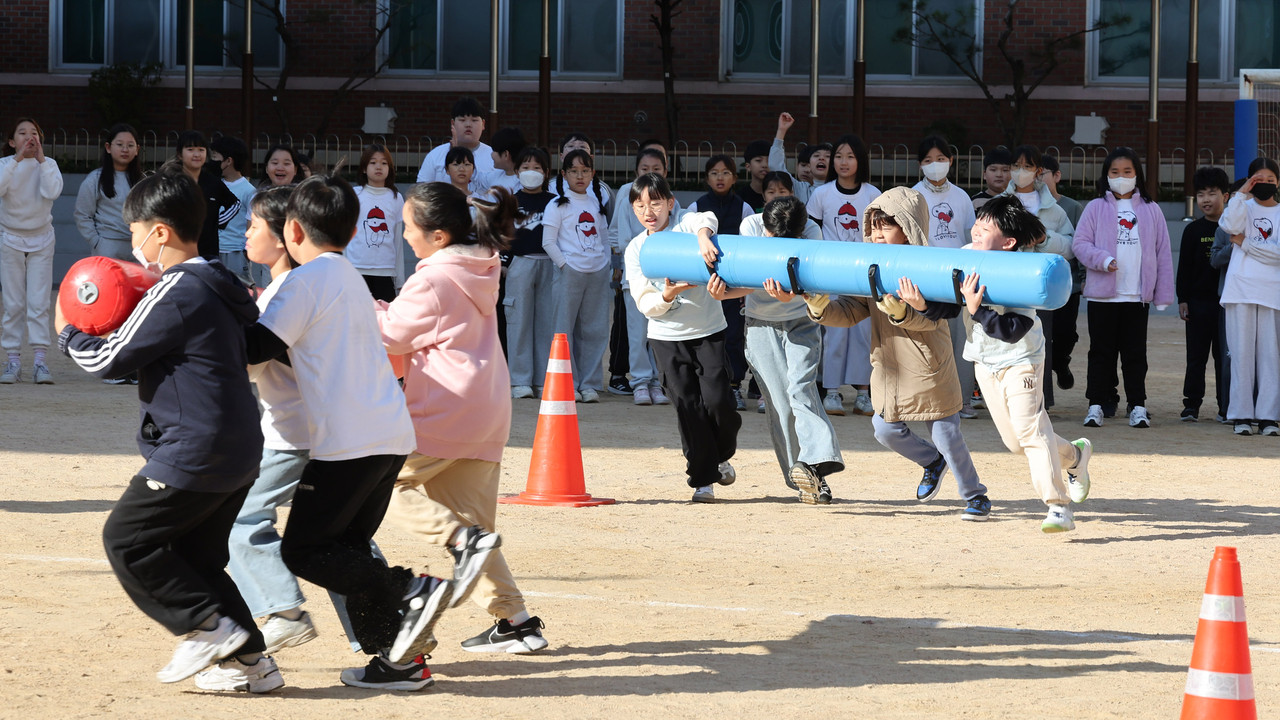
These issues frequently arise on parent forums.
"Both sets of grandparents can't look after the child during the day. My husband and I both work. Would sending our child to a private elementary school be a better option?" a parent asked on DSchool, an online community for parents in South Korea.
"At first, I heard that tuition at private schools is more expensive than some universities, so I was hesitant. But then I thought sending my child to a private school is better than having to send her to many after-school centers," shared a parent surnamed Kim whose daughter attends a private elementary school.
Some parents believe that the teaching staff and curriculum at private schools are of higher quality.
"A teacher at my child's school just left to become a university professor," one parent proudly wrote online.
A private school in Seongbuk District, Seoul, promotes a “holistic English experience” program, with each class having a native English-speaking teacher and regularly holding activities such as games and debates in English.
The preference for private primary schools grew even stronger during the COVID-19 pandemic, as many parents noted that public schools struggled to maintain the quality of online teaching.
The competition ratio increased from 2.1/1 in the 2020 school year to over 12/1 in 2023, prompting the city to implement a limit of three applications per student starting the following year.
Lim Sung-ho, chairman of Jongno Hagwon, told local media that this shift reflects demographic changes.
"Previously, private primary schools were considered exclusively for the children of wealthy families, but now many middle-class families with both parents working are also enrolling their children. Parents want their children to receive a good education, and private schools also help them solve the problem of childcare after school," he said.
The Seoul Education Office announced that the city has implemented an after-school care program for first and second graders. Additionally, a new policy aimed at reducing the rush to private schools is planned for implementation starting in 2026.
“We plan to provide 500,000 won (approximately 9 million VND) per student per year for after-school activities, starting in March and initially for third-grade students,” a Seoul Education Office official said. The agency also stated that it will develop more “unique programs” for students to participate in after school.
"Public elementary schools in Seoul are already very good. We believe the demand for public schools will increase," she added.
Source: https://vietnamnet.vn/truong-tu-hoc-phi-hon-200-trieu-nam-phu-huynh-xep-hang-gianh-suat-cho-con-hoc-2471274.html

![[Photo] Prime Minister Pham Minh Chinh holds a phone call with the CEO of Russia's Rosatom Corporation.](/_next/image?url=https%3A%2F%2Fvphoto.vietnam.vn%2Fthumb%2F1200x675%2Fvietnam%2Fresource%2FIMAGE%2F2025%2F12%2F11%2F1765464552365_dsc-5295-jpg.webp&w=3840&q=75)




























































Comment (0)