

The place that preserves the soul of Ba Tri's traditional cuisine.
On a morning in early December 2025, amidst the cool shade of coconut trees, visitors flocked to the century-old Phu Le rice wine village in Tan Xuan commune, Vinh Long province (formerly Ba Tri district, Ben Tre province) to experience the traditional aroma that has accompanied this land for over 190 years. Here, hundreds of households still maintain the traditional rice wine brewing process, from selecting glutinous rice, grinding it, fermenting, and distilling… all passed down through generations.
In the home of Mr. Ha Chi Quynh's family, whose ancestors have been making rice wine for three generations, the fire in the still-burning still glows as brightly as it did in the beginning. He said, "We've kept the same brewing method from the beginning, without changing it. I want to introduce Phu Le rice wine – a local cultural feature – to more people."
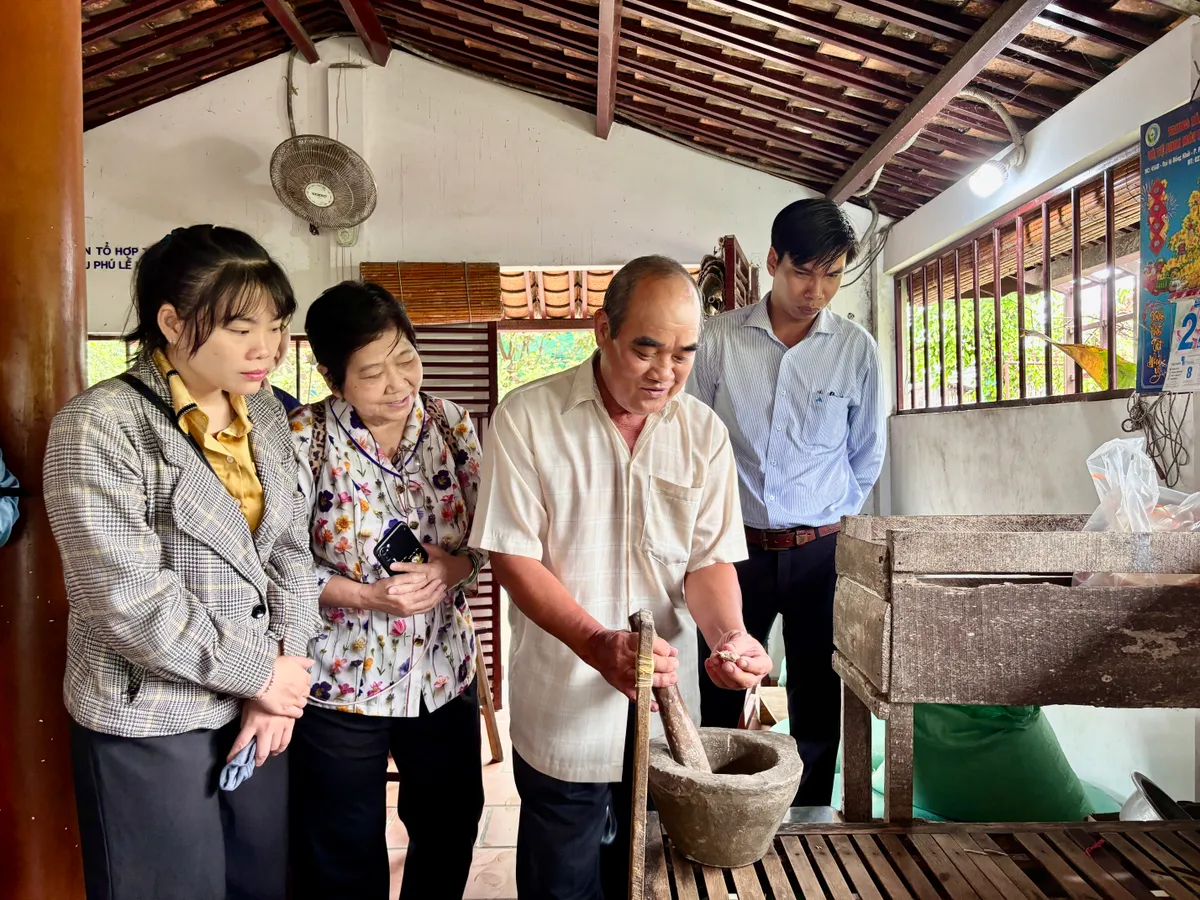
Visitors can learn about the process of grinding 36 different herbs mixed with bran or glutinous rice to create the distinctive flavor.

Next comes the fermentation process.

Mr. Quynh carries out the distillation process in his small house, where the craft has been kept alive for three generations.
In recent years, as the locality has developed community tourism , Mr. Quynh's house has become a stopover for experiential tourism. The distillation space has been renovated but still retains its traditional charm. He sees this as an opportunity for the locals to earn extra income and spread the traditional craft to tourists from near and far.
Tourist Huynh Nhat Nghia from Gia Dinh ward, Ho Chi Minh City, said he was impressed by the opportunity to witness the rice wine making process firsthand. Besides buying the product, Mr. Nghia wanted to interact with the artisans, understand how the product is created to become more "soulful" and valuable.

Visitors observe the modern wine production model at Phu Le Wine Joint Stock Company.
For over a century, Phu Le rice wine has existed not only as a commercial product but also as a cultural symbol of Ba Tri. Within this, Phu Le Rice Wine Joint Stock Company, part of the local business ecosystem, continues to preserve the traditional brewing secrets while applying quality control technology to develop various product lines such as Phu Le, Vi Dan, Co Gai Xu Dua, My Tuu… distributed throughout the country.
This company is also actively preserving the Phu Le folk singing tradition, a national intangible cultural heritage, through various community activities.
Combining traditional crafts, tourism, and agriculture creates new livelihoods and aims for sustainable development.
During the survey tour "Business Ecosystem - New Life" on December 11th, businesses including Phu Le Wine, VinaEcolife, Biz Educo, and Lac Dia Sustainable Agricultural Cooperative built a linked model encompassing production, education, tourism, agriculture, and cultural creativity, all connected within a unified value system, offering visitors a complete experiential journey.
Besides the Phu Le traditional rice wine village and Lac Dia Cooperative playing a role in building a model of regenerated, low-emission rice fields, the cooperative currently links with more than 80 farming households, aiming towards the carbon credit market and reducing plastic waste.
"The local environment, from mangrove forests and rice paddies to coconut groves and traditional craft villages, has created a harmonious natural ecosystem. The 'ecosystem business' mindset is also formed from that foundation," said Ms. Le Thanh Truc, Chairwoman of the Board of Directors of Lac Dia Sustainable Agricultural Cooperative.
The new-style cooperative is not a complete transformation, but a continuation. "The new doesn't mean destroying the past, but rather 'separating the wheat from the chaff,' preserving values that have existed since the 17th century such as growing sticky rice, brewing rượu (rice wine), raising cattle, making cakes, and singing folk songs..." Ms. Truc added.

The closed-loop circular economy model contributes to reducing waste and creating sustainable added value.
The ecosystem operates on a circular economy model, encompassing everything from growing sticky rice and brewing rượu (rice wine) to using the leftover mash to feed pigs, and utilizing the manure as fertilizer for the fields. This model reduces waste, improves efficiency, and creates stable livelihoods for farmers.
Ms. Vu Kim Hanh, President of the Association of High-Quality Vietnamese Goods Businesses, highly appreciated the new direction of Phu Le and the businesses in the ecosystem through the program. The community of high-quality Vietnamese goods businesses affirms its efforts to accompany the national strategy on circular economy, climate adaptation, raw material development, and preservation of local values.
From Mr. Quynh's fiery distillery to the regenerated rice fields of Lac Dia Cooperative, Phu Le is demonstrating a new direction of development, where businesses are not separate from the community but are closely connected, living and developing together.
Centuries-old craft villages are not only preserved but also become cultural materials for building economic, tourism, and educational models, opening up new, sustainable, and distinctive livelihoods.
Source: https://vtv.vn/tu-lang-nghe-ruou-phu-le-tram-tuoi-den-he-sinh-thai-doanh-nghiep-ben-vung-100251212004959078.htm














![[Photo] Prime Minister Pham Minh Chinh holds a phone call with the CEO of Russia's Rosatom Corporation.](/_next/image?url=https%3A%2F%2Fvphoto.vietnam.vn%2Fthumb%2F1200x675%2Fvietnam%2Fresource%2FIMAGE%2F2025%2F12%2F11%2F1765464552365_dsc-5295-jpg.webp&w=3840&q=75)











































Comment (0)