

If thinking of yoga brings to mind backbends and handstands, think again. You don't need to be a professional yoga practitioner or even exceptionally flexible to enjoy the benefits of simpler, easier poses.
One of these is the viparita karani pose, often called the legs-up-the-wall pose. As its name suggests, the torso and head lie flat on the ground while the legs are placed against the wall.
Below, Dr. Robert Saper, Head of Health and Preventive Medicine, shares the benefits of the legs-up-the-wall pose for the body and how to do it safely:
Health benefits of the legs-up-the-wall pose
According to the Cleveland Clinic , the legs-up-the-wall pose is one of several yoga poses known as inversions (for example, downward-facing dog, shoulder stand, and headstand).
In Sanskrit, viparita means inversion and karani means activity. When performing the legs-up-the-wall pose, you are in an active inversion. With your legs above the rest of your body, gravity acts on them in a way it wouldn't for most of the day. This is an easy pose to perform.
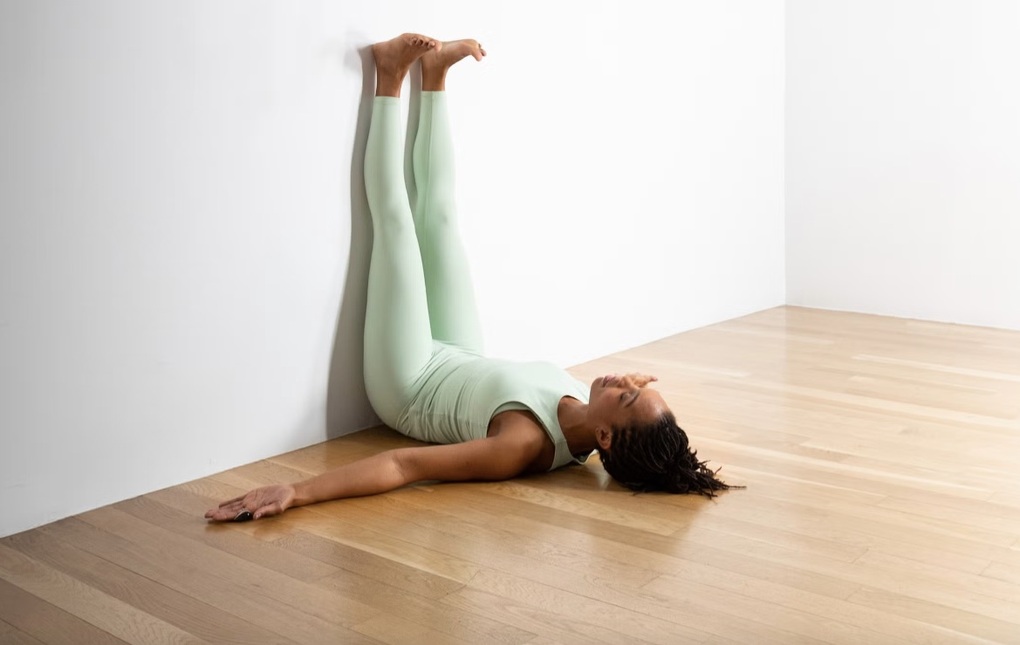
The leg-up-against-the-wall pose is very good for the circulatory system (Photo: Yoga journal).
"The advantage of this position over headstands or shoulder stands is that you can achieve the benefits of an inverted posture without putting strain or pressure on your neck and head," explains Dr. Saper.
He warned that anyone with chronic neck pain or any disorder of the cervical spine should not perform shoulder stand or headstand poses.
Improve blood circulation
A common cause of swollen legs is venous insufficiency, where the veins in the legs don't efficiently carry blood back to the heart. Poor blood circulation is associated with blood pooling in the legs, increasing the risk of blood clots and at least causing swelling and discomfort.
Even if you don't have chronic venous insufficiency, standing or sitting all day can restrict blood flow back into your body. However, resting your legs against a wall can help.
"The main benefit of this posture is that it helps bring stored bodily fluids in the legs back into circulation. Holding this position allows blood to flow back and reduces swelling in the lower legs," says Dr. Saper.
Helps reduce stress
Research shows that yoga in general can have a positive impact on the body's stress response system. Restorative yoga poses, such as legs-up-the-wall, help to put your body into a relaxed state.
"Many patients report finding this posture very relaxing," says Dr. Saper. Reduced stress is associated with better overall physical and mental health, and even a stronger immune system.
If the leg-up-the-wall pose helps you relax, it may indeed help you feel better overall, but be wary of any claims that it's a panacea.
"Some people claim it alleviates other conditions like headaches and high blood pressure, but there is no evidence to support that," Dr. Saper explained.
Frequency of execution
"As a yoga researcher and yoga instructor, I recommend performing this pose as part of a holistic restorative yoga practice, done at the end of a session," says Dr. Saper.
This pose is safe to perform regularly, perhaps once or twice a day, whether as part of a regular yoga practice or as a standalone pose.
How to do it
"Initially, you should be guided by a yoga instructor to ensure you perform the pose safely and avoid straining your neck, head, or spine. But this pose is quite easy to do," advises Dr. Saper.
Here's how to perform the legs-up-the-wall pose:
- Prepare the equipment: Lay a blanket or yoga mat on the floor, next to a wall, and use a thin pillow to support your head if needed.
- Getting ready: Lie down on a blanket or mat, buttocks facing the wall; your tailbone should be on the floor, buttocks a few centimeters from the wall. Your back and head should be aligned on the floor, perpendicular to the wall, and relaxed.
- Feel the stretch: The back of your leg should rest against the wall, your knee relaxed, and your foot parallel to the floor. You should feel a gentle stretch in your leg, but it shouldn't be painful.
- Relax: Relax and breathe deeply while holding the pose. You should hold this pose for about 2-3 minutes or longer if you wish.
- Slowly exit the pose: When finished, gently sit down. You should not abruptly exit the inverted pose.
Who should not do the leg-up-against-the-wall pose?
As with any yoga pose, the legs-up-the-wall pose carries some risks. Avoid this pose if you have been diagnosed with any of the following conditions:
- Glaucoma, also known as open-angle glaucoma.
Conditions that cause excessive fluid retention.
- Congestive heart failure.
- Kidney failure.
- Liver failure or cirrhosis.
- Uncontrolled high blood pressure.
Source: https://dantri.com.vn/suc-khoe/tu-the-yoga-don-gian-den-bat-ngo-gac-chan-len-tuong-va-loi-ich-khong-ngo-20250905163644651.htm






















![[Photo] Prime Minister Pham Minh Chinh holds a phone call with the CEO of Russia's Rosatom Corporation.](/_next/image?url=https%3A%2F%2Fvphoto.vietnam.vn%2Fthumb%2F1200x675%2Fvietnam%2Fresource%2FIMAGE%2F2025%2F12%2F11%2F1765464552365_dsc-5295-jpg.webp&w=3840&q=75)















































Comment (0)