

Building a revolutionary diplomacy
The tragedy of losing the country and the crisis in the path to national liberation spurred the patriotic young man Nguyen Tat Thanh to leave and seek a way to save the nation. His horizons broadened by traveling the world , he understood that the "closed-door" policy of the feudal regime had caused the country to lag behind, become vulnerable to invasion, and that the individual strength of each nation could not withstand the combined strength of imperialist and colonial powers. Therefore, Nguyen Ai Quoc was the first in Vietnamese history to affirm that "the Annam revolution is also a part of the world revolution."
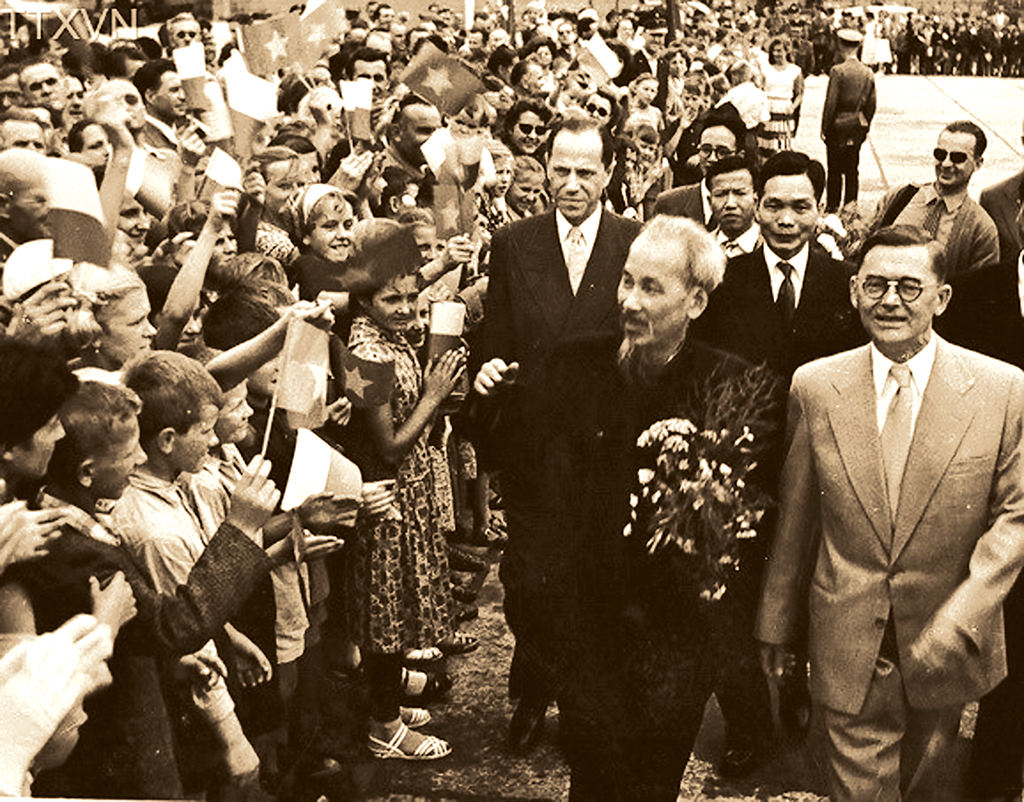
President Ho Chi Minh visited the People's Republic of Poland in 1957.
Returning to lead the Vietnamese revolution after 30 years of international activity, he summarized the truth: "Whoever has more favorable diplomatic conditions will win." After the August Revolution, in a situation where the nation's fate hung in the balance, he twice directly served as Minister of Foreign Affairs (August 28, 1945 - March 2, 1946; November 3, 1946 - March 1947) and led revolutionary diplomacy according to a system of scientific, revolutionary, and humanistic viewpoints.
Representing a nation that had suffered greatly from war, peace and friendly cooperation were prominent themes in Ho Chi Minh's diplomatic thought. He advocated persistently resolving conflicts between nations through peaceful negotiations, with the motto "as long as there is life, there is hope"; war was only a necessary solution. When the enemy was "bogged down" and wanted to "de-escalate" the war, Ho Chi Minh was ready to negotiate to avoid harm to both sides. As the head of the Democratic Republic of Vietnam, Ho Chi Minh declared: Vietnam is ready to "befriend all democratic countries and not harbor enmity towards anyone"; Vietnam is ready to implement an open-door policy and cooperate in all fields with those who sincerely cooperate with Vietnam.
Ho Chi Minh always emphasized the idea of "making more friends and fewer enemies," because gathering broad forces and isolating the enemy was the decisive factor in the success or failure of the struggle. To distinguish between friends and enemies and avoid confusing past and present enemies, he declared: "Anyone who does anything beneficial for our people and our country is a friend. Anyone who does anything harmful to our people and our country is an enemy." Implementing the idea of "making more friends and fewer enemies," Ho Chi Minh skillfully exploited contradictions within the enemy's ranks and employed a principled strategy of compromise to isolate the main enemy. He also clearly distinguished between the people and the belligerent government of the opposing country, and thus, the anti-war movements of the French and American people supported the just struggle of the Vietnamese people.
Ho Chi Minh considered international solidarity based on the principles of independence, self-reliance, and pure internationalism as a crucial strategy. He clearly stated the Vietnamese people's guiding principle in their interactions with the international community: "In a hundred years in this world, a rich heart of compassion is the hallmark of the Vietnamese people." Therefore, UNESCO assessed that Ho Chi Minh's thought "is the embodiment of the aspirations of nations wishing to affirm their cultural identity and to enhance mutual understanding among nations."
Diplomacy of the heart
As a seasoned diplomat, Ho Chi Minh always considered diplomacy a battlefront, but on the other hand, he emphasized: "If one does not have a foundation of national strength, then one cannot talk about diplomacy" and "national strength is the gong, and diplomacy is the sound. The bigger the gong, the louder the sound." Self-interest in international relations is an obvious reality, so the success or failure of diplomatic endeavors, whether large or small, depends primarily on the nation's strength.
Inheriting the "people-centered" tradition of progressive Eastern dynasties and the Marxist-Leninist view that "revolution is the work of the masses," along with the diplomacy of the Party and the State, Ho Chi Minh focused on developing people-to-people diplomacy because it possessed the strength of the largest "army" and could be conducted in countries and fields where state diplomacy was not yet feasible. The richness of diplomatic forms led by Ho Chi Minh contributed to enhancing the effectiveness of revolutionary diplomacy.
Ho Chi Minh led the nascent revolutionary diplomacy not only with a sound ideological system but also with lofty morals. He always believed in the principle of "do not do to others what you would not want done to yourself." Therefore, he resolutely defended his own nation's independence but also respected the independence of other nations, respected cultural differences between nations, and magnanimously believed that "helping others is helping oneself"...
Mr. Vu Dinh Huynh, who accompanied Ho Chi Minh on his visit to France in 1946, remarked: "The President's diplomatic skill was so persuasive not because of his strategies, tactics, or eloquent rhetoric, but because of his inherent virtue." Diplomat Vo Van Sung argued that Ho Chi Minh created a school of diplomacy – diplomacy of the heart. Under the leadership of this man of "great humanity, great wisdom, and great courage," Vietnam's nascent revolutionary diplomacy matured remarkably and contributed greatly to the nation's great victories.
Guiding light value
As time passes and Vietnam's integration process deepens, Ho Chi Minh's diplomatic thought shines even brighter. Therefore, faithfully and creatively applying Ho Chi Minh's thought – the ideological foundation and guiding principle of the Party – is the foremost principle of Vietnamese diplomacy today. From his perspective on friends and enemies, our Party has developed a perspective on partners and adversaries.
Applying President Ho Chi Minh's ideology of peace and cooperation, the Communist Party of Vietnam declares that Vietnam is a friend, a reliable partner, and a reputable and responsible member of the international community. Implementing an independent, self-reliant, and diversified foreign policy, Vietnam has established diplomatic relations with nearly 200 countries worldwide, including comprehensive strategic partnerships with six countries: China, Russia, India, Japan, South Korea, and the United States, and strategic and comprehensive partnerships with nearly 30 other countries.
The establishment of the comprehensive strategic partnership between Vietnam and the United States in recent times has demonstrated that while the past cannot be undone, a friendly future can be built if both sides are truly sincere. This will not only bring a better future for the two countries but also positively impact peace, cooperation, and friendship in the region and the world as a whole.
With the great and proud achievements of the Doi Moi (Renovation) process, Vietnam is enjoying a favorable international position. The volatile international context and the goal of national development for prosperity and happiness demand that Vietnamese diplomacy strive to become a comprehensive, modern diplomacy, deeply rooted in the Vietnamese "bamboo" school of diplomacy – characterized by flexibility, adaptability, and unwavering loyalty.
Ho Chi Minh's diplomatic thought will forever be a guiding light for Vietnamese diplomacy to fulfill its immense responsibility of ensuring security, development, and enhancing the country's position and prestige in the international arena, contributing to Vietnam's progress alongside humanity, as strongly envisioned by President Ho Chi Minh.
Source link


![[Photo] Prime Minister Pham Minh Chinh attends the Conference summarizing and implementing tasks of the judicial sector.](/_next/image?url=https%3A%2F%2Fvphoto.vietnam.vn%2Fthumb%2F1200x675%2Fvietnam%2Fresource%2FIMAGE%2F2025%2F12%2F13%2F1765616082148_dsc-5565-jpg.webp&w=3840&q=75)
































































Comment (0)