

Ngoc Linh ginseng is considered a national treasure of Vietnam due to its rarity and high medicinal properties. For many years, its seeds, flowers, leaves, and roots have been valuable and their prices have skyrocketed to tens of millions of dong per root. However, recently, they have been widely advertised for sale online at prices as low as a few hundred thousand dong per root or plant.
Mr. Hoa in Lai Chau is selling 2 kg of Ngoc Linh ginseng, over 7 years old, at a retail price of 250,000 VND per root, and says he has a few kilograms available each month. According to him, this is a Ngoc Linh ginseng variety he imported from Kon Tum when it was only a few months old and has been cultivating in Lai Chau for many years.
"My garden has several thousand plants, yielding 1-2 kg each month for sale. Customers can check the quality before paying. The quantity is limited, so if customers buy late, there won't be any left," Mr. Hoa said.

"Ngoc Linh ginseng" is being sold at incredibly low prices on online marketplaces. Photo: Hong Chau
Similarly, another vendor in Lai Chau is selling five-year-old tubers for 300,000 VND each. He stated that because they are cultivated, the price is lower than those harvested from the forest. These tubers weigh between 50 and 70 grams each.
Besides selling the roots, this man also sells 3-4 year old seedlings for only about 200,000 VND and a combo of 10 Ngoc Linh ginseng seeds for about 50,000 VND.
Not only on social media, but also on e-commerce sites like Lazada and Shopee, ginseng roots, seedlings, and seeds are being sold for several hundred thousand dong. Particularly at online stores, the price is around 200,000-300,000 dong for a 4-year-old plant. Those over 5 years old, including roots and leaves, weighing up to 250 grams, are priced at 649,000 dong. This is 80-85 times cheaper than the ginseng sold by companies in Kon Tum.
When asked about the certification for Ngoc Linh ginseng, these vendors all said they didn't have it. Some promised to send the certification later, but ultimately none responded.
Meanwhile, according to VnExpress 's observations at Ngoc Linh ginseng gardens in Kon Tum, the selling price of each seed ranges from 110,000 to 120,000 VND. One-year-old seedlings cost 280,000 VND, two-year-old seedlings cost 600,000 VND, three-year-old seedlings cost 1.2-1.5 million VND, and four-year-old seedlings cost 2 million VND.
For ginseng roots weighing 50-70 grams, the price is 7-12 million VND per 100 grams. Roots weighing more than this amount are priced at 14-15 million VND per 100 grams. Roots weighing 200 grams can fetch up to 30 million VND per 100 grams. However, these large roots are very rare, and most households have to cultivate them for over 15 years or harvest them from the wild to have any for sale on the market.

Genuine Ngoc Linh ginseng (right), fake (left). Photo: Hong Chau
Ms. Dang Thi Kim Thao, a gardener who owns 2,000 Ngoc Linh ginseng plants in Kon Tum, believes that most of the cheap ginseng sold online is Chinese Panax notoginseng or Lai Chau ginseng (which contain very low levels of saponin). Ngoc Linh ginseng from Kon Tum, however, commands a very high price because it contains 52 rare and valuable saponins, and only it possesses the active compound MR2.
Saponins are beneficial substances for health. The higher the saponin content in ginseng, the better its quality. According to the Ngoc Linh Ginseng Research and Development Center, ginseng from North Korea and South Korea only contains about 26 saponins with common chemical structures, while Ngoc Linh ginseng from Vietnam has up to 56 saponins (more than double).
MR2, on the other hand, is a dammarane saponin compound containing ocotillol with majonosid-R2, accounting for over 50% of the saponin content in ginseng. This substance allows Ngoc Linh ginseng to be processed into medicinal products to treat many dangerous diseases. Therefore, it is considered the most precious ginseng in the world .
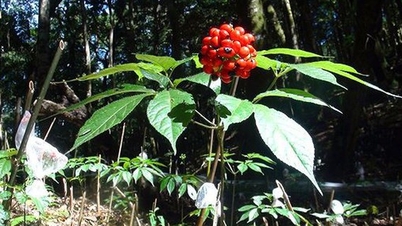
Observing the products posted by the sellers, Ms. Thao said that at first glance, the images look quite similar, but upon closer examination, the leaves, stems, flowers, and roots are completely different. “Lai Chau ginseng leaves are usually large and round. Ngoc Linh ginseng leaves, on the other hand, are long, thin, and have green stems (some forest plants have slightly purple stems). Fake Ngoc Linh ginseng leaves have more hairs on the front and fewer on the back than the real thing,” Ms. Thao said.
Regarding the root, genuine Ngoc Linh ginseng has deeply recessed nodes that are not perfectly round and grow unevenly. When washed, the root is yellowish-brown or grayish-green. In contrast, fake ginseng has densely packed nodes that grow in straight lines.
Furthermore, she stated that the largest roots of Ngoc Linh ginseng over 10 years old, grown naturally in her garden, only weigh about 100 grams, but many roots listed online weigh up to 250 grams. This indicates that the product is not of guaranteed quality; if the variety originates from Ngoc Linh, then it is likely that growth stimulants were used to produce roots of such large weight.
Sharing the same view, Mr. Tran Duc An, Director of Ngoc Linh Tu Mo Rong Ginseng Joint Stock Company (Kon Tum), said that even with engineers caring for his ginseng garden using full technical expertise, the survival rate is not high. Each year, the harvest yield at his garden is low, while online, you can buy any quantity you want. Many establishments even arrange hundreds of ginseng roots in various bonsai shapes and sell them at "dirt cheap" prices. In reality, Mr. An believes that most of them are Chinese Panax notoginseng roots disguised as Ngoc Linh ginseng.
"In Kon Tum and Quang Nam, the rate of cultivating Ngoc Linh ginseng is increasing, but the supply to the market remains very low," Mr. An said. According to him, to avoid wasting money, in addition to distinguishing by appearance, customers can have the product's DNA tested.
Recently, in Kon Tum, two ginseng companies were granted the right to use the geographical indication "Ngoc Linh" for their ginseng root products. Therefore, consumers should purchase from reputable sources that have been granted this certification.
Ginseng growers and businesses in Kon Tum province report that counterfeit ginseng from Lai Chau, China, falsely labeled as "Ngoc Linh," is flooding online marketplaces, significantly impacting the Ngoc Linh ginseng brand. Therefore, these businesses request that government agencies implement policies to address and prevent these issues.
Source


![[Image] Close-up of the newly discovered "sacred road" at My Son Sanctuary](/_next/image?url=https%3A%2F%2Fvphoto.vietnam.vn%2Fthumb%2F1200x675%2Fvietnam%2Fresource%2FIMAGE%2F2025%2F12%2F13%2F1765587881240_ndo_br_ms5-jpg.webp&w=3840&q=75)






































































Comment (0)