

 |
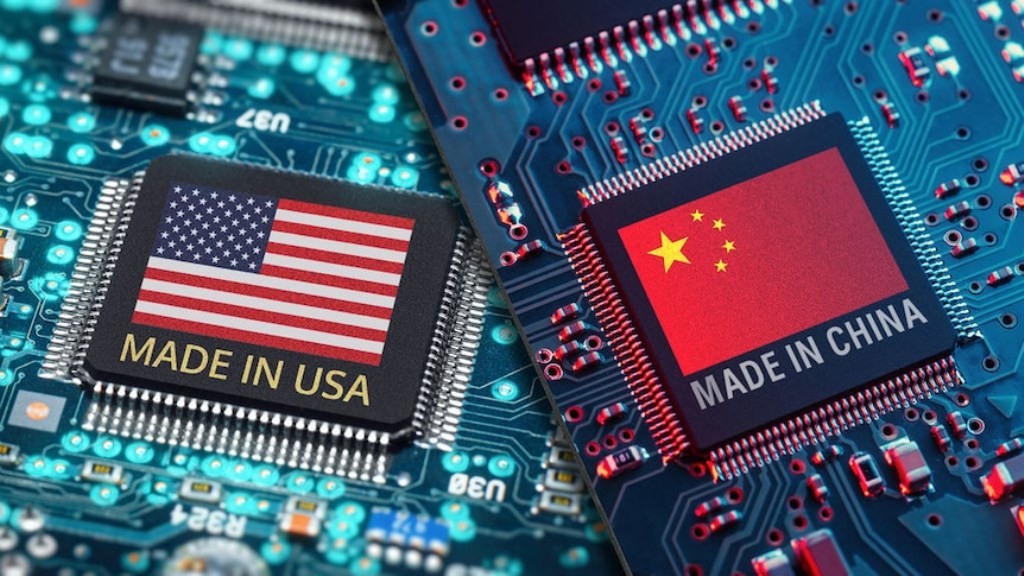
| American technology companies remain heavily reliant on China. (Source: ABC News) |
People flocked to China.
Earlier this year, leaders of many of America's most powerful technology companies flocked to China after the country ended its Covid-19 pandemic control measures and gradually reopened. Despite strained relations between Washington and Beijing, major American corporations continued to seek opportunities in the billion-person market.
In March, Tim Cook, Apple's CEO, attended the China Development Forum held in Beijing. There, he stated: "Apple and China are developing together. It's a symbiotic relationship."
In April, Intel CEO Pat Gelsinger also visited Beijing and met with Chinese officials.
In late May, Elon Musk, co-founder of the electric car company Tesla, visited China. The famous entrepreneur met with Chinese government officials in Beijing and then visited the Tesla factory in Shanghai.
And most recently, in June 2023, Bill Gates, co-founder of the American technology giant Microsoft, was received by Chinese President Xi Jinping in Beijing – an almost unprecedented exception for a business leader.
"He is the first American friend I've met this year," the Chinese president told the American billionaire.
The market is indispensable.
The attention that Washington's tech leaders are paying to Beijing demonstrates the importance of the country to some of America's largest businesses.
While the world's largest economy is striving to tighten sanctions to prevent China from accessing American technology, Washington's biggest tech companies remain heavily reliant on the billion-person market.
In fact, even after five years of "separation," this dependence has remained virtually unchanged.
In 2018, Washington began a gradual shift toward decoupling from Beijing under then-US President Donald Trump. He imposed restrictions on exports and investment aimed at limiting China's access to advanced American technology.
But five years later, a Nikkei Asia analysis of financial data revealed that American technology companies remain heavily reliant on China.
Measured as a percentage of annual sales, the revenue of leading technology brands, such as Apple and Tesla, has either increased or remained virtually unchanged since 2018. Even companies in the semiconductor sector, a particular target of the U.S. government, have seen little change in revenue.
According to QUICK-FactSet data, Apple, the world's most valuable company by market capitalization, earned the most money in China in 2022, nearly $70 billion. Meanwhile, Qualcomm – a major American chip company – also relies on China for more than 60% of its revenue.
Qualcomm, Lam Research, and four other US semiconductor companies claim that the Chinese market was their largest source of revenue last year, surpassing major markets such as Europe, the US, and Japan.
In 2022, total bilateral trade between the world's two largest economies reached a record high of $690 billion. Washington's exports to Beijing also increased by 28% between 2018 and 2022.
Fu Fangjian, Associate Professor of Finance at the Lee Kong Chian School of Business, Singapore Management University, commented: "China has developed into an indispensable part of the global economy. The country is also a unique market that is not far behind the US. While Washington tries to block Beijing's access to advanced technology, American tech giants find it difficult to distance themselves from this crucial market."
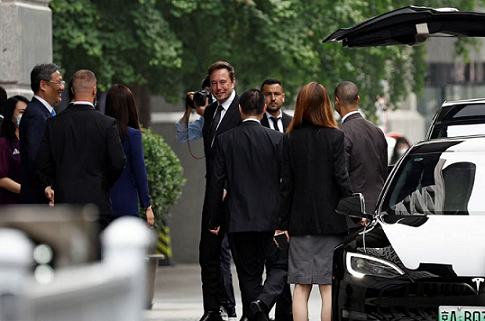 |
| Tesla CEO Elon Musk in Beijing on May 31. (Source: Nikkei Asia) |
Efforts to eliminate risk
Some experts warn that a heavy reliance on China for revenue could harm American technology companies.
Abishur Prakash, CEO of The Geopolitan Business, a Toronto-based consulting firm, emphasized: "The biggest risk for American technology companies is a complete ban and the loss of the ability to sell or manufacture in China."
For Apple, Tesla , and chip manufacturers that supply semiconductors to electronics factories in China, US-China tensions have enormous implications.
In May, Chinese authorities announced that the American memory chip giant Micron Technology had failed a security review. Micron was banned from selling its products to domestic Chinese companies.
Sanjay Mehrotra, CEO of Micron, said: "Approximately half of Micron's revenue in China is at risk of being severely impacted. This 'headwind' is affecting our growth prospects and slowing our recovery."
To mitigate geopolitical risks, some US technology companies have begun reorganizing their operations in China in an effort to prevent potential damage from sanctions.
In May, LinkedIn, a social media platform owned by Microsoft, announced it would close its apps in China and cut more than 700 jobs. LinkedIn cited: "Changing customer behavior and slower revenue growth are the reasons behind this decision."
In late May, Hewlett Packard Enterprise (HPE) announced plans to sell its stake in H3C for $3.5 billion. H3C is a company that sells HPE hardware in China.
HPE CEO Antonio Neri said: "This is the best outcome for our customers, employees and shareholders. Clearly, doing business in China is becoming increasingly complex. HPE will have only a very small presence in China to support its multinational customers and will continue to sell HPE services through H3C."
In early June, Sequoia Capital, a leading US venture capital firm, also announced its decision to spin off its China operations. This decision aims to restructure the company's operations and simplify its business activities.
And this month, Amazon.com also announced it will officially close its app store in China.
A new situation is emerging.
According to Nikkei Asia 's assessment, in the past, the direct "victims" of the US-China technology competition were mostly on Beijing's side.
US sanctions have dealt a severe blow to Chinese tech giants, restricting their access to critical American technologies. Huawei and ZTE are two major companies directly affected.
Furthermore, Washington and several other Western countries have banned the use of Huawei and ZTE 5G equipment in their communications infrastructure.
However, experts have observed that as the US-China confrontation drags on and worsens, restrictions from both sides are beginning to harm key American industries.
Qualcomm stated in its annual report that, "a significant portion of our business is concentrated in China, and the risks of that concentration are exacerbated by trade tensions between the world's two largest economies."
Meanwhile, Apple noted: "Tensions between the US and China have led to a series of new tariffs and business restrictions being imposed. Tariffs increase the cost of products, components, and raw materials. These increased costs will cause the company's profit margins to decline."
Analysts believe the US-China technology rivalry will not end anytime soon.
Akira Minamikawa, a senior consulting director at UK-based research firm Omdia , predicts that the world's largest economy will only retreat when China's technological competitiveness declines.
According to Prakash: "There are no easy paths for businesses seeking to cope with the competition between the US and China. Business owners must accept that a new status quo is emerging."
Source

![[Photo] Prime Minister Pham Minh Chinh holds a phone call with the CEO of Russia's Rosatom Corporation.](/_next/image?url=https%3A%2F%2Fvphoto.vietnam.vn%2Fthumb%2F1200x675%2Fvietnam%2Fresource%2FIMAGE%2F2025%2F12%2F11%2F1765464552365_dsc-5295-jpg.webp&w=3840&q=75)


![[Photo] Closing Ceremony of the 10th Session of the 15th National Assembly](/_next/image?url=https%3A%2F%2Fvphoto.vietnam.vn%2Fthumb%2F1200x675%2Fvietnam%2Fresource%2FIMAGE%2F2025%2F12%2F11%2F1765448959967_image-1437-jpg.webp&w=3840&q=75)





























![[OFFICIAL] MISA GROUP ANNOUNCES ITS PIONEERING BRAND POSITIONING IN BUILDING AGENTIC AI FOR BUSINESSES, HOUSEHOLDS, AND THE GOVERNMENT](https://vphoto.vietnam.vn/thumb/402x226/vietnam/resource/IMAGE/2025/12/11/1765444754256_agentic-ai_postfb-scaled.png)


































Comment (0)