

Speaking at the Kennedy Space Center in Florida on August 8, Bill Nelson expressed concern that China could seize the south pole of the Moon if Beijing's astronauts arrived there first. "Of course, I don't want China to get people to the south pole first and then claim it as their territory."
The race to the Moon's south pole.
According to Nelson, the US and China are racing to see who will be the first to reach the frozen water trapped at the Moon's south pole.
“We need to protect the interests of the international community. If we find abundant water that can be used for future crews and spacecraft, we want to ensure that water is available to everyone, not just those who claim to have it,” Nelson added.
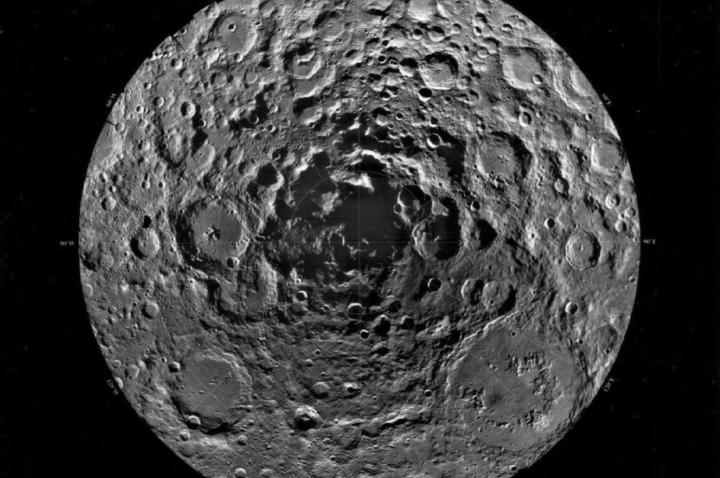
Many countries are aiming for the Moon's south pole. (Photo: Getty)
Potential landing sites and resource exploitation locations on the Moon's south pole may be limited. This is because satellite imagery reveals a landscape very different from the areas previously chosen for landings during earlier lunar missions.
“The images of the south pole don’t look like what we’ve seen where Neil Armstrong and Buzz Aldrin landed. The south pole of the Moon has many deep craters. Because of the angle of the sun’s rays, most of those craters are completely in shadow, which significantly reduces the surface area of contact,” Nelson said.
However, space policy expert Brian Weeden, director of program planning at the Secure World Foundation think tank, said the U.S. and China “don’t necessarily have to compete.” “It’s not a race, because it’s not just the U.S. and China that will go to the moon; many other countries will go there for different reasons.”
The Moon's south pole is vast, with enough space for multiple exploration teams. He rejected the NASA director's idea that whoever gets there first will "win" the race, because "no matter who gets to the Moon first, other nations will keep going there."
China has been researching and developing launch vehicles and spacecraft with the goal of sending its astronauts to the Moon by 2030. The Chinese-led International Lunar Research Station and the US Artemis program both aim to establish a permanent human base in the Moon's south pole region.
Russia and India launch spacecraft to land on the Moon.
Meanwhile, Russia and India are competing to be the first nation to undertake a mission to search for signs of water on the Moon using a probe. Both Russia's Luna 25 and India's Chandrayaan 3 are scheduled to land on August 23.
Russia successfully launched a spacecraft to the Moon after nearly 50 years. (Source: Roscomos)
On the morning of August 11th, Moscow time, the Russian Federal Space Agency Roscosmos successfully launched the Luna-25 spacecraft, opening a new phase in Moscow's lunar exploration program. This is also Russia's first lunar mission in 47 years since 1976.
Luna-25 is expected to land on the Moon's south pole on August 21st. The spacecraft will study areas previously inaccessible to humans.
Despite Moscow's successful launch, the NASA administrator dismissed Russia's role as a rival in the space race. He questioned Russia's readiness to land astronauts on the Moon before 2030.
NASA also outlined the timeline for the Artemis II mission – a four-member crew marking NASA's first manned lunar mission. The mission is scheduled to begin in 2024. This will also be the second launch in the Artemis program, a multinational initiative aimed at establishing a "permanent human presence on the Moon." Prior to this, in 1972, NASA's Apollo crew successfully landed on the Moon.
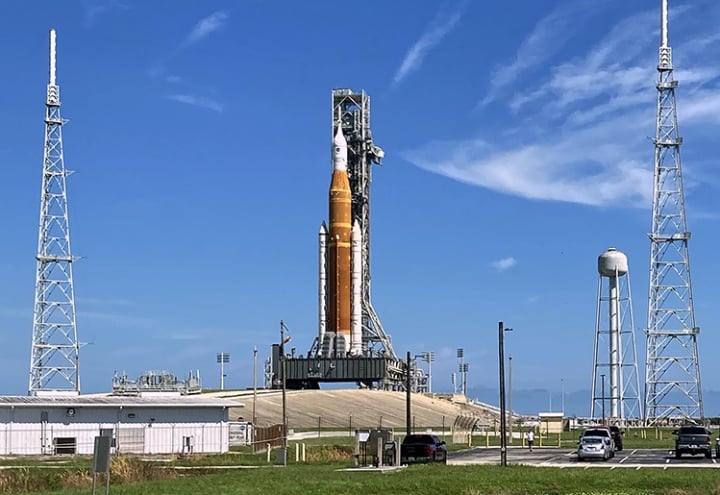
The SLS rocket and Orion spacecraft on the launch pad in Florida during the Artemis I mission. (Photo: Getty)
According to Weeden, a far more important question than the competition between nations to reach the Moon is whether they share the same interpretation of international law, given that current space treaties often have very broad principles.
28 countries signed the Artemis Accords.
The Artemis Accords, launched on October 13, 2020, aim to promote peaceful use of space and cooperation, with eight signatory countries: the United States, Australia, Canada, Japan, Luxembourg, Italy, the United Kingdom, and the United Arab Emirates (UAE). In November 2020, Ukraine joined the agreement. In May 2021, South Korea became the tenth member. In June 2021, New Zealand and Brazil were the next two countries to sign the Artemis Accords.
To date, 28 countries have signed the Artemis Accords, led by the United States.
China was not invited to participate because NASA is not permitted to sign any bilateral agreements with the country. Russia argues that the agreement initiated by the US is " politicized " and "too US-centric."
Other countries such as Germany, France, and India also rejected the agreements, believing that resources in space should remain outside the economic reach of any single nation.
China and Russia, as well as several other nations, have expressed concerns about the possibility that the agreement will restrict their activities on the Moon. While the treaty stipulates that no nation has the right to claim sovereignty over territories on the Moon, it does not specify how the principle of non-appropriation applies to space resources, such as the right to mine, possess, and use lunar ice.
According to Weeden, the concept of a "moon race" arose in part from international concerns about China's rapid rise as a space power.
"For a long time, the U.S. thought it was ahead of China in space technology. That's no longer true. The U.S. relative advantage is narrowing, and people worry that one day it could drop to zero," he said.
Furthermore, there are concerns that China is using its space capabilities as a “soft power” to influence other countries and build global influence. This is demonstrated by Beijing's continuous invitations to partners to conduct scientific research and send its astronauts on missions to the Tiangong space station.
Phuong Thao (Source: SCMP)
Beneficial
Emotion
Creative
Unique
Wrath
Source

























































































Comment (0)