

This was one of the hot topics discussed at the seminar "Aviation and Tourism Join Hands for Sustainable Development" organized by Nhan Dan Newspaper on the afternoon of June 12th in Hanoi.
Many rising costs have led to higher airfares.
According to research and assessments by the Association of Asia Pacific Airlines (AAPA), airfares worldwide are currently and will continue to rise compared to previous periods. Given the current challenges faced by airlines, including high fuel costs, sustainability changes, fleet upgrades, aircraft leasing/purchasing and maintenance, workforce shortages, and airport service fees, global airfares are projected to increase by 3-7% in 2024 and continue to rise in subsequent years.
Speaking at the conference, Mr. Nguyen Quang Trung, Head of Planning and Development at Vietnam Airlines, stated that the increase in airfares is actually part of the general trend in the global aviation industry, influenced by various factors such as fuel prices, inflation and currency devaluation, and the global shortage of aircraft affecting aircraft leasing prices.
"In Vietnam, recently, the highest airfares have mainly occurred on peak days during holidays or during peak hours and times when air travel demand is high. Currently, passengers can still choose lower, more reasonable prices by selecting flights that avoid peak periods and peak hours," Mr. Trung shared.
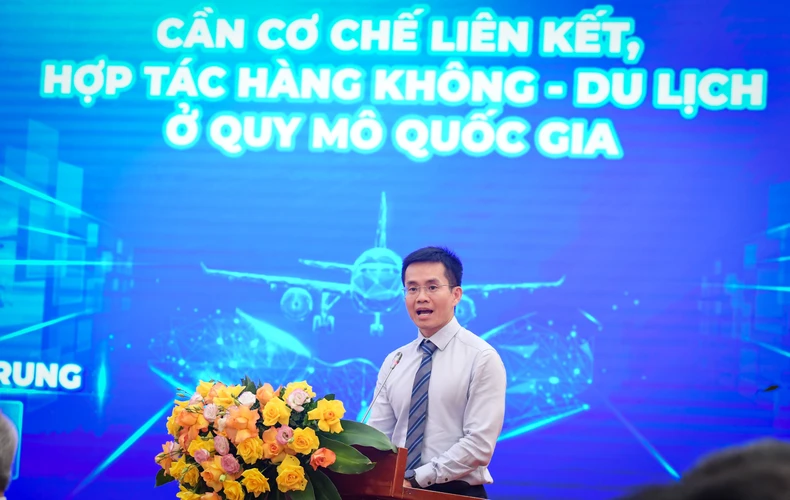 |
Mr. Nguyen Quang Trung, Head of Planning and Development at Vietnam Airlines, shared this information at the seminar. |
Analyzing this issue further, Dr. Bui Doan Ne, Vice President and Secretary General of the Vietnam Aviation Business Association (VABA), commented: In the recent period, due to international economic and political fluctuations and the recall and repair of engines by manufacturers, the global and Vietnamese aviation industries have been severely affected by sharply increased input costs. Most notably, these include fuel costs, engine leasing, aircraft maintenance, exchange rate fluctuations, and airport infrastructure congestion... Specifically, fuel prices are currently pegged at over $100 per barrel. It is projected that Vietnam Airlines' air transport costs for the entire year of 2024 will increase by an additional VND 5,527 billion compared to 2019 due to high fuel prices.
Furthermore, unfavorable exchange rate fluctuations, coupled with the fact that many of the airline's expenses are paid in USD and local currencies in key markets such as Japan and South Korea, mean that, from an exchange rate perspective, Vietnam Airlines' air transport costs for the entire year of 2024 will increase by an additional VND 4,729 billion compared to 2019.
Global airfares are projected to increase by 3-7% in 2024 and will continue to rise in subsequent years.
Global airfares are projected to increase by 3-7% in 2024 and will continue to rise in subsequent years.
On the other hand, aircraft engine rental prices in 2024 are expected to double compared to 2019 (Airbus A321 engines, which cost $48-50 thousand USD/month in 2019, will increase to $80-100 thousand USD/month in 2024; Boeing 787 engines: $160 thousand USD/month in 2022 will increase to $370 thousand USD/month in 2024). Spare parts and supplies prices are expected to increase by 10-13%.
“The time it takes to send engines for repair has more than doubled: In 2019 it took about 75 days, but now it takes 140-160 days. In exceptional cases, it can take up to a year. This causes revenue losses because aircraft are grounded for extended periods. Air traffic and ground congestion at major airports during peak season causes flight times to be longer than planned, resulting in increased costs. Notably, foreign airlines are continuously opening new routes and increasing frequencies on long-haul routes, especially Chinese airlines, leading to increased competition for gateway flights,” the General Secretary of the Vietnam Aviation Business Association further analyzed.
Meanwhile, neighboring countries like Thailand and Malaysia are continuously implementing policies such as visa exemptions, reduced fees, or extended lengths of stay, which is increasing competition among tourist destinations.
Solutions to help the aviation industry overcome difficulties.
Sharing solutions to overcome the current difficulties facing the aviation industry, Mr. Nguyen Quang Trung stated that for many years, Vietnam Airlines has implemented a strategy to upgrade its services, aiming for international 5-star standards. The airline has invested heavily in upgrading its fleet, expanding its route network, developing human resources, and enhancing the service experience for passengers.
"By improving service quality, airlines can attract more and more customers who demand high quality and have high spending power. This will effectively increase revenue and profits not only for airlines but also for the entire tourism industry," Mr. Trung said.
In the context of challenging market and environmental conditions, the aviation industry's efforts over the past period have played a crucial role in the full recovery of international tourist arrivals, ensuring Vietnam's competitiveness as a destination.
However, according to Mr. Trung, given Vietnam's tourism potential, the figures on the number of tourists and the growth rate of the domestic tourism industry could be even more impressive if cooperation between the aviation and tourism sectors were implemented synchronously and effectively.
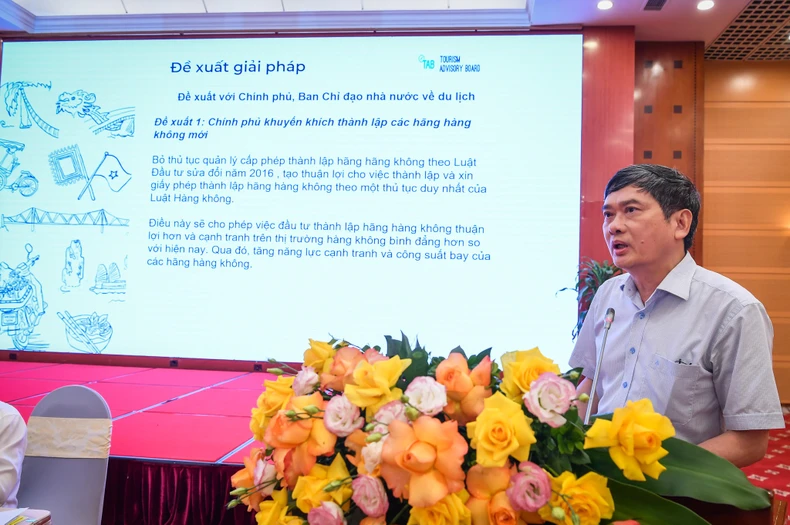 |
Mr. Hoang Nhan Chinh, Head of the Secretariat of the Tourism Advisory Board (TAB), proposed solutions to reduce costs for airlines. |
Proposing solutions to reduce costs for airlines amidst rising input costs, creating conditions for airlines to lower ticket prices and support tourism stimulus, Mr. Hoang Nhan Chinh, Head of the Secretariat of the Tourism Advisory Board (TAB), suggested abolishing the price ceiling regulation and reviewing the current domestic airfare ceiling mechanism in Vietnam so that the market determines domestic airfare prices according to the law of supply and demand, with management and regulation under the Competition Law.
For the time being, a flexible price ceiling will be applied based on fuel prices. If the Ministry of Transport does not abolish the price ceiling regulation, then a price ceiling will be applied based on fluctuations in aviation input costs, especially fuel prices.
In addition, the government needs to encourage the establishment of new airlines. This will allow for easier investment and airline establishment, and create a more level playing field in the aviation market than is currently the case. This will increase the competitiveness and flight capacity of existing airlines.
What mechanisms of linkage and cooperation will help the aviation and tourism sectors "take off"?
Regarding policy support in terms of taxes, fees, and prices, Mr. Chinh proposed: “The government should consider adjusting and reducing import taxes on petroleum products to support airlines during this difficult period. Specifically, exempting the 7% import tax on petroleum products for domestic flights, and applying an environmental protection tax on aviation fuel at 70% of the stipulated rate.”
Source: https://nhandan.vn/vi-sao-gia-ve-may-bay-tang-cac-hang-hang-khong-van-keu-kho-post814126.html

















![[Video] Hue and Quang Ninh mark strong tourism growth](https://vphoto.vietnam.vn/thumb/402x226/vietnam/resource/IMAGE/2025/12/12/1765555481742_dung00-22-16-02still007-jpg.webp)



















































Comment (0)