

Mortgage loans are sluggish and increasing slowly.
Expected to be a driving force for bank lending to accelerate in the final months of the year, home loan lending has been sluggish and recovering slower than anticipated.
High housing prices, coupled with low liquidity and rising lending interest rates, are making investors and homebuyers cautious and hesitant to commit their money.
According to Ms. Nguyen Duc Thach Diem, General Director of Sacombank , bank credit in the first nine months of the year did not meet expectations. One of the reasons for this situation is the decrease in income of real estate buyers, while the supply of affordable housing to meet demand has not been sufficient, according to the Investment Newspaper.
According to analysts at VCBS Securities Company, demand for housing has not recovered due to limited housing supply. In addition, housing prices (especially apartments in central areas) have risen sharply recently, causing apprehension among investors and homebuyers. In the first half of this year, real estate business credit increased by more than 10%, while consumer home loan credit increased by only over 1%.
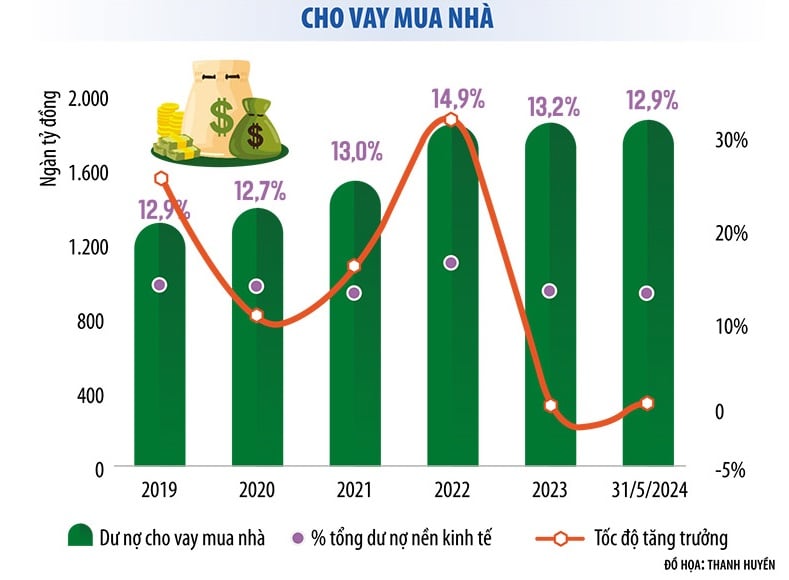
Weak demand for home loans has led to slow credit growth across the entire system.
Home loans are expected to be the main driver of retail credit growth in the coming period, given that interest rates remain low and demand for housing for both residential and investment purposes remains high.
“We believe that real estate and construction credit will continue to increase rapidly in the coming period as supply improves, with projects continuing to be accelerated following efforts to support interest rates and legal frameworks, especially after the new real estate laws come into effect. At the same time, low lending interest rates stimulate borrowing demand from real estate businesses as well as homebuyers,” a VCBS analyst commented.
However, Phan Le Thanh Long, CEO of AFA Group, shared on Vnexpress that the reality is not as predicted. “Many real estate brokers believe that low interest rates will stimulate capital flow into real estate, but in reality, idle funds are not flowing into real estate, but rather into bank savings. High house prices and a market that is ‘difficult to buy, difficult to sell’ are causing real estate transactions to decrease and failing to attract capital,” Long stated.
Personal home loans are one of the most profitable segments for banks today. This is also the sector that accounts for a large proportion of outstanding loans in banks' credit portfolios. Therefore, banks are eagerly awaiting a speedy recovery of lending to this segment.
However, according to Mr. Pham Duc Toan, General Director of EZ Property Investment and Development Joint Stock Company, many homebuyers are currently hesitant to borrow from banks, partly because they have experienced the pain of being stuck with real estate in 2023.
It is difficult for people to realize their "dream of owning a home".
Home loans surged in 2021 and 2022, partly due to banks offering low interest rates during the Covid-19 pandemic. However, the subsequent sharp increase in floating interest rates, coupled with a liquidity crisis in the real estate market, forced many investors to sell off properties at a loss to reduce their interest burden.
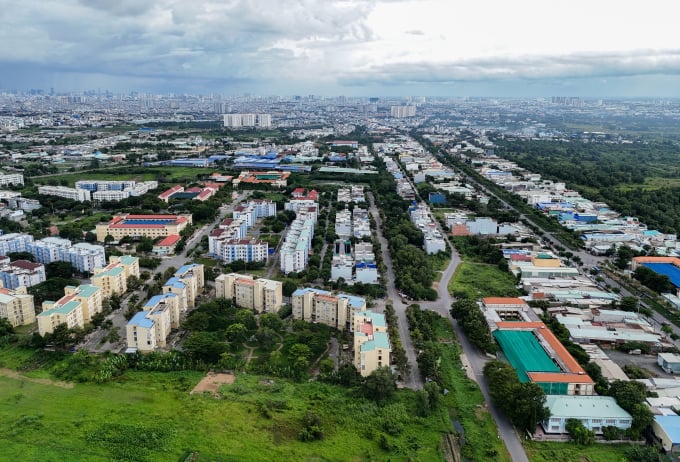
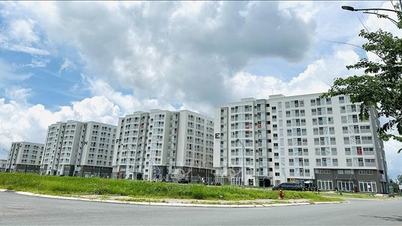
Real estate in the western part of Ho Chi Minh City, including resettlement areas, apartments, townhouses, and land plots in Binh Chanh district, August 2024. Photo: Quynh Tran
Currently, although mortgage interest rates have decreased, borrowers remain concerned about floating interest rates after the preferential rates end. In addition, persistently high house prices relative to income are making people cautious and hesitant to borrow money to buy a home.
According to Ms. Phuong (head nurse at a hospital in District 1, Ho Chi Minh City), her budget for buying a house is around 3 billion VND, including about 2 billion VND from savings and an additional 1 billion VND borrowed from the bank. She wants to buy a two-bedroom apartment in the area around District 7. After a week of surveying, she found several apartment buildings that met her criteria, but she hesitated because she felt the prices were still high compared to the actual value of the apartments.
"It's possible that the current supply shortage is driving up house prices. I want to wait for the market to improve and for a more diverse supply to have more options," she said, explaining why she hasn't finalized a purchase yet, according to Vnexpress .
In fact, housing prices have been continuously rising recently, especially in the apartment segment. The Vietnam Association of Real Estate Brokers (VARS) reported that the apartment price index in Hanoi and Ho Chi Minh City increased by 58% and 27% respectively in the second quarter compared to 2019. More than 80% of the supply launched this year is priced at 50 million VND per square meter or higher. Real estate prices in suburban areas range from 40-80 million VND per square meter, while in the city center they reach over 100 million VND per square meter.
According to VARS, to borrow money to buy an affordable apartment priced under 2 billion VND, each family needs a minimum monthly income of 35-40 million VND to cover loan repayments and monthly living expenses. However, the current income of urban families is only 10-20 million VND per month. Low prices and liquidity are obstacles preventing the expected flow of money into real estate.
Mr. Nguyen Van Dinh, Chairman of VARS, further analyzed that credit growth is driven by real estate, especially the demand for home loans. Therefore, to stimulate lending in this sector, policies are needed to regulate housing prices to match people's income levels. In addition, legal obstacles need to be removed to allow businesses to reduce costs and be more flexible in terms of credit granting conditions, thereby stimulating capital flow back into real estate.
From the borrower's perspective, economic experts also recommend careful consideration when investing in real estate at this time. According to real estate expert Le Quoc Kien, when borrowing to buy a house, borrowers must first have a stable income from salary and at least 40-50% of the capital themselves, with the remainder financed by the bank to maintain repayment ability and avoid bad debt.
Mr. Kien shared that, generally, homebuyers should only allocate a maximum of 40% of their total monthly income to housing, in order to cover other basic living expenses. Therefore, in addition to comparing mortgage interest rates between banks to choose a suitable loan package, homebuyers need to carefully consider their cash flow and ability to repay the loan. Paying monthly interest and principal without careful and reasonable planning can create a significant financial burden and pressure on life.
Overvaluation of real estate coupled with low liquidity not only prevents buyers from speculating and ties up their capital for the long term, but also makes it difficult for those buying for long-term accumulation to expect high returns. High house prices also reduce rental income (accounting for only about 3% of the total investment value, much lower than bank interest rates). This is also why money flows into savings instead of real estate, according to the Investment newspaper.
Analysts at VPBank Securities believe that the ratio of housing prices to income in Vietnam has increased and is currently about 4-5 times higher than the recommended ratio. Therefore, although mortgage interest rates have decreased significantly over the past year, housing prices remain high, making it difficult for many people to realize their "dream of owning a home".
KHANH LINH (compiled)
Source: https://www.nguoiduatin.vn/vi-sao-nguoi-mua-nha-than-trong-chua-dam-xuong-tien-trong-khi-lai-ngan-hang-da-giam-dang-ke-204241008145745643.htm

![[Photo] Closing Ceremony of the 10th Session of the 15th National Assembly](/_next/image?url=https%3A%2F%2Fvphoto.vietnam.vn%2Fthumb%2F1200x675%2Fvietnam%2Fresource%2FIMAGE%2F2025%2F12%2F11%2F1765448959967_image-1437-jpg.webp&w=3840&q=75)


![[Photo] Prime Minister Pham Minh Chinh holds a phone call with the CEO of Russia's Rosatom Corporation.](/_next/image?url=https%3A%2F%2Fvphoto.vietnam.vn%2Fthumb%2F1200x675%2Fvietnam%2Fresource%2FIMAGE%2F2025%2F12%2F11%2F1765464552365_dsc-5295-jpg.webp&w=3840&q=75)

















































































Comment (0)