

The conflict in Ukraine is entering its third year, and its outcome remains unpredictable.
Russia achieved a significant victory in Avdiivka, but it wasn't enough to dramatically alter the course of the battlefield. In the final days of February 2024, the fighting on other fronts unexpectedly intensified, revealing complex calculations and strategic complexities.
A series of blows and calculated moves.
Faced with Ukraine's somewhat unfavorable situation, the West and NATO launched a series of attacks. Many NATO member states signed 10-year security agreements with Ukraine, pledging long-term support and cooperation in political , military, security, economic, and financial fields. More than 500 new Western sanctions targeted Russia and corporations from countries with military technology ties to Moscow.
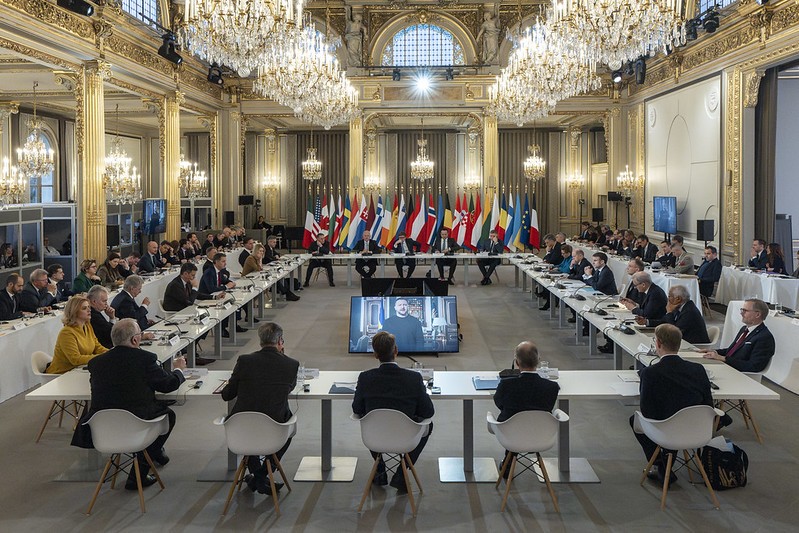 |
| European leaders met at the Elysee Palace in Paris, France, on February 26 to discuss the issue of Ukraine. (Source: Reuters) |
On February 26th, two significant events took place simultaneously. The Hungarian Parliament voted to approve Sweden's accession to NATO; and approximately 20 European leaders met in Paris to discuss support for Ukraine. With the admission of Finland and Sweden, NATO has essentially completed its encirclement of Russia. Ukraine has become the fundamental, most important, and almost final battleground in the confrontation between NATO and Russia in Europe. Now, both sides will focus all their efforts on this front.
NATO and the West want to leverage their numerical superiority, but what to do and how to defeat Russia is a difficult question. Defeating Russia militarily is very difficult. The West and NATO desire to push Russia into a quagmire, economic collapse, political and diplomatic isolation, leading to overall weakening, even fragmentation. This forms the basis for the West and NATO to launch a series of more aggressive, multi-faceted attacks, potentially crossing taboos.
Agreement or disagreement, division?
In its third year, Ukraine needs significant aid in terms of modern weapons, finance, support, direct and indirect involvement in personnel, equipment, technology, intelligence, information, cybersecurity, logistics, transportation, and on-site defense production… to defend itself and prepare for a strategic counterattack.
International experts acknowledge that without aid, Ukraine will fail. However, the US Congress and some Western countries are still suspending aid packages for Ukraine. In this context, the meeting of NATO members in Europe to discuss comprehensive support for Ukraine has attracted considerable attention.
German Chancellor Olaf Scholz stated, "We agree that everyone needs to do more to help Ukraine. Kyiv needs weapons, ammunition, and air defense capabilities. We are trying to address those issues." French President Emmanuel Macron was more assertive, saying, "nothing should be ruled out," including sending troops to Ukraine.
It seems NATO is in agreement and ready to act at the highest level. But that's not entirely true. Slovak Prime Minister Robert Fico frankly assessed that supplying weapons wouldn't change the battlefield situation; military solutions are unreliable; and even the West's approach to the war is an "absolute failure."
The German leader expressed opposition to any idea of deploying troops to Ukraine. The United States, leading the way, along with Britain, Poland, the Czech Republic, Hungary, and many others, also stated they had no plans to send troops to Ukraine. Direct combat in Ukraine is something to be avoided. The reasons are crystal clear.
That was President Emmanuel Macron's idea. Discussing it is one thing, but whether or not to deploy troops and how to do so is another. The occupant of the Elysee Palace wanted to demonstrate a leading role with his European allies. That calculation backfired. French Foreign Minister Stephane Sejourne had to intervene, saying Macron only wanted to encourage debate; the deployment of troops (if any) would be limited to bomb and mine clearance, cybersecurity, and local weapons production...
President Macron, despite his strong stance, also showed hesitation when he declared that the West would do everything necessary to prevent Russia from winning. Preventing Russia from winning does not mean forcing Russia to lose. Regardless of the argument, the truth cannot be hidden: NATO and the West have differing and divided views on the conflict and how to resolve the crisis in Ukraine.
In reality, besides providing weapons, some NATO member states have trained Ukraine, used reconnaissance aircraft, directed attack targets, sent advisors and soldiers to participate in combat under the guise of private companies… These activities have helped Ukraine improve its combat capabilities, inflicting damage and losses on Russia, but it is difficult, if not impossible, to change the course of the battlefield.
The door is open but difficult to get in, or the need to take a roundabout route.
During a gathering of Western leaders in Kyiv marking the second anniversary of Russia's special military operation, NATO Secretary General Stoltenberg reiterated that Ukraine will certainly join the military alliance. He emphasized that Ukraine is closer to NATO than ever before.
But most importantly, when and under what conditions is unclear. Will NATO dismantle its defensive principles? It's highly unlikely. Many NATO countries don't want to burden themselves or violate the principle of common defense when a member state is attacked. Even a country like Sweden struggled for nearly two years; Ukraine's prospects are still very uncertain.
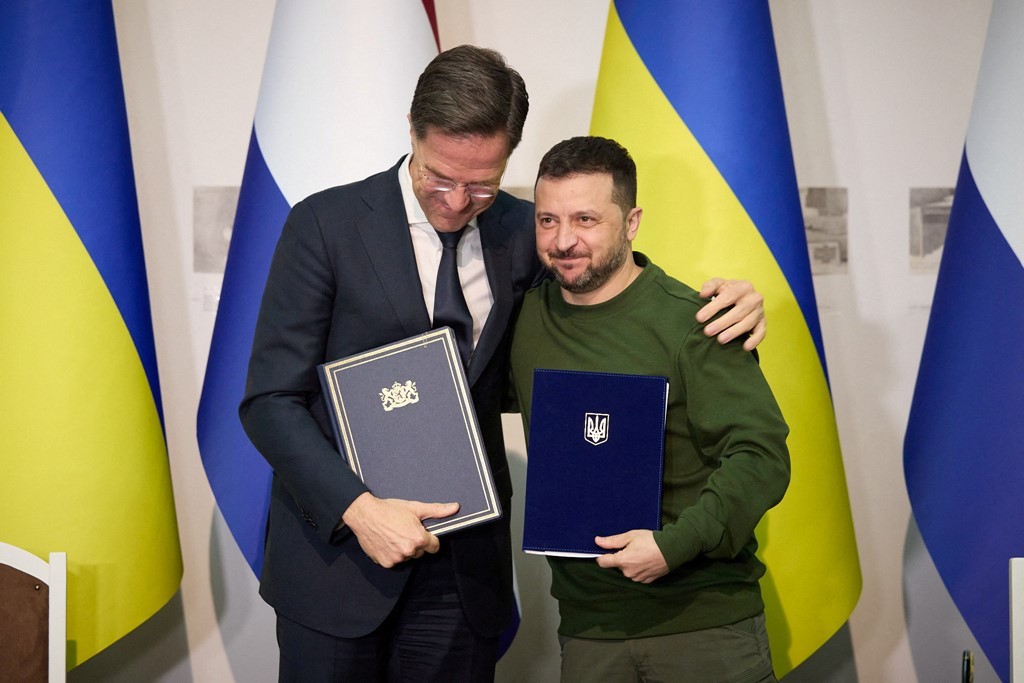 |
| Ukrainian President Volodymyr Zelensky (right) and Dutch Prime Minister Mark Rutte signed a security agreement on March 1, paving the way for Amsterdam to provide Kyiv with up to 2 billion euros in military aid this year. (Source: Reuters) |
The West has to find a workaround. Some countries have signed security agreements with Ukraine, committing to multifaceted support, partially compensating for the shortfall caused by the US Congress and some other countries suspending aid bills for Kyiv. Through this, NATO can mobilize more weapons and equipment from countries inside and outside Europe for Ukraine; creating conditions for counterattacks and raids deep into Russia's rear.
The security agreements demonstrate both the resolve of the West and NATO, and provide material and moral support to Ukraine. However, they do not commit to shared defense, which is the most important and highest level of a military treaty.
Russia's response
In light of NATO's recent moves, the West, and especially the idea of sending troops to Ukraine, Russia will undoubtedly respond accordingly, using various measures. First and foremost, it will retaliate with a stern and deterrent warning statement.
Kremlin spokesman Dmitry Peskov made it clear that Moscow shouldn't be discussing the possibility of a direct confrontation between Russia and NATO, but rather its inevitability. He urged them to question whether the decision to deploy troops aligns with their national interests and, most importantly, the interests of their people. Konstantin Kosachev, Vice Chairman of the Federation Council of Russia, warned that NATO sending troops to Ukraine would be a "catastrophic scenario," potentially a "declaration of war" against Moscow.
President Putin's State of the Union address on February 29th indicated that Russia will strengthen its power through unity and solidarity among its peoples; economic development; cooperation with friendly nations; and the advancement of its defense industry, equipping itself with advanced strategic weapons. Russia is ready to engage in dialogue with the US on strategic issues, but warned that the West's deployment of troops to Ukraine risks provoking a nuclear war, and that Moscow possesses sufficient weapons to destroy enemy targets. President Putin affirmed that Russia will do everything possible to end the conflict, eradicate fascism, and achieve its stated goals.
In recent days, Western media have reported that North Korea, Iran, and several other countries are supplying Russia with missiles, drones, artillery shells, and semiconductor chips. Moscow has not acknowledged this, but it may be a necessary step for Russia.
It's very clear and weighty. Russia isn't just talking; it's capable of taking action. How they respond depends on the actions of NATO and the West.
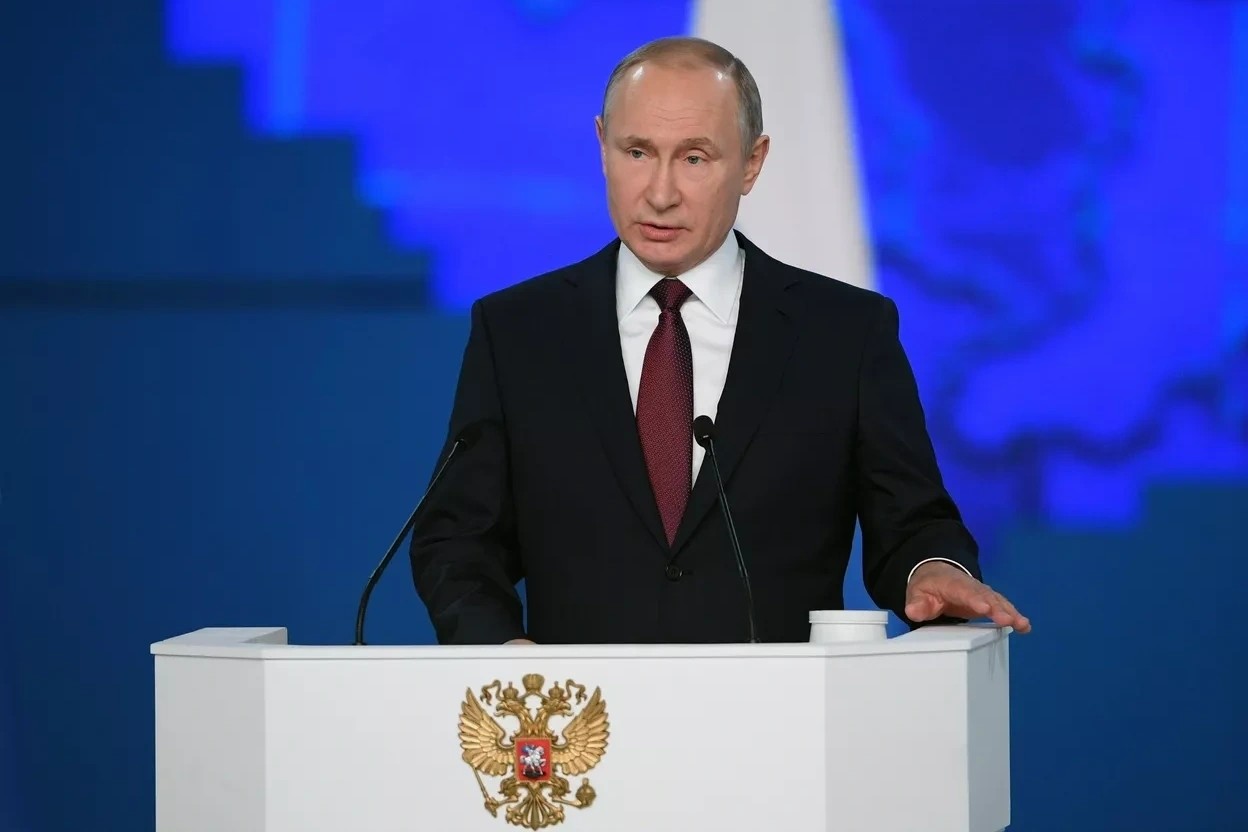 |
| In his 2024 State of the Union address, Russian President Vladimir Putin warned that the West could ignite a nuclear conflict if it sent troops to Ukraine. (Source: Sputnik) |
Which scenario was chosen?
The actions of the parties involved make the conflict unpredictable, but the following scenarios can be outlined:
Firstly , both sides are locked in a protracted stalemate. Ukraine, strongly supported by NATO and the West, continues its defenses, launching deep attacks into Russian rear areas and potentially retaking some regions. Russia is consolidating its defenses in the areas it occupies, continuing its war of attrition, combining artillery fire with ground offensives… Both sides are suffering losses, aid is not as expected, and external pressure is increasing. Russia is neither winning nor Ukraine is losing; the situation remains a stalemate, with little prospect of a decisive outcome in the near future.
Second, the war ends in Russia's favor, and the rest of Kyiv falls within Moscow's political orbit. Russia capitalizes on its victory in Avdiivka, advances its offensive on other key targets, consolidates its position, expands its occupied territories, and gains battlefield advantage. This is the scenario Russia desires. NATO and the West will do everything in their power to prevent it from happening.
Third, neither side achieved victory, facing both internal and external difficulties, and suffering losses beyond their capacity, forcing them to seek a non-military solution. Both Russia and Ukraine have put forward preconditions that are difficult for the other to accept, but negotiations remain a possible scenario, albeit a very difficult one.
Ukraine might accept a return to the pre-conflict state of affairs. Moscow is attempting to expand its controlled territory and establish a security buffer zone between Russia and the West. A "peace agreement" could also be temporary.
Fourth, a war could break out between NATO and Russia, possibly even a nuclear war. While not entirely ruled out, this scenario is very, very unlikely, given the extremely dire consequences that all parties would try to avoid.
***
The longer a conflict lasts, the more losses and exhaustion both sides suffer, sometimes to the point of unbearable strain. Other nations, whether supporting one side or remaining neutral, also bear the consequences of the war. The majority desire a solution to end the conflict.
The outcome and the specific scenario depend primarily on Russia and Ukraine. However, external factors play a crucial and indispensable role. As long as NATO and the West want to maintain a proxy war with Russia, and as long as all parties advocate using force to subdue and compete for strategic interests, the conflict will continue.
Source
































































Comment (0)