


18 years of quietly waiting for a miracle.
For many couples struggling with infertility, the saying "as long as there's life, there's hope" is not just encouragement, but a philosophy of life – a race of faith.
But for the man in this story, that once became meaningless. He was diagnosed with complete azoospermia, meaning there were absolutely no sperm in his semen.
In the rare semen samples that do contain sperm, the number is often scattered and too small to perform any assisted reproductive techniques, including in-vitro fertilization (IVF).
“We tried everything. Years of treatment, multiple rounds of IVF, each time a gamble of hope and then disappointment,” the wife shared. “Gradually, we learned to live without waiting anymore. We still love each other, we still walk together, but a child has become a distant dream.”
In that seemingly hopeless situation, they agreed to try a last-ditch option: STAR technology, short for Sperm Tracking and Recovery , an artificial intelligence system developed by experts at the Center for Reproductive Medicine at Columbia University (USA).
AI finds life in the smallest things.
Unlike manual methods that rely on microscopes, STAR is designed to function like an artificial brain, capable of capturing up to 8 million images in less than an hour.
Then, machine learning models are used to analyze and determine the location and activity of each sperm cell, including even the weakest and rarest ones.
“There was a sample where we spent two days searching for sperm and still found nothing. But STAR only took an hour to detect 44 sperm,” Dr. Williams recalled. “At that moment, we knew this technology was going to be a game changer.”
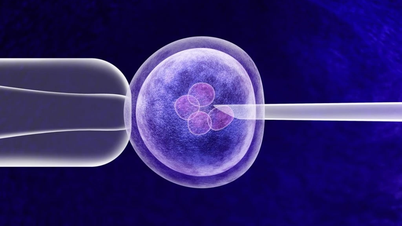
Of the sperm found, the three healthiest were selected for in-vitro fertilization. And a miracle happened: the wife became pregnant, a completely natural pregnancy with no complications.
"I had to see the ultrasound images to believe it," she said emotionally. "Every morning when I wake up, I still can't believe I'm carrying a life inside me. But it's true after 18 years."
The story not only brings hope to the couple, but also opens up new prospects for millions of people worldwide suffering from azoospermia.
STAR doesn't produce sperm, but it can optimize the search for and harvesting of what was thought to be lost.
In an era where AI is often discussed in terms of risks and control, technologies like STAR demonstrate that artificial intelligence, when placed in the right context, can deliver not only results but also life, hope, and a future.
(According to CNN)
Source: https://vietnamnet.vn/18-nam-vo-sinh-ai-quet-8-trieu-anh-tim-thay-tinh-trung-2418816.html












































































Comment (0)