

The General's secret order and the lightning-fast sea voyage to liberate Truong Sa.
In April 1975, while five rapid-fire army columns advanced into Saigon, a silent assault column moved out to sea. Under the special orders of General Vo Nguyen Giap, the sixth column launched the campaign to liberate the Spratly Islands, marking a strategic turning point and affirming Vietnam's sovereignty over this sacred maritime region. From then on, the Spratly Islands were not just islands, but the very flesh and blood of the Fatherland.
The 6th Army Corps makes a "lightning-fast" advance to the sea.
In the final days of March 1975, at the "Headquarters" of the Ho Chi Minh Campaign, despite anxiously following the rapid advance of the troops storming Saigon, General Vo Nguyen Giap still paid special attention to the sea, to the islands of the Spratly Archipelago occupied by the South Vietnamese army.
In his memoir "General Headquarters in the Spring of Total Victory," the General dedicated an entire chapter to the "liberation of the Spratly Islands," calling it "a special event that took place outside the initial strategic plan." This involved the direction of the Politburo , the Central Military Commission, and the General Staff to liberate the islands of the Spratly archipelago, which were occupied by the Saigon puppet army – a sacred maritime territory of the Fatherland with a strategically important economic and military position. The General affirmed: "If we delayed, allowing another country's army to invade this place, the situation would become very complicated. The biggest difficulty was capturing the islands with our small naval force at that time. On the East Sea front, action had to be 'swift, bold, unexpected, and certain to win'."
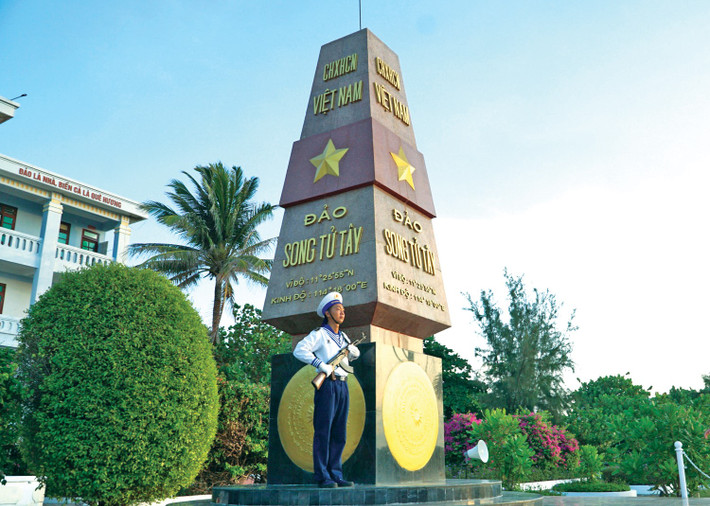
Song Tu Tay Island was the first of the islands in the Spratly Islands to be liberated, on April 14, 1975. Photo: TT
In response to developments on land, on the afternoon of April 4, 1975, General Vo Chi Cong issued secret order No. 990B/TK to the Political Commissar of Military Region 5 and Commander Chu Huy Man, emphasizing: " Immediately seize the islands in the South China Sea, especially the Spratly Islands (which we call Truong Sa). This must be prepared urgently and secretly, known only to responsible officers." This order was executed immediately. Military Region 5 and the Naval Command deployed their operational plan.
The forces of Military Region 5, along with a reorganized naval landing force and transport ships, included: transport ships from Regiment 125 that had just arrived from Hai Phong to take over Da Nang; these unmarked ships were familiar with the "Ho Chi Minh Trail at Sea," having repeatedly traversed the Spratly Islands, thus familiar with identifying and distinguishing the islands and also experienced in avoiding reefs; and Team 1 of Regiment 126, a special forces unit with a long history of success using secret and surprise tactics, having sunk many enemy ships in the Cua Viet battlefield. Their commander was Comrade Mai Nang.
On April 9th, the Military Intelligence Department detected enemy troop withdrawal from islands in the South China Sea. The Central Military Commission sent an "urgent" telegram to the Political Commissar of Military Region 5, Vo Chi Cong, and Commander Chu Huy Man, Deputy Commander of the Navy in Da Nang, stating: "There is information that the puppet army is preparing to withdraw from the Spratly Islands. Please verify this immediately and instruct our forces to act promptly according to the established plan. Any delay could allow foreign forces to occupy them first, as several foreign countries are currently harboring intentions of invasion."
Following direct instructions from General Vo Nguyen Giap, the naval forces and units of Military Region 5 disguised themselves as fishing boats and set off before dawn. Facing the enemy's large warships and the vast ocean with limited resources, our troops fought in their own unique way: secretly approaching, quickly landing, and unexpectedly seizing the target.
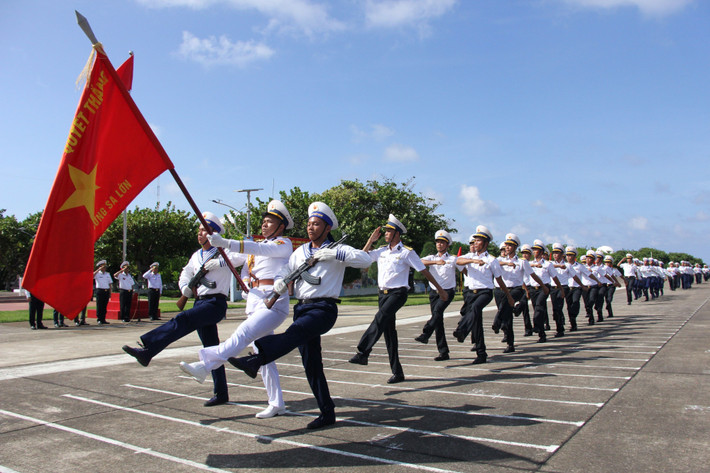
Flag-raising ceremony on Truong Sa Lon Island
At exactly 4:30 a.m. on April 14th, after more than an hour of organizing the landing, our forces opened fire and launched an attack, quickly eliminating and capturing all enemy troops, liberating Song Tu Tay Island, and raising the national flag atop the flagpole on the island.
Next, on April 25th, our troops attacked and captured Son Ca Island. On April 27th, we liberated Nam Yet Island. On April 28th, we liberated Sinh Ton Island, and by 9:00 AM on April 29th, we liberated Truong Sa Island and An Bang Island, successfully completing the assigned mission within half a month with the greatest efforts. “The offensive and uprising power of the key battlefield, along with the immense support from the rear, greatly strengthened the position and power of our army and people. The enemy's distant defense line was broken. A vast sea area rich in resources, with islands and archipelagos of extremely important strategic positions, came under the sovereignty of the Fatherland. Large, experienced combat units were ready to launch an attack on the enemy's last stronghold (excerpt from memoirs: General Headquarters during the Spring of Total Victory).”
The land, rivers, seas, and sky unite as one.
Arriving in Truong Sa during these historic April days, each submerged and above-water island in the vast ocean holds within it heroic stories of the soldiers' long struggle. There are losses, sacrifices, tears mixed with pride and emotion when hearing about the swift campaign to liberate Truong Sa 50 years ago. Each island bears the indelible footprints of soldiers from generations past.
Lieutenant Colonel Nguyen Van Khuong, Political Commissar of Song Tu Tay Island, shared that the swift liberation of the Truong Sa archipelago by our military units holds great historical significance, affirming the sacred territorial sovereignty of the Fatherland. The soldiers and people of Song Tu Tay Island always remember the immense sacrifices and losses of their forefathers in the fight to protect the island. On the occasion of the 50th anniversary of the liberation of the Truong Sa archipelago, we also organized a rally and offered incense to commemorate the heroic martyrs. We propagated to the officers, soldiers, and civilians on the island the great struggle of our ancestors, reminding them to engrave in their hearts the oath of a soldier to Truong Sa: "As long as there are people, there is the island." Even if it means sacrificing their lives, they must fulfill their duty to the army, the people, and the nation, protecting every inch of land and every stretch of sea belonging to their ancestors.
Looking back 50 years after liberation, Lieutenant Colonel Khuong believes that it embodies outstanding military art and the courageous and unwavering spirit of the soldiers. Continuing that tradition, the military and people of Song Tu Tay Island today are determined to train and successfully accomplish all assigned tasks. They are undeterred by hardship and ready to make sacrifices to firmly protect the sacred sovereignty of the Fatherland's maritime territory.
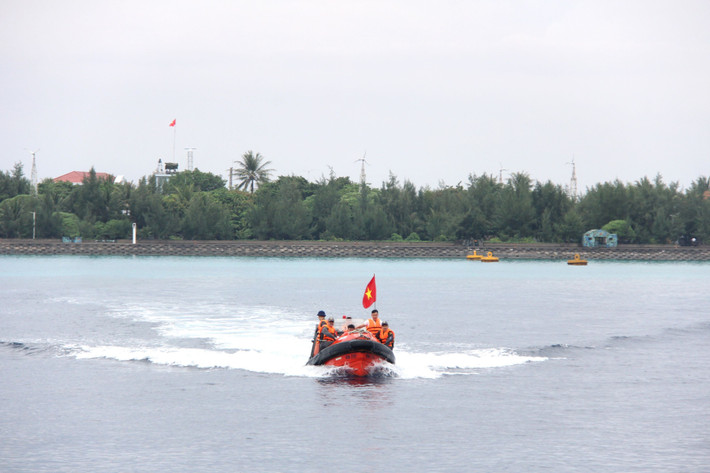
Following in the glorious tradition of their forefathers, the soldiers of Truong Sa today remain steadfast, holding firm to every inch of sacred land and sea of the homeland.
After liberating Song Tu Tay, the troops continued their advance towards Sinh Ton. Every step of the march was fraught with lurking dangers. The heroic deeds of the soldiers that year are deeply etched in the minds of the soldiers and civilians on this frontline island. Lieutenant Colonel Hoang Van Cuong, Political Commissar of Sinh Ton Island, said emotionally: “No matter the circumstances, naval soldiers must overcome difficulties and be determined to firmly protect every inch of land and every stretch of sea that our ancestors left behind. The liberation of Sinh Ton Island on April 28, 1975, contributed to the overall liberation of the Truong Sa archipelago as well as the overall victory of the historic Spring Offensive of 1975, bringing the country, land, sea, and sky of the Fatherland together from now on.”
Source: https://daibieunhandan.vn/50-nam-giai-phong-truong-sa-thanh-tri-bat-khuat-giua-bien-dong-post410613.html




































































Comment (0)