

The world's two leading economies are locked in a battle to secure the future of the solar energy industry. Could the upcoming US presidential election reverse this trend?
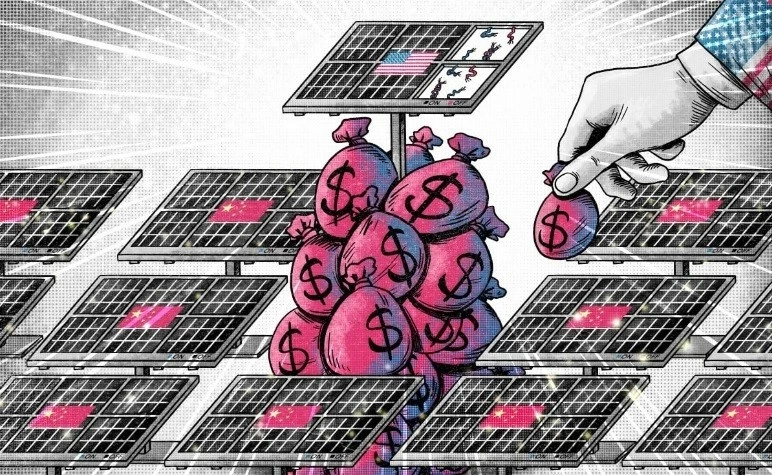 |
| In fact, the world's two leading economies are both vying to secure the future of the solar energy industry. (Illustrative image. Source: SCMP) |
Claims that subsidies in the solar energy sector have led to overcapacity have become a familiar refrain in the past year's US-China trade war. Last month, Beijing retaliated.
The China Photovoltaic Industry Association stated that the US has "aggressively expanded its solar power capacity through monopolistic and discriminatory subsidy policies" in recent years, but still accused China of excessively subsidizing its new energy industry.
"These actions are leading to overcapacity in the U.S.," the association warned, adding that it could negatively impact the healthy development of the industry globally.
In fact, the world's two largest economies are both vying to secure the future of the solar energy industry. The Inflation Reduction Act (IRA), introduced by the Biden administration in 2022, provides billions of dollars in subsidies and tax credits, demonstrating Washington's efforts to level the playing field.
All eyes are on the presidential election next month. Republican candidate Donald Trump said he would "cancel all unused IRA funds" but asserted he was a "big fan" of solar energy during a debate with Democratic candidate and Vice President Kamala Harris on September 10.
"It's unlikely that either candidate will retain their current incentives if elected," said Jenny Chase, a leading solar energy analyst at BloombergNEF.
China has dominated the global photovoltaic supply chain thanks to 20 years of intensive industrial policies, but it is now on the defensive, fearing that excessive competition could undermine its domestic growth potential.
Meanwhile, the U.S. is doubling down on massive subsidies aimed at fostering an industrial ecosystem independent of China as part of its efforts to "reduce risks" amid strategic competition. Industry experts say the success of that effort largely depends on a steady and consistent injection of funds from both the government and capital markets.
Although China's overall and enormous manufacturing capacity may be difficult to surpass, technological breakthroughs could create shortcuts.
"Could the U.S. dominate the solar energy manufacturing industry? Absolutely, with enough subsidies, you can do anything," expert Jenny Chase predicts.
According to the China Photovoltaic Industry Association, a long list of federal and state subsidies for the solar energy industry proposed by the IRA is worth up to $369 billion, focusing on supporting investment and production in the clean energy sector, including photovoltaic products.
The world's second-largest economy has chosen a different approach. China doesn't provide specific cash incentives to domestic solar energy producers. Instead, local governments are the key force behind industrial policies, fostering rapid growth in the sector by providing comprehensive support such as cheap land leases, affordable power purchase agreements, and incentives for building more solar power plants and farms.
Daniel Qiu, managing director and co-head of investment banking and capital markets at Credit Suisse Securities, said: "Five or six years ago, local governments offered very good terms to manufacturers, some even helping to build factories and manufacturers just had to move their equipment in."
With such special incentive policies, China has easily become the world's number one producer of solar energy products over the past two decades, accounting for more than 80% of the global supply chain.
In the US, prior to the introduction of IRAs, there were already supportive industrial policies in place, including research funding and tax credits for solar panel installations, but the total cost of production, from labor to factory construction, far exceeded that of China.
Ocean Yuan, founder and CEO of Grape Solar, a US-based manufacturer and seller of solar energy equipment, said the IRA has been a "game changer" because, for the first time, US manufacturers can receive direct financial incentives.
"Now, for any company, whether Chinese or other, as long as they manufacture solar panels, if they don't come to the U.S., they have no future," Yuan said. "The U.S. has always had the manufacturing capacity, and it's just a matter of expansion," Yuan added.
Source: https://baoquocte.vn/bau-cu-tong-thong-my-co-dao-nguoc-the-tran-cuoc-dua-trong-nganh-nang-luong-mat-troi-292030.html


![[Image] Close-up of the newly discovered "sacred road" at My Son Sanctuary](/_next/image?url=https%3A%2F%2Fvphoto.vietnam.vn%2Fthumb%2F1200x675%2Fvietnam%2Fresource%2FIMAGE%2F2025%2F12%2F13%2F1765587881240_ndo_br_ms5-jpg.webp&w=3840&q=75)
































































Comment (0)