


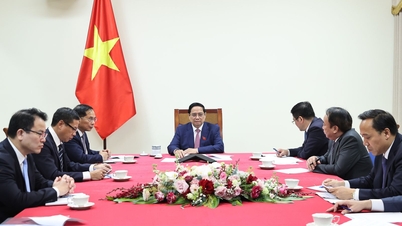
National online conference to provide professional and technical training for commune-level officials, civil servants, and public employees in the field of state management of the Ministry of Interior - Photo: VGP/TG
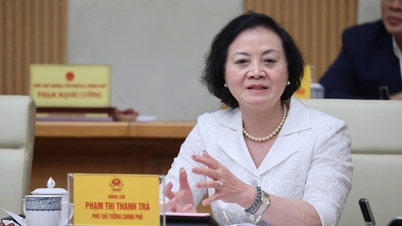
Minister of Home Affairs Pham Thi Thanh Tra emphasized the above at the National Online Conference on professional training for commune-level cadres, civil servants and public employees in the field of state management of the Home Affairs sector.
The conference was held in one day (August 9). The main bridge was located at the headquarters of the Ministry of Home Affairs ( Hanoi ) and online to local bridges established in 34 provinces and cities and 3,321 communes, wards and special zones across the country.
In her opening remarks at the conference, Minister of Home Affairs Pham Thi Thanh Tra assessed that, in the past period, the team of officials and civil servants at the commune level have accomplished a great deal and made outstanding efforts.
Within one month of completing the provincial and city mergers, the Politburo , the General Secretary, the Government, and the Prime Minister acknowledged the initial results of the stable and basically smooth operation of the two-tiered local government system, without interruption or major problems arising, and the basic objectives were largely achieved.
"The initial results are important and form a foundation, but the most fundamental and crucial thing is to ensure the operation of the two-tiered local government system with the goal of being streamlined, efficient, effective, close to the people, and serving the people better. The ultimate goal is to create, develop, and serve the people," the Minister emphasized.
Therefore, in the coming time, the first key task, the Minister emphasized, is still to operate the apparatus smoothly, continuously, and rhythmically, ensuring efficiency, effectiveness, and more positive changes every day.
The Minister requested that officials at all levels closely monitor the actual operation of the two-tiered local government system, and work together to resolve difficulties and obstacles so that the entire administrative system, from the central government to the commune level, operates smoothly.
Regarding commune-level leaders, the Minister stated that this is a major test. Commune-level leaders must work systematically, scientifically, and rigorously, starting with specific work plans, ensuring adherence to the six clear principles: "clear person, clear task, clear product, clear time, clear responsibility, clear authority," and the two "no's": "no shirking responsibility, no shirking responsibility."
"Commune-level leaders must have a comprehensive understanding of their functions, duties, and powers, and focus on innovating methods to solve problems for the people. The satisfaction of the people should be the yardstick for evaluating the effectiveness of the government's operations," the Minister said.
Encourage staff who do not meet the requirements to resign voluntarily.
The Minister of Home Affairs also noted the need to focus on improving the personnel structure and the team of commune-level civil servants to meet operational requirements and enhance efficiency in the new context.
According to the Minister, the entire system must now review, evaluate, and classify officials and civil servants, encouraging those who truly cannot meet job requirements, have limited abilities, or health to voluntarily resign to make way for younger, more qualified individuals, or those newly recruited under contract.
In the coming time, the Ministry of Home Affairs will have specific instructions to transfer civil servants from places with surplus to places with shortage. If after transfer there is still a shortage, the unit or locality will be allowed to recruit more people according to Decree 170 and Decree 173.
Regarding the implementation of regulations and policies under Decree 178 and Decree 67, the Minister emphasized the need to strive to complete the process before August 31st. At this time, it is crucial to actively review and encourage the dismissal of those who do not meet the requirements, in order to focus on improving the quality of commune-level civil servants.
“This is a very important task, but we should not be worried. There is still time for us to train, develop, and coach our staff so that they can meet the tasks in the new situation,” the Minister emphasized.
Minister Pham Thi Thanh Tra stated that the Ministry of Interior will advise the competent authorities to adjust personnel to suit the population size, natural area, according to decentralization, delegation of power, delineation of authority, and other necessary criteria.
Regarding staffing allocation, the Minister of Information will assign the total staff quota to localities based on population size, natural area, authority, level of decentralization and delegation of power, as well as considering functions, tasks, economic scale, and specific factors.
"From there, the Ministry of Interior will calculate and allocate the overall staffing quotas to localities. In reality, some communes and wards may need hundreds of officials and civil servants, but some localities only need about 30 officials and civil servants, such as communes that remain unchanged without restructuring or small special zones," the Minister outlined the staffing allocation plan.
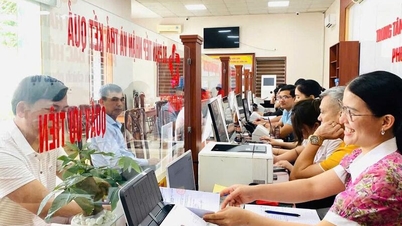
In addition, the Minister of Home Affairs also requested attention be paid to the public administrative centers – the face of the commune-level government. Currently, localities are doing quite well in the initial stages, but further improvements to the infrastructure, research into professional expertise, and software upgrades are needed to meet current tasks.
At the conference, delegates received training on the basic and core contents of the Law on Organization of Local Government in 2025; the duties and powers of the Chairman, Vice-Chairman, and Heads of Committees of the People's Council at the commune level; the duties, powers, and management skills for handling matters within the authority of the Chairman, Vice-Chairman of the People's Committee at the commune level, Heads of specialized departments under the People's Committee at the commune level, and commune-level civil servants. The training also covered decentralization, delegation of power, and delineation of authority in the field of Internal Affairs; and guidance on the procedures for handling administrative procedures at the commune level in the field of Internal Affairs.
Delegates also listened to presentations on the organizational structure, functions, and tasks of specialized agencies under the People's Committee at the commune level; the organization of public service units under the People's Committee at the commune level; and the orientation for determining job positions for commune-level civil servants. At the same time, the Ministry of Interior also addressed requests compiled from localities.
Thu Giang
Source: https://baochinhphu.vn/bo-noi-vu-se-huong-dan-dieu-tiet-cong-chuc-noi-thieu-van-duoc-tuyen-them-102250809135015451.htm


![[Photo] Prime Minister Pham Minh Chinh holds a phone call with the CEO of Russia's Rosatom Corporation.](/_next/image?url=https%3A%2F%2Fvphoto.vietnam.vn%2Fthumb%2F1200x675%2Fvietnam%2Fresource%2FIMAGE%2F2025%2F12%2F11%2F1765464552365_dsc-5295-jpg.webp&w=3840&q=75)


![[Photo] Closing Ceremony of the 10th Session of the 15th National Assembly](/_next/image?url=https%3A%2F%2Fvphoto.vietnam.vn%2Fthumb%2F1200x675%2Fvietnam%2Fresource%2FIMAGE%2F2025%2F12%2F11%2F1765448959967_image-1437-jpg.webp&w=3840&q=75)




































![[OFFICIAL] MISA GROUP ANNOUNCES ITS PIONEERING BRAND POSITIONING IN BUILDING AGENTIC AI FOR BUSINESSES, HOUSEHOLDS, AND THE GOVERNMENT](https://vphoto.vietnam.vn/thumb/402x226/vietnam/resource/IMAGE/2025/12/11/1765444754256_agentic-ai_postfb-scaled.png)













































Comment (0)