

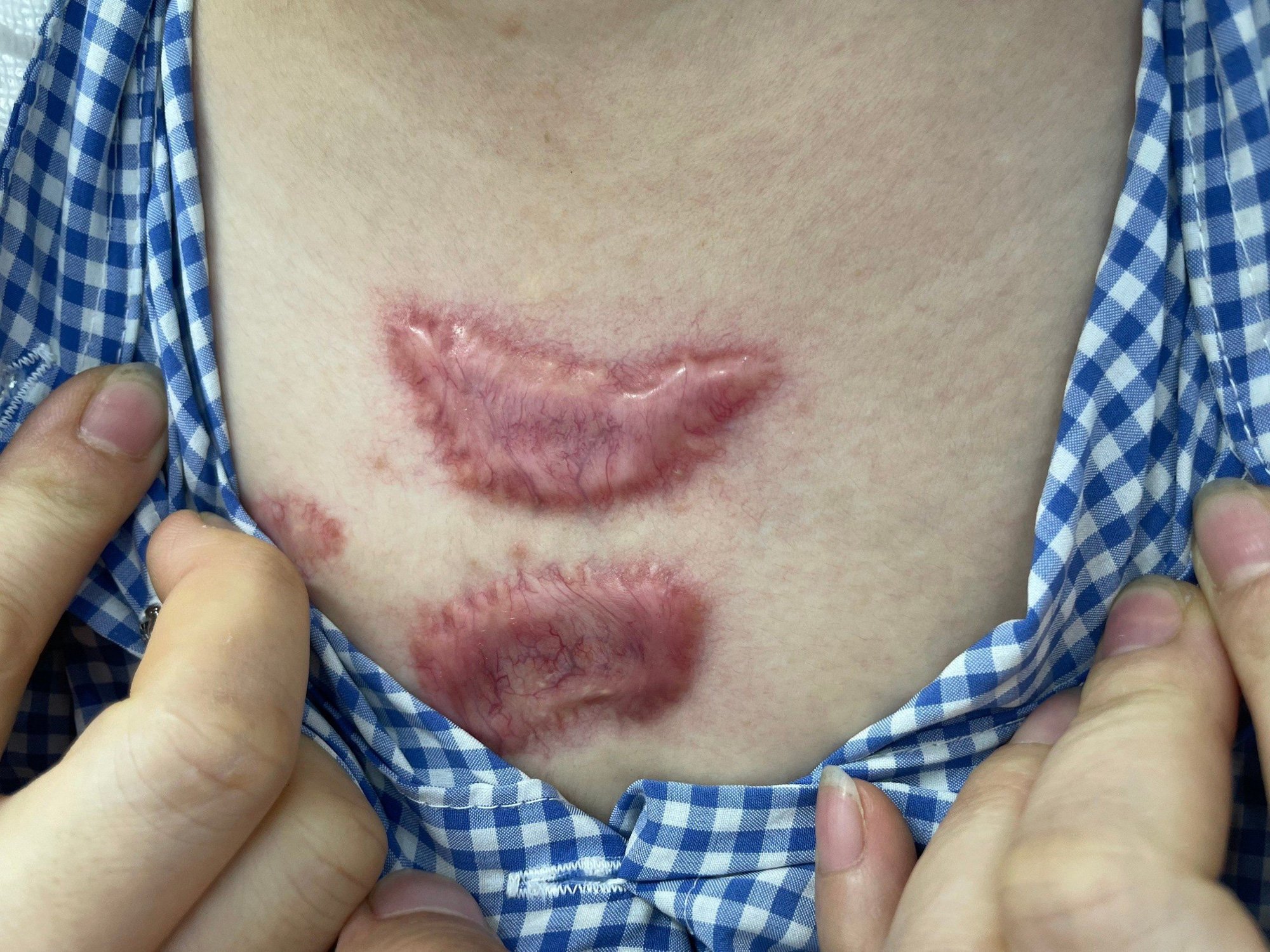
Ms. A. came for a check-up with spreading, painful, and itchy scars after undergoing scar treatment at a spa - Photo: Provided by the doctor.
The scar is 2-3 times larger than the original size.
Ms. A shared that she previously had acne on her chest that left keloid scars. She went to a spa near her home and was advised on a one-time treatment technique. The spa staff told Ms. A that this was a "super-fast" and painless treatment technique.
Hoping for a cure, Ms. A paid 30 million VND, including medication costs, for the treatment. After the treatment, she learned that the staff had injected local anesthesia to cut the scar. She was very worried because her doctor had advised her against any surgical procedures on the scar, as she had a tendency to develop keloid scars.
After the scar removal procedure, the staff advised her to come in for daily infusions to reduce pain and promote healing, and to continue paying for these daily infusions.
Ten days after the stitches were removed, the scar started to itch and become raised. She continued to monitor it for two months, and the scar was 2-3 times larger than before, itchy, and painful… When she returned, the spa had closed.
After directly examining Ms. A., Dr. Nguyen Tien Thanh, a member of the Vietnam Dermatology Association, stated that she had a raised scar measuring 6 x 8 cm on her chest, with old and new scars overlapping each other in a complex manner.
After the examination, Dr. Thanh determined that Ms. A. had keloid scars that tended to spread further.
According to Doctor Thanh, keloid scars can appear anywhere but are most common on the chest, shoulders, upper back, in front of the sternum, ears, etc. The scars usually grow rapidly and widely beyond the original lesion, often do not regress, are difficult to treat, and have a high recurrence rate.
Additionally, keloid scars can be pink, brown, or red, soft or firm in consistency, and some may contract, causing pain and limiting movement.
There is no one-time scar removal method.
Dr. Thanh explained that each type of scar requires a specific treatment. Specifically, keloid scars are the result of excessive tissue proliferation in response to skin damage, characterized by localized fibroblast proliferation and excessive collagen production.
Keloid scars are fibrous growths that extend beyond the original lesion into the surrounding normal skin; these scars do not regress spontaneously and often recur after treatment.
"Keloid scars often appear after skin injuries such as acne, local infections, burns, surgery, and trauma."
Due to their tendency to spread to the surrounding healthy skin, keloid scars severely impact patients' quality of life.
"Treatment methods for keloid scars are quite diverse, depending on the type and condition of the scar. Doctors will use different treatment methods. However, to date, there is no method that can completely cure keloid scars in a single treatment," Dr. Thanh emphasized.
In Ms. A.'s case, Dr. Thanh prescribed a combination of treatments. Currently, after about 4-5 treatment sessions, Ms. A. no longer experiences pain or itching at the scar site, and the scar has reduced in size by over 50%.
For individuals prone to keloid scarring or those with a family history of keloid scarring, Dr. Thanh advises caution in daily skin and wound care.
These people should avoid ear piercings, body piercings, tattoos, and cosmetic procedures (if they want surgery, they should contact a dermatologist to have their skin checked beforehand to avoid the risk of keloid scarring).
Take immediate care of all wounds (even small ones) to help the skin heal quickly and reduce the risk of scarring. Avoid scratching or rubbing the affected area.
If you have keloid scars or unsightly scars, you should consult a specialist directly and avoid treatment at unreliable facilities to prevent wasting money and suffering further harm.
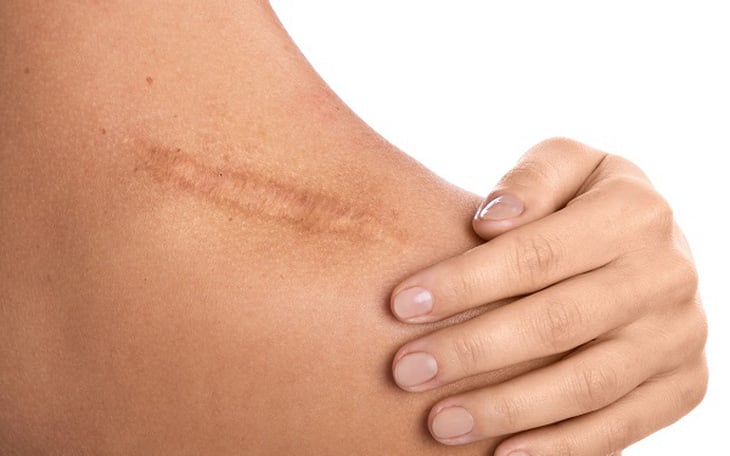 New scar treatment method: Hair follicle transplantation
Source: https://tuoitre.vn/chi-30-trieu-tri-seo-sieu-toc-nhan-lai-seo-loi-nhu-dia-trau-20240625162412543.htm


![[Photo] Prime Minister Pham Minh Chinh holds a phone call with the CEO of Russia's Rosatom Corporation.](/_next/image?url=https%3A%2F%2Fvphoto.vietnam.vn%2Fthumb%2F1200x675%2Fvietnam%2Fresource%2FIMAGE%2F2025%2F12%2F11%2F1765464552365_dsc-5295-jpg.webp&w=3840&q=75)














































































Comment (0)