

In the software export sector,FPT took 24 years to achieve $1 billion in revenue from the international market. Mr. Binh is pushing for FPT to reach $5 billion in international revenue by 2030. Tuoi Tre Spring had a conversation with Mr. Truong Gia Binh.

* The Fourth Industrial Revolution is astonishing humanity with the remarkable advancements in fields such as AI and semiconductors… How do you assess the opportunities for Vietnam in the current context?
- The recent COVID-19 pandemic simultaneously witnessed a global chip crisis. Consequently, the Semiconductor Association established the Chips and Science Act to seek allies within the industry in case of geopolitical crises.
They selected Vietnam as one of the participating countries for production. India was chosen for the design. Vietnam could participate fully, from design and production to packaging.
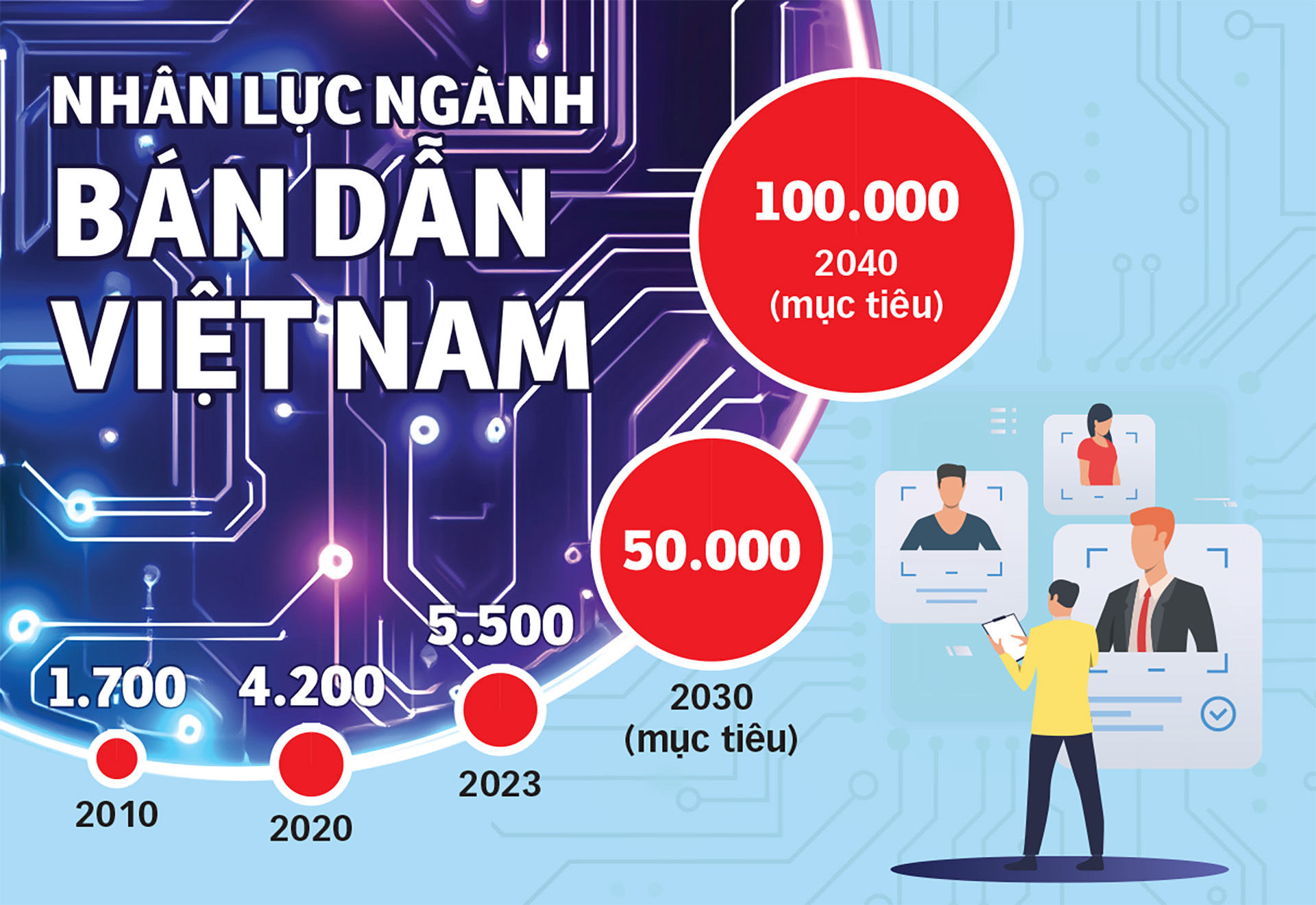
Source: Vietnam Microchip Community, Vietnam Semiconductor Industry Development Strategy to 2030 and Vision 2050.
* In your opinion, what are the key factors that make Vietnam a potential choice as a semiconductor industry "ally"?
- The number one factor is geopolitics. The question will be: Does Vietnam have friendly relations with all countries in the world , and will these friendly relations be sustainable in the long term?
The second factor answers the question: where is the electronics manufacturing hub located? In the current new geopolitical context, Vietnam is situated within the electronics industry ecosystem.
For example, we can package and test finished chips, or Vietnam accounts for nearly half of the world's mobile phone assembly production...
The third factor is that Vietnam now has a relatively strong presence of semiconductor companies from around the world.
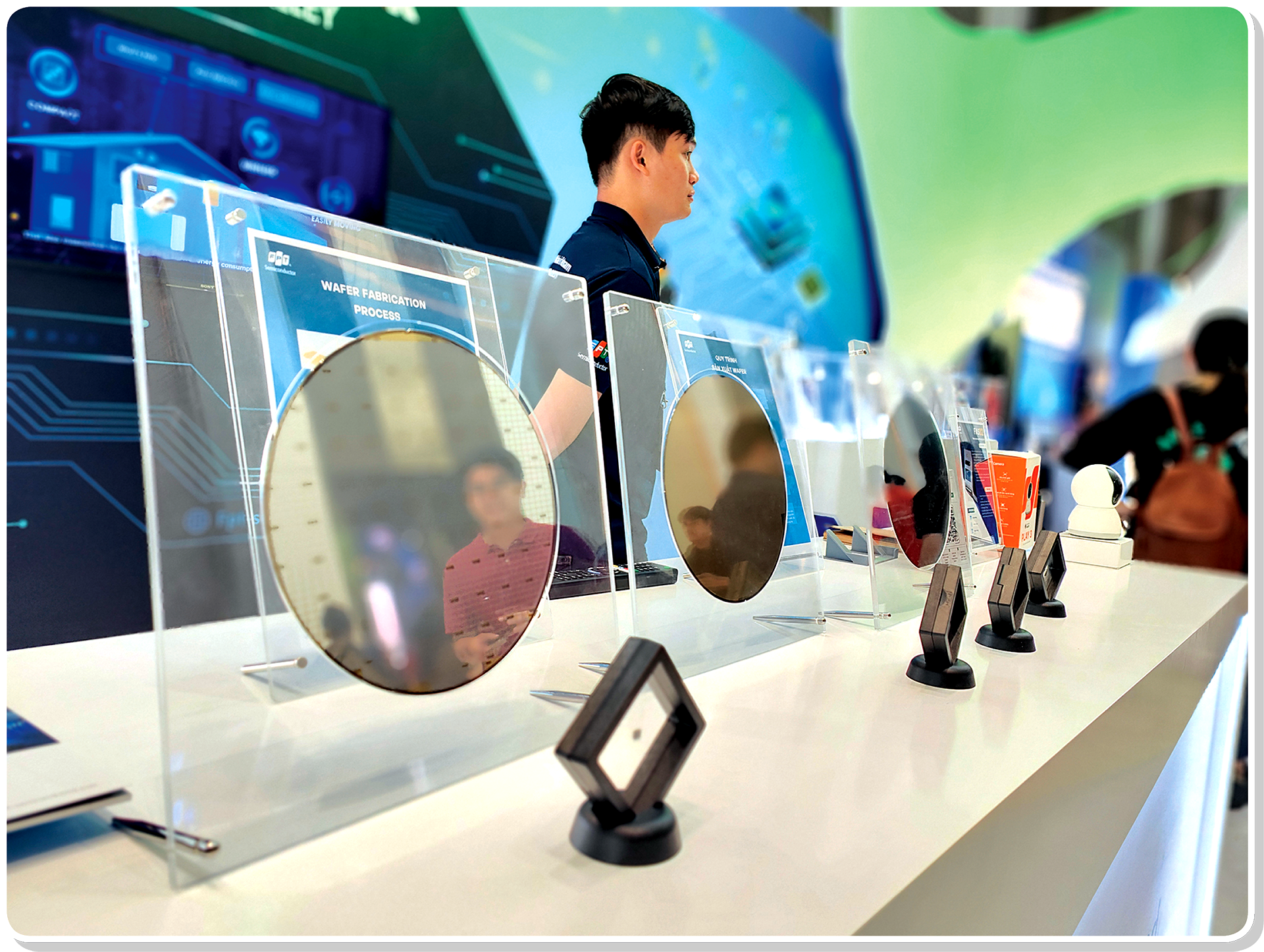
A Vietnamese company's chip products are on display - Photo: D. THIEN
The fourth factor is a plentiful supply of human resources to enter the industry. Currently, South Korea and Taiwan are building many new semiconductor factories with cutting-edge technology to maintain technological secrecy, but they lack a large workforce.
When talking about labor, we must also talk about training, research and development… Vietnam has great potential in this area.
It can be said that Vietnam's strength and influence in the field of foreign economic diplomacy now lies in its people, not in land and cheap labor. Vietnam's future position in the world depends on its high-quality human resources.
Another crucial factor is the government's commitment to attracting investment to develop the semiconductor industry.
No other country has made such strong commitments as Vietnam. Prime Minister Pham Minh Chinh signed a decision establishing the National Steering Committee for Semiconductor Industry Development to promote the development of the semiconductor industry in Vietnam.

* While the advantages are there, the challenge of securing high-quality human resources, especially in the semiconductor industry, remains significant.
Currently, we have 5,000 people working in the semiconductor industry. This is a very valuable workforce, but it's too small a workforce.
Speaking of training, we are lacking everything from instructors to laboratories – like miniature factories, which play a crucial role in training personnel to produce and test simple chips.
To develop education and training, we must cooperate internationally. For example, in the current semiconductor workforce training, students only study part of their curriculum domestically, then go to Taiwan, South Korea, or Japan for their final year of practical training before working in factories there.
We have met with many universities and factories in South Korea, Japan, Taiwan, etc., and during the cooperation exchange, there were quite a few commitments with FPT that the newly built factories would be operated by Vietnamese people with personnel provided by FPT.
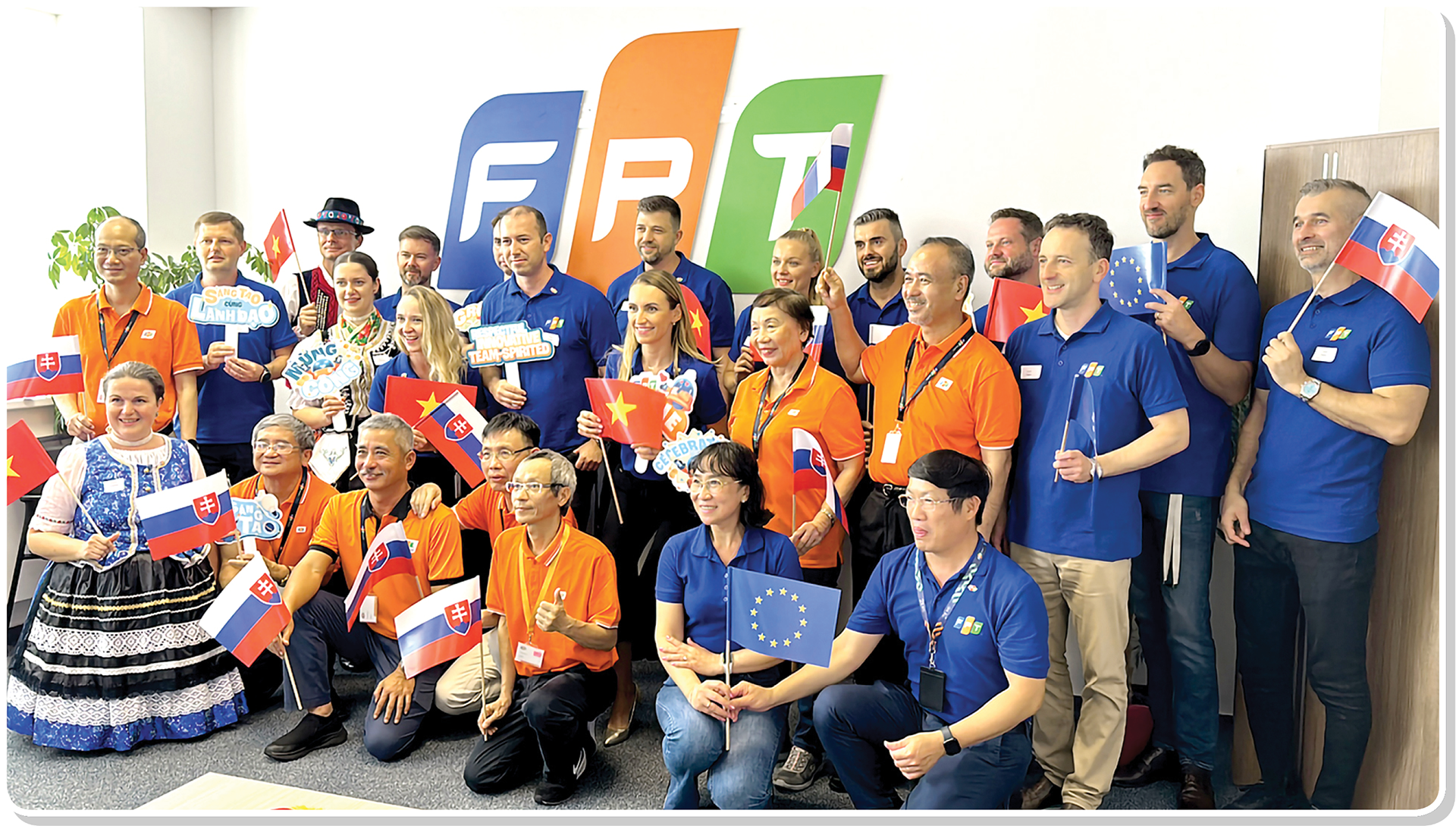
FPT leaders and staff at the FPT office in Slovakia - Photo: PT
* We still have a lot of work to do, but what makes you believe that Vietnam has the opportunity to develop its semiconductor industry?
- If we look back at history, all of humanity's progress, even in wars, has been backed by technological development.
In the three previous scientific and technological revolutions, Vietnamese people did not have an advantage, but the current technology sector presents a great opportunity for us and other Asian countries, which I often refer to as "the countries that use chopsticks".
Looking back at the history of the semiconductor industry, the Americans started it, but the subsequent "heroes" came from Asia. Specifically, the workforce currently employed in the semiconductor industry all have cultural origins in countries like Japan, South Korea, Taiwan, China, and Vietnam, where people traditionally use chopsticks.
Vietnam is ranked number 1 by the American Semiconductor Association, not by its own designation. Vietnam's biggest advantage lies in its human resources. The semiconductor industry is both a science and a industry.
In partnership with the brand: Mr. Truong Gia Binh and his belief in Vietnam's opportunities in the new era.
Industry requires manpower, and in Vietnam, this means graduates, masters, and doctoral degree holders... often from disadvantaged regions with a burning desire for change. When people want to accomplish something extraordinary, they can work tirelessly day and night.
These qualities are abundant in Vietnamese people, but are difficult to find in many other countries in such large numbers.

* Recently, several leaders of technology corporations visited Vietnam and then finalized investments in other countries. Are our current investment attraction policies attractive enough?
- That's a big deal. Look at countries like Singapore, Japan, South Korea, China… not to mention semiconductors or AI, businesses investing in high-tech are subsidized 50% of the costs.
For example, if we hire an employee with a salary of $100,000 per year, they will pay $50,000 to the investor.
Of course, we still have ways to do it if all parties are truly determined. For example, FPT has many ways to attract talent and investment, and in fact, we have invited many leading technology figures to Vietnam to learn about and collaborate with us.
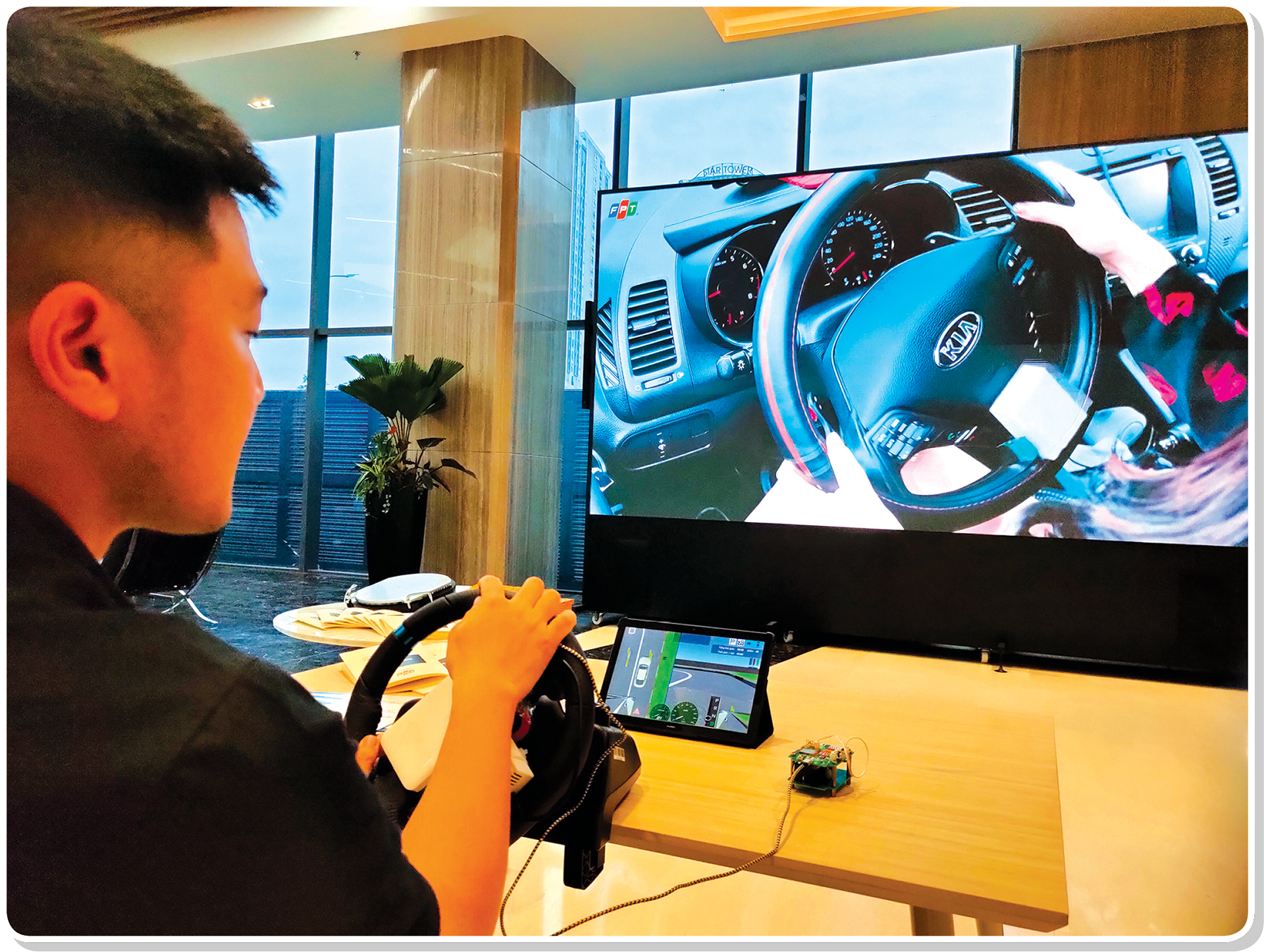
Experiencing FPT's digital automotive technology - Photo: D.T.
* Over the past two years, FPT has achieved impressive growth figures, including the milestone of $1 billion in revenue from software exports. What were your feelings at that moment?
- Before talking about the $1 billion figure, I'd like to share that the biggest feeling was reaching our first $1 million. For us at that moment, the dream of Vietnamese intelligence expanding its territory and making its mark on the world map was gradually becoming a reality.
I once told a world-renowned computer manufacturer: "I'm serious! If you buy $1 worth of software from me, I'll buy you $1,000 worth of machinery." That exchange rate of $1 for $1,000 at the time showed just how ambitious I was.
There were times when I was so thrilled to walk out of the Net (Japan) office thinking they would place an order, but in the end they didn't… so the feeling of reaching $1 million in revenue was immense!

Reaching the $1 billion mark wasn't particularly surprising, as we had planned it beforehand.
But I was surprised to hear the man dubbed the "father" of India's information technology (IT) industry, billionaire Narayana Murthy - founder of Infosys, currently one of India's leading technology companies - comment that, having gone global from providing IT services, India and Vietnam have a leading position on the world's IT services map. That's great because Vietnam is highly regarded.
* Returning to FPT, how long do you think it will take for the $1 billion software export figure to double?
- FPT took 24 years to achieve $1 billion in revenue from the international market. FPT's typical growth rate in recent years has been 20%.
However, during his visit to FPT in Vietnam, billionaire Narayana Murthy said that his Infosys company (founded in 1981) took 23 years to reach its first billion dollars in revenue, 23 months later its second billion dollars, and 11 months after that its third billion dollars.
Narayana Murthy predicted that it would take FPT 24 years to reach the billion-dollar revenue milestone, but it would only take another 24 months to reach the next $2 billion, and then approximately 3 billion after another 12 months.
The $1 billion milestone is like a tipping point, a breaking point from which revenue can rapidly increase.
Because when your company reaches $1 billion in software service revenue, people no longer ask about your position; at that point, they usually believe whatever you say and are willing to cooperate. FPT is doing this and has experienced it firsthand.
* Achieving $1 billion in export revenue is extremely difficult for a business, and even more so for the software industry. What lessons can be learned from this success at FPT? What is the role of the leader, and how does he inspire his team at FPT?
- When aiming to "expand Vietnam's intellectual horizons," FPT recognizes that its internal strength is still very weak while its competitors are very strong. Our ancestors, from ancient times, used the weak to defeat the strong, the few to defeat the many. So what is the essential lesson here? We have read and researched extensively on people's war, including meeting with military leaders...
And I believe that to inspire, a leader must lead the way. The true character of a leader is not demonstrated through words, but through actions—going into battle, being at the forefront, and igniting their own passion. That is the example for their comrades to follow.
In 2011, when the earthquake and tsunami struck Japan, the Japanese market was our greatest hope. But most foreigners flew out of Japan to return to their home countries.
Three days after it happened, I was in Japan. I was probably the only foreigner flying back to Japan.
Earlier, the secretaries warned that the radiation levels had increased more than 200 times, and going would be fatal. I replied, "You still have to go." To visit my team, my partners, and find ways to overcome the difficulties together.
The way to inspire here is to instill a sense of purpose: why should we do this? I have to do this because I want to contribute more, for the business to grow, and for the country to escape poverty and progress…
A company asked me how they managed to sell software to foreign companies. I told them: the head of the organization has to "go out into the streets" and sell the product.
Why? Because when we first started, Vietnam was not on the world software map, so customers were hesitant to cooperate, even though we had personnel who had previously worked for American companies.
We only made one small mistake and lost our jobs. In that context, only the head of the partner company could decide whether to cooperate with the Vietnamese company.
Selling is very difficult because the heads of large foreign corporations usually don't have the time. I only have the opportunity to meet them and have to convince them in a single visit.
Thorough preparation and understanding customer needs are crucial. Many leaders in successful companies no longer engage in sales, but at FPT, everyone has to do it; every leader has to sell. It's a responsibility to the organization.
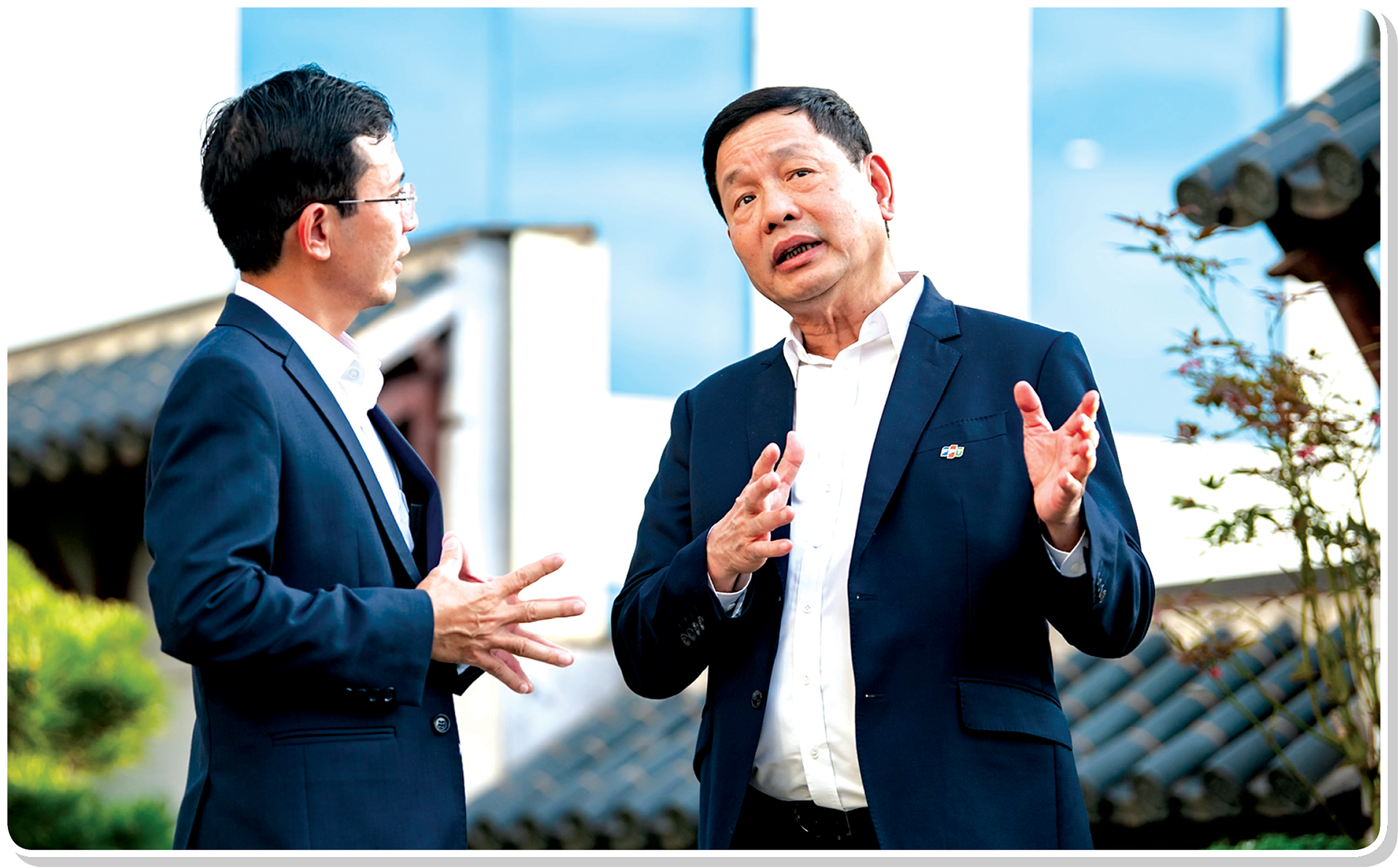
Mr. Truong Gia Binh - Chairman of FPT and Mr. Tran Xuan Toan - Deputy Editor-in-Chief of Tuoi Tre Newspaper - in the Japanese garden on the FPT headquarters tower. Photo: N.TRAN

What has kept you burning with entrepreneurial spirit for so many years?
- Who would have thought that the Intel chip manufacturing "empire" could face such difficulties today? Other famous names like Kodak and Nokia are now gone…
Conversely, Microsoft once achieved the grand dream of having its computer on every desk, but now it leads in cloud computing and AI. Therefore, it can be said that whether a company disappears or not depends on its entrepreneurial spirit.
Any successful company must constantly innovate. That is, you might be successful in one field, but the waves rise and then fall. At that point, you have to push another wave up, surpassing the previous peak. And then it falls, and you continue pushing another wave…
At FPT, countless startup projects are submitted every week. We're constantly discussing how to do this and that new thing.
Technology and markets are changing rapidly, and we also have to constantly start new ventures. I sincerely hope that Vietnamese businesses will continuously maintain their entrepreneurial spirit without ceasing.

Employees of diverse skin colors at FPT's workplace in Hanoi - Photo: PT
* How have you prepared the succession leadership team at FPT?
- FPT has been planning a generational transition for 18 years. The first generation (founding board) of FPT has mostly retired. The second generation consists of those born in the 70s and 80s who are currently in leadership positions.
They commanded units of several thousand people as usual, while the previous generation, led by a single commander, commanded only a few hundred. In terms of workload, we were smaller than them.
Personally, when I feel like it, I can leave a task open without asking about it, and the team will still do a good job. In other words, the younger generation has been and is currently running the FPT system.
So, is it perfect yet? The answer is, there's no such thing as perfection in life, only progress. What more do you want? Most importantly, I want a strategic mindset in young people. They need to see the forest, not just the trees.

Performed by: Xuan Toan - Duc Thien
































































Comment (0)