

After years of uneven growth, the foldable phone market is believed to be poised for a real surge in development.
Counterpoint Research expects shipments of foldable display panels to surge 46% by 2026, the time Apple begins ordering components for its first foldable iPhone.
In addition, IDC also noted a significant increase in shipments. Both analytics firms believe that the trajectory of the foldable phone segment now depends on Apple's launch of the foldable iPhone.
Reshaping market expectations
Foldable screens are a groundbreaking idea, but they have long been criticized for an inherent drawback: a noticeable crease at the hinge. Even with products like Samsung's Galaxy Z Fold, despite years of technological advancements, the crease remains an unresolved issue.
This not only affects aesthetics but also diminishes the user experience, especially when watching content or playing games on a large screen.
Apple, as a latecomer to this market, is expected to break through barriers. Counterpoint argues that the time is ripe, because Apple's acquisition cycle alone has the potential to restructure the foldable smartphone market.
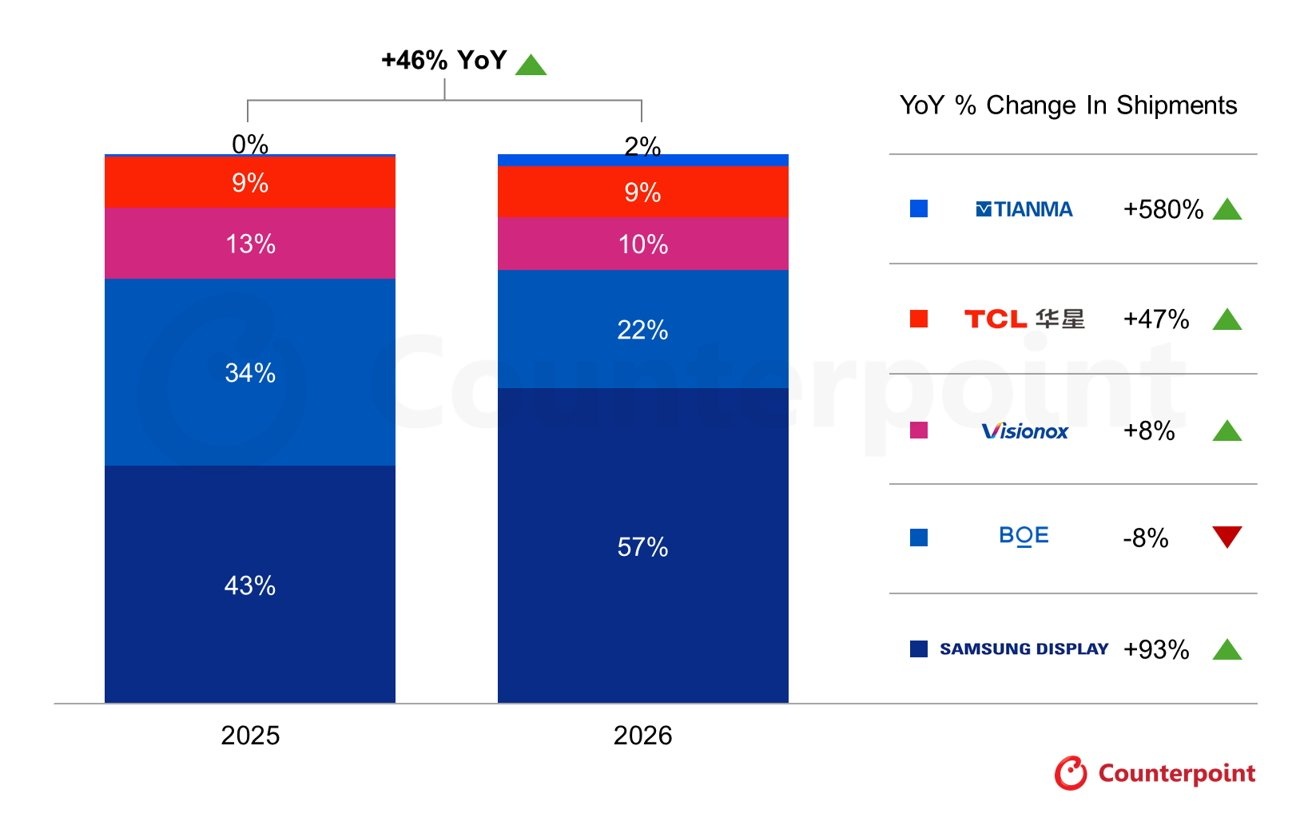 |
Forecast of foldable smartphone display panel shipments by supplier. Image: Counterpoint. |
According to sources, Apple has set stringent technical requirements for its partner Samsung to completely resolve the issue of the screen crease. “Apple is determined to completely eliminate the crease, regardless of cost, in order to differentiate itself from existing foldable phone models,” an internal supply chain source revealed to ET News .
This is a costly endeavor, but it could give Apple a significant competitive advantage when the product launches in 2026.
According to BGR , Samsung will be the sole supplier of this nearly crease-free display for the future foldable iPhone. Apple has been working with Samsung on foldable display development since last year. Only Samsung Display has been supplying screens that meet Apple's requirements.
Additionally, the design of the foldable iPhone also reveals some interesting details. Apple will use Corning tempered glass for the outer screen, while the inner foldable screen will feature ultra-thin glass (UTG), similar to that on Samsung's Galaxy Z Fold.
A crease-free display will be an advantage for foldable iPhones over their competitors by 2026, provided Samsung and other manufacturers don't manage to release a similar solution in time.
The big challenge
Even with the momentum from the foldable iPhone, this segment still faces familiar problems. Buyers remain wary of fragile hinges, visible creases, and battery trade-offs.
Furthermore, developers have been inconsistent in optimizing applications for large and diverse layouts, diminishing the appeal of extended screens. The Android operating system also suffers from device support issues and feature fragmentation.
The iPhone manufacturer's tight control over both hardware and software could help address some issues by making the transition from phone to tablet mode smoother.
Furthermore, a key differentiating factor of Apple products lies in the hinge mechanism, allowing the device to open into a single large screen instead of being made up of two panels. Thinness is a factor that Apple particularly emphasizes.
Reports indicate that when unfolded, the iPhone Fold will be as thin as the iPhone Air, while when folded, the device will be at least twice as thick. This is a technical challenge but aligns with Apple's direction of optimizing hardware weight.
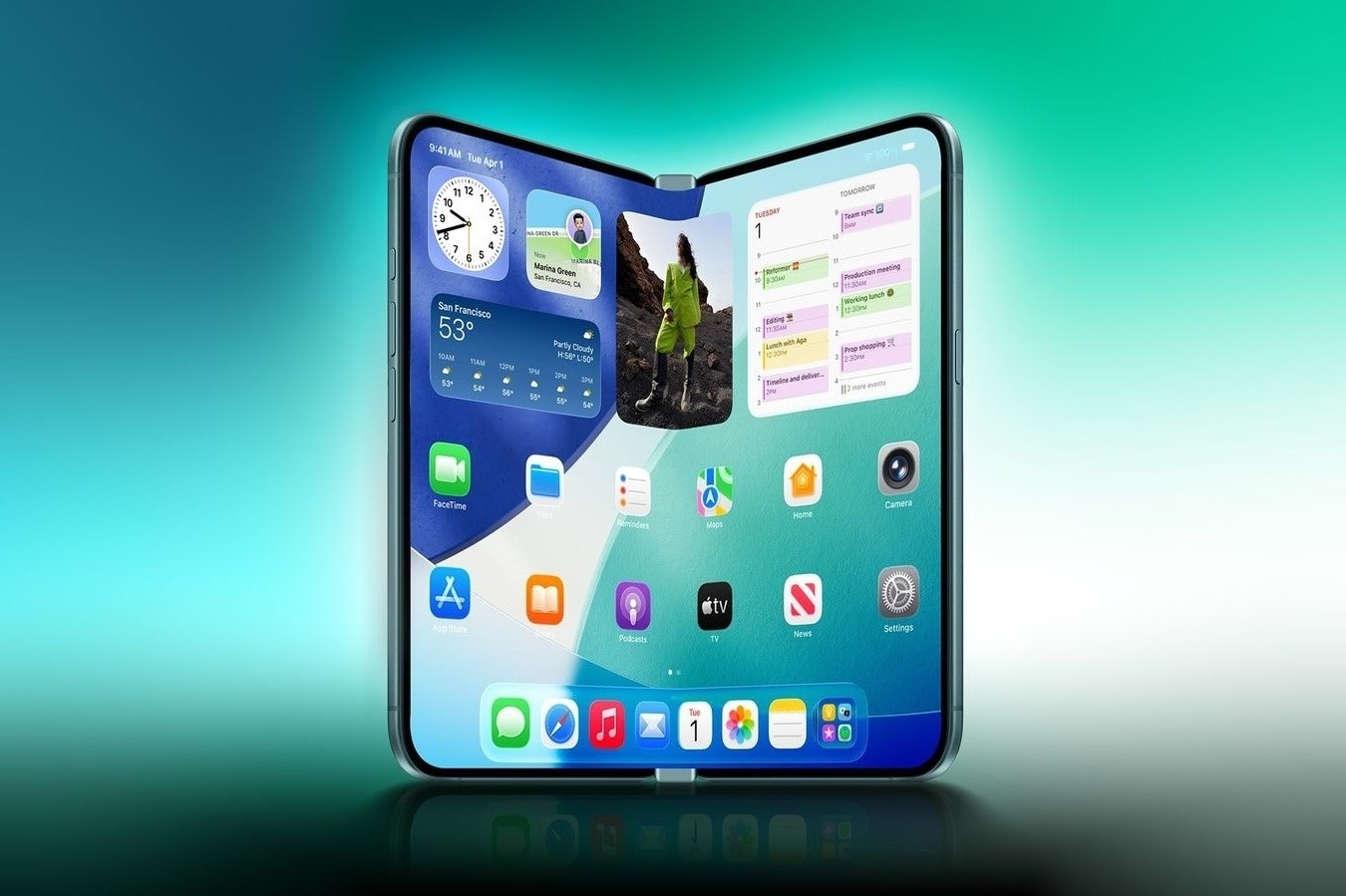 |
Rendered images of a foldable iPhone are based on rumors. Image: MacRumors. |
Some rumors even suggest that the iPhone Fold could reach a thickness of just 4.8 mm, or even 4.5 mm according to analyst Ming-Chi Kuo's predictions.
Carriers and retailers will also have a clearer story to tell, and this could reach shoppers who have ignored foldable phones until now.
However, Apple can't fix everything at once. Foldable phones are still an expensive product and it could take years to reach the mass market.
Next-generation products like foldable iPhones will need to prove that larger screens and new forms justify the premium price tag, rather than just being a novelty for consumers.
Analysts believe that 2026 is poised for significant growth in the foldable phone segment. A successful foldable iPhone could help the product break out of its niche market next year.
However, one wrong move could signal that foldable smartphones need more than just a crease-free display to attract users.
Source: https://znews.vn/chua-ra-mat-iphone-gap-da-ganh-hi-vong-cua-toan-nganh-post1610605.html




































































Comment (0)