

According to the Tet holiday train schedule announced by the Ho Chi Minh City Metro Line 1 Company Limited (HURC1 - the metro operator), on the 1st, 2nd, and 3rd days of Tet, the metro will operate 156 trips per day, spaced 12-15-18 minutes apart. This announcement was made based on the expectation that the number of passengers would decrease as many people had returned to their provinces and cities for the Tet holiday. However, right before New Year's Eve, the trains were continuously overloaded.
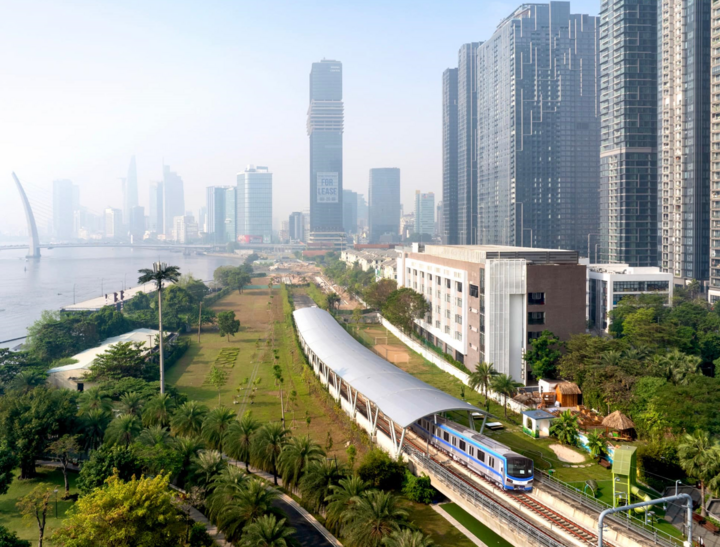 Metro Line 1 began operating just days before the Lunar New Year of the Year of the Snake, alleviating the public transportation shortage in Ho Chi Minh City. (Photo: HURC)
On the first day of Tet (Lunar New Year), many people from neighboring provinces such as Tay Ninh, Binh Duong, Dong Nai, and Long An travel to Ho Chi Minh City to celebrate Tet and experience the train ride to Nguyen Hue flower street.
Many families patiently waited for nearly an hour to board the train. Therefore, from the evening of the first day of Tet (Lunar New Year), HURC1 increased the number of trips and reduced the interval to just 9 minutes per trip. From the third day of Tet, starting from 9:40 AM to 10:00 PM, there will be a train every 10 minutes.
The Lunar New Year of 2025 (Year of the Snake) will be the first time that people from Ho Chi Minh City and surrounding provinces can conveniently visit Nguyen Hue Flower Street, Le Loi Book Street, and other destinations such as the Independence Palace, Notre Dame Cathedral, the City Post Office , Ben Thanh Market, the City Theatre, Van Thanh Tourist Area, Landmark 81, Suoi Tien Tourist Area, etc., by metro train, without worrying about traffic jams or struggling to find parking.
Previously, when the train started selling tickets after a month of free travel for the public, many people thought it would be deserted, as the initial crowds were due to people taking advantage of the free ride.
However, even after fares were introduced, the number of train passengers did not decrease but continued to increase, with people choosing Metro Line 1 as their daily mode of transportation. This confirms that Metro Line 1 has solved the public transportation shortage for Ho Chi Minh City, a city with over 10 million inhabitants.
Metro Line 1, nearly 20km long, starting from Ben Thanh Market and ending at the new Eastern Bus Station, runs from the city center through Binh Thanh and along the length of Thu Duc City. It is Ho Chi Minh City's first urban railway line, scheduled to begin operation in the final days of 2024 after more than a decade of waiting and hope by the city's residents.
The first urban railway line not only carries the responsibility of reducing traffic congestion at the eastern gateway, but also embodies the aspiration to transform the face of transportation, serving as a foundation and lesson for Ho Chi Minh City to complete 7 urban railway lines with a total length of 355km by 2035.
According to HURC1, Metro Line 1 has received a great deal of positive feedback and interest from residents and tourists. Every day, hundreds of thousands of passengers use it, not only for the experience but also because many have switched to using the metro combined with buses as their daily means of commuting to school and work.
After more than a month of official operation, Metro Line 1 has transported 1.76 million passengers (as of January 6th). The average daily passenger volume is 109,915 passengers/day, 2.8 times higher than the forecast.
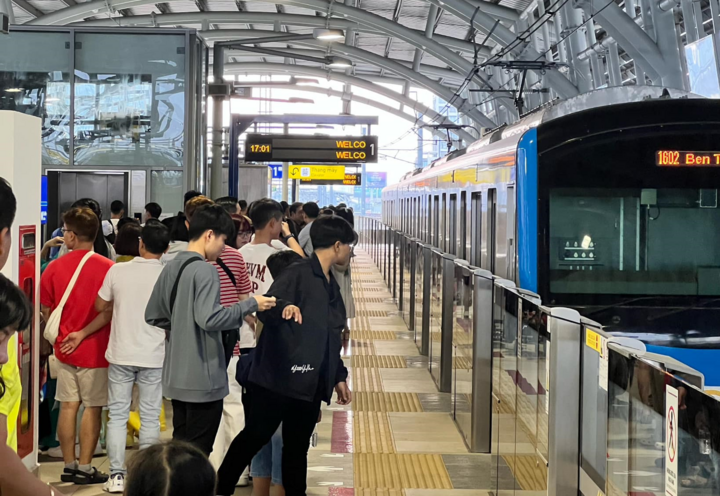 Train stations are always crowded with passengers waiting for trains. (Photo: N. Son)
Mr. Le Minh Triet, Director of HURC1, said that the demand for metro services is increasing sharply, especially during peak hours from 4 PM to 10 PM, which account for about 35% of the daily passenger volume, showing that the metro has gradually become an important means of transportation in Ho Chi Minh City.
According to the Chairman of the Ho Chi Minh City People's Committee, Phan Van Mai, the commissioning and commercial operation of Metro Line 1 Ben Thanh - Suoi Tien is a significant milestone, marking a turning point in the transportation development of Ho Chi Minh City.
He expressed optimism about the future of Ho Chi Minh City's urban railway network, especially with the urban railway development plan approved by the Politburo . This plan aims to develop an additional 355 km of urban railway in Ho Chi Minh City by 2035.
Speaking to the press during the Lunar New Year of the Year of the Snake, Chairman Phan Van Mai said that Ho Chi Minh City and Hanoi are coordinating with the Ministry of Transport to prepare documents for the urban railway project.
The proposal is expected to be submitted to the National Assembly in the middle of this year, to issue a resolution on mechanisms and policies for developing new, superior urban railways, from preparation to bidding mechanisms, to shorten project preparation time to 3-5 years, construction time also around 3-5 years; urban development according to the TOD (Transit-Oriented Development) model; attracting strategic investors, diversifying investment resources...
Following the National Assembly's resolution, Ho Chi Minh City plans to begin construction on Metro Line 2 first and pilot new mechanisms and policies. The remaining lines will be prepared for implementation in groups, for example, a package of 3-5 lines, instead of one line at a time. Ho Chi Minh City remains committed to its goal of completing 355 km of urban railway by 2035.
How can Ho Chi Minh City complete 355 km of urban railway by 2035?
In the Ho Chi Minh City People's Committee's submission on the metro development plan, based on the Politburo's Conclusion No. 49 on the orientation for the development of Vietnam's railway transport system until 2030, with a vision to 2045, Ho Chi Minh City proposes investing in and completing 7 metro lines totaling approximately 355 km by 2035, with an investment of over 40.21 billion USD. By 2045, the city will complete an additional 155 km, bringing the total length to approximately 510 km.
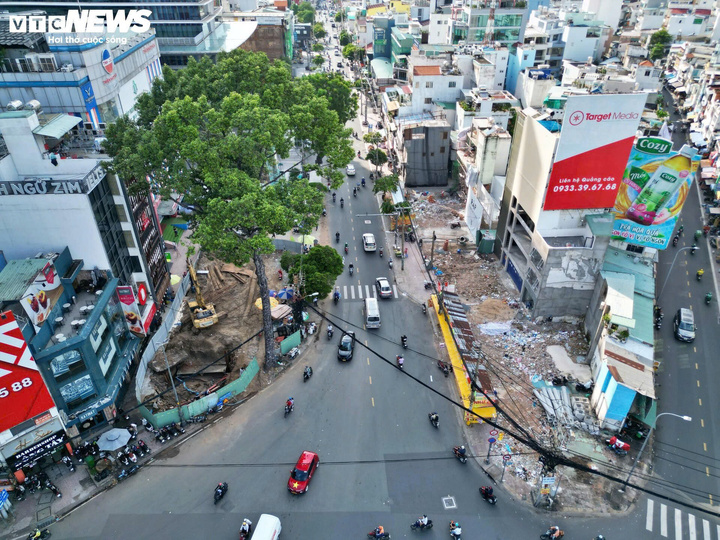 Following Metro Line 1, Metro Line 2, which is over 11 km long, is accelerating construction. (Photo: Luong Y)
Experts believe that to achieve the goal of completing hundreds of kilometers of metro lines in the next 10 years, Ho Chi Minh City needs to establish a standardized process, from developing transportation infrastructure, integrating the TOD (Transit-Oriented Development) model, mobilizing financial resources, organizing connecting traffic, to building commercial services around the stations.
In an interview with VTC News, architect Ngo Viet Nam Son stated that the success of Line 1 will provide the city with valuable experience to replicate in other urban railway lines, starting with investing in and completing seven metro lines totaling approximately 355 km by 2035.
He said, "Don't look at the first 20km line, which took over 10 years to build, and then you'll see that constructing 355km of metro in the next 10 years is difficult, challenging, but actually feasible. There are precedents in the world. Look at developing countries with urban rail networks, especially China; Shenzhen has built dozens of metro lines in 5-6 years, and Shanghai has also built dozens of metro lines in a decade."
Therefore, it's clear that Ho Chi Minh City can also do it. The important thing is that to realize such an ambitious plan, the city needs preparation, innovative thinking, and a completely different approach to planning, management, and implementation compared to Metro Line 1.
According to Mr. Son, Ho Chi Minh City should not hesitate to spend 2-3 years preparing thoroughly and systematically, researching solutions with a new and groundbreaking mindset. Anything that is incomplete or unclear should be supplemented immediately. From legal frameworks, mechanisms, policies, and investment capital, scenarios must be readily available. This is a very large market economy problem, so if there is a lack of experience, experts can be hired for more effective support.
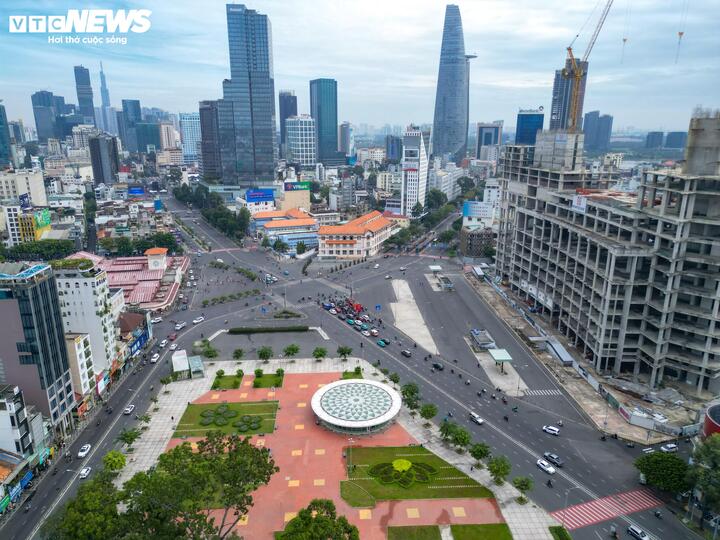 Connecting the underground space of Metro Line 1 with buildings in the city center is a suggestion from experts for Ho Chi Minh City to develop its urban rail network. (Photo: Luong Y)
And most importantly, compensation and land clearance are the reasons why the project is delayed. Many projects have compensation and land clearance phases that take decades; now there should be a solution to complete them within one year.
"In our plan to build dozens of metro lines in the next 10 years, the first thing we must learn from the experience of Metro Line 1 is why it took so long. Let's consider whether, under ideal conditions, a metropolitan railway line like Metro Line 1 could be completed in just 4-5 years."
"I often joke that it took me 15 years to chop down the first ancient tree, but if I want to chop down the other 10 trees in a shorter time and more efficiently, I need a sharper axe. Therefore, dedicating a few years to preparing well for the big journey ahead is essential," Mr. Son said.
Once all the necessary conditions are met, consider launching multiple lines simultaneously. If each line is built to ideal conditions, the city will have its desired urban rail system within the set timeframe. Of course, the reality is much more complex when implementation begins, but set requirements for improvement and prepare for the best possible deployment.
Ho Chi Minh City is currently proposing to the Government the establishment of an infrastructure investment corporation with a capital scale of tens of billions of USD. This corporation will involve the participation of the State and private investors, but the State will play the leading role.
This model has been implemented extensively and successfully in many countries, so if adopted, it would serve as a central hub for tasks such as compensation and resettlement based on market mechanisms, mobilizing investment capital, standardizing the technical specifications of the lines, and investing in TOD (Transit-Oriented Development) infrastructure to attract investment; it could also include the production of locomotives and carriages, and the repair and maintenance of the entire city's metro system...
Dr. Phan Huu Duy Quoc, a member of the senior advisory group on urban railway development in Ho Chi Minh City and an expert involved in the construction of Metro Line 1, believes that according to the plan, the development of the city's metro system in the coming years will involve a massive amount of work.
Ho Chi Minh City needs a long-term strategy that goes beyond simply building individual metro lines, developing a modern and integrated transportation network. Successful implementation requires a different approach.
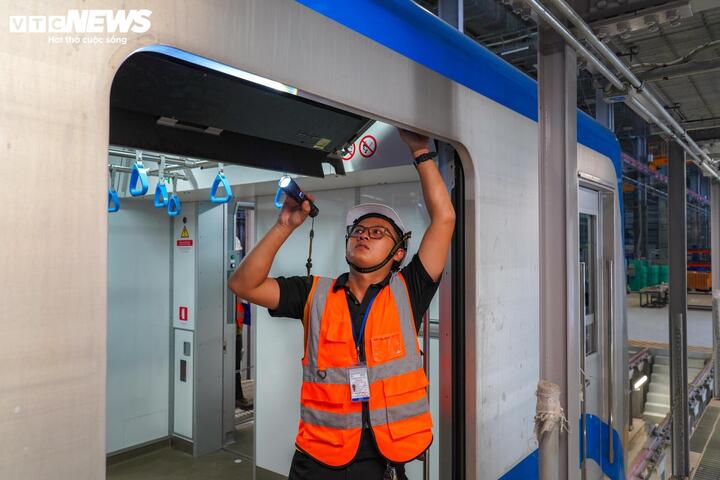 Self-reliance in technical standards and the development of domestic resources are sustainable ways for Ho Chi Minh City to build and operate hundreds of kilometers of urban railway. (Photo: Luong Y)
Mr. Quoc stated that the current metro system is still based on a transportation mindset and has not fully exploited the potential for urban development. Developing towards public transportation and utilizing the Transport for Development (TOD) around stations is necessary to increase efficiency and ensure sustainable development. To achieve this, the city needs to establish an integrated corporation to handle TOD planning, construction, and metro operation. This is an effective model in Japan, combining public-private partnerships to optimize resources.
The city also needs to empower the Ho Chi Minh City Urban Railway Management Board with greater autonomy and financial independence, reducing reliance on ODA funds and focusing on developing domestic technology. Lessons learned from the construction of Metro Line 1 will serve as an important basis for implementing subsequent lines more effectively, avoiding the delays and difficulties of the past.
"In the 10-year plan, to fundamentally complete the Metro system, a change in approach is required. Ho Chi Minh City must be given more decision-making power and autonomy, and the Urban Railway Management Board must also be given more autonomy. Instead of controlling every small detail of the implementation process, let's focus on the quality of the final product. If we continue to seek permission and control the process as we do now, we certainly cannot realize this ambitious plan," Mr. Quoc said.
Furthermore, this expert also suggested that the city should become self-sufficient in funding, reducing its dependence on ODA loans. Alongside this is self-reliance in technical standards and gradually developing domestic resources, from locomotives and carriages to technical systems. Only when all these factors are present can the ambition to complete the metro network within 10 years become a reality.
In the recently announced Ho Chi Minh City Master Plan for the period 2021-2030, with a vision to 2050, regarding the urban railway development plan, the city will develop 12 lines associated with the formation and development of urban areas following the TOD (Transit-Oriented Development) model, linking the Southeast region. The priority lines to be implemented in the 2021-2030 period include:
Route No. 1 (40.8km): Starting point in Binh Chanh District - Ending point in Thu Duc City
Route No. 2 (62.2km): Starting point in Thu Duc City - Ending point in Cu Chi District
Route 3 (45.8km): Starting point in Binh Chanh District - Ending point in Thu Duc City
Route No. 4 (47.3km): Starting point in Hoc Mon District - Ending point in Nha Be District
Route No. 5 (53.9km): Starting point in Binh Chanh District - Ending point in Thu Duc City
Route 6 (53.8km): Primarily passes through Thu Duc City, District 7, Binh Chanh, and inner city districts.
Route No. 7 (51.2km): Starting point in Binh Chanh District - Ending point in Thu Duc City.
HA LINH - Vtcnews.vn

![[Photo] Closing Ceremony of the 10th Session of the 15th National Assembly](/_next/image?url=https%3A%2F%2Fvphoto.vietnam.vn%2Fthumb%2F1200x675%2Fvietnam%2Fresource%2FIMAGE%2F2025%2F12%2F11%2F1765448959967_image-1437-jpg.webp&w=3840&q=75)


![[Photo] Prime Minister Pham Minh Chinh holds a phone call with the CEO of Russia's Rosatom Corporation.](/_next/image?url=https%3A%2F%2Fvphoto.vietnam.vn%2Fthumb%2F1200x675%2Fvietnam%2Fresource%2FIMAGE%2F2025%2F12%2F11%2F1765464552365_dsc-5295-jpg.webp&w=3840&q=75)




































![[OFFICIAL] MISA GROUP ANNOUNCES ITS PIONEERING BRAND POSITIONING IN BUILDING AGENTIC AI FOR BUSINESSES, HOUSEHOLDS, AND THE GOVERNMENT](https://vphoto.vietnam.vn/thumb/402x226/vietnam/resource/IMAGE/2025/12/11/1765444754256_agentic-ai_postfb-scaled.png)



































Comment (0)