

Traces of the ancient temple
The temple has a rather modest area, located on Quang Trung Street, Tan Thanh Ward, Ca Mau , with many different names, such as: Gia Long Temple, Quoc Cong Temple and Am Duong Than. Ms. Chau Kim Yen, who is in charge of burning incense and sweeping, said that in the past, the temple was located in the campus of Quang Trung Primary School next door. When the school was built, the temple was moved to its current location.
In front of the temple is a plaque with the inscription of the Yin Yang God. The tablet on the main altar also has the inscription of the Great Southern Yin Yang God. On both sides of the entrance door are parallel sentences written in Vietnamese: "Once upon a time, I worshiped the Vietnamese mountains and rivers/Forever famous in the Southern sky and land". Inside are the altars of the Left and Right Bans and the altar of the Ancestors, similar to the worship rituals in village communal houses.
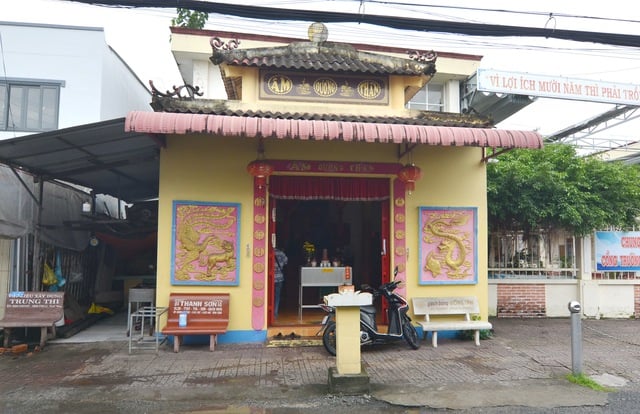
Temple of Yin and Yang Gods in Ca Mau
Author Nghe Van Luong in Ca Mau Xua An Xuyen now describes this temple in quite detail: "The small temple was formerly called Gia Long temple, also called Quoc Cong temple or Am Duong Than temple, with an area of about 80 square meters. The temple was established by King Gia Long's decree to worship meritorious mandarins. In the temple there is an old altar, painted red and gold, faded, on which are placed many tablets, incense burners and a large wooden box eaten by termites in many places. This box contains many white papers with Chinese characters, some of which are still there and some are missing. All we know is that it is a royal decree, recording many names and positions of entourage officials, who either died of illness or died while escorting. Among them is Nguyen Van Vang, the admiral who died in battle at Khoa Giang (Ong Doc river) and many other military officials".
The origin of the Yin Yang Temple is also recorded quite clearly in the documents. Dai Nam Nhat Thong Chi ( Luc Tinh Nam Viet , translated by Tu Trai Nguyen Tao) wrote: "The ancient temple of Ca Mau is located next to Long Xuyen district, formerly called Hoi Dong temple. In the temple there is a golden plaque, embroidered screen, red painted door, secret room, looks very bright and clean, worshiping the sacred gods of the three worlds. The National Dynasty recorded it in the dictionary".
Also according to Dai Nam Nhat Thong Chi , Hoi Dong Temple in Ca Mau was moved to Dong My Commune, Ha Chau District, Ha Tien Province in the 15th year of Minh Mang (1834). That year, the temple was still thatched. In the 3rd year of Tu Duc (1850), the temple was restored and roofed with tiles. Later, this temple became the communal house of Thanh Hoang Commune of My Duc (now Ha Tien Ward, An Giang ), while the temple in Ca Mau was called "ancient temple".
According to the Nguyen Dynasty regulations, Hoi Dong Temple worships "the Yin and Yang gods in the locality". The human and natural gods in that temple were granted the titles of superior, middle and inferior gods by the royal court, along with beautiful titles. The name Am Duong Than Temple in Ca Mau also originated from here. The name Cong Than Temple is probably due to the way people call it, similarly to Hoi Dong Temple in Vinh Long, which is also called Cong Than Temple.
Ceremony of Tong On
In the past, during the hot season, epidemics often occurred. Therefore, on the day of worshiping the temple, a shaman was often invited to perform the Tong On ceremony (also known as Tong Gio, or Sending Guests), which meant sending off the god "On Hoang Dich Le". The ancient Tong On ceremony had rituals such as the shaman beating gongs, making seals, reading spells, chanting spells... then taking the On Hoang Dich Le god onto a boat made of banana leaves with offerings, sticky rice and meat... and releasing it into the river, implying sending it far away.
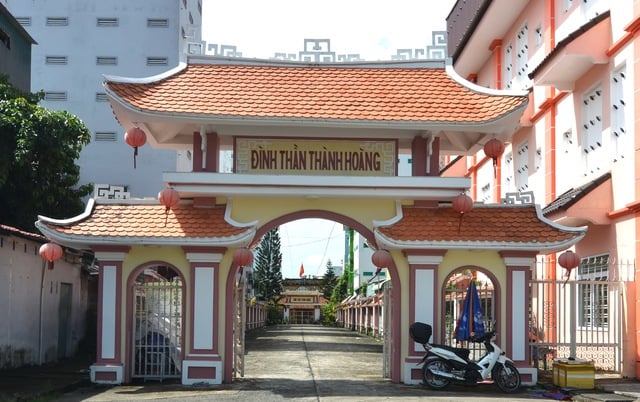
My Duc Commune Communal House, Ha Tien
PHOTO: HOANG PHUONG
According to author Nghe Van Luong, before 1945, the Am Duong Than temple in Ca Mau still maintained this worshiping custom with many rituals. During the Tong On ceremony, people made a boat from water coconut leaves and placed it on a banana raft, decorated with a mannequin carrying colorful flags. The ceremony started at midnight and lasted until morning. After the ceremony in the temple was over, at dawn, three drum beats sounded loudly, wax lamps were lit brightly on the boat, and incense was placed everywhere. At that time, about 20 strong young men carried the boat down to the river bank, placed it on a banana raft, and waited for a tugboat to take it to Ong Doc river.
The offerings placed on the boat included a pig of about a hundred kilograms, along with chickens, ducks, sticky rice, sweet soup, incense, fruits, cakes of all kinds. There was also a tray of lamps and a box of opium. At the bow of the boat, a shaman dressed in black, with a red belt, his face painted with stripes, holding a sword, waving it back and forth, shouting loudly on the river. When the boat passed a house, the house on the shore had to put salt on the fire and light it up. When the boat pulled the raft to the junction of Ong Doc and Rach Gieng rivers, they waited until the ebb tide was strong, then cut the rope and let the raft drift out to sea.
However, the Song On raft often had difficulty drifting to the mouth of the Ong Doc River. Because when they were near Rach Cui, about 10 km away, the villagers were already waiting and pulled the raft to shore. They removed all the offerings on the raft, held a party right on the riverbank, and then destroyed the raft to sink it.
The Yin Yang Temple now also has a committee in charge of worshiping, and holds worshiping ceremonies every year on the 24th and 25th of the second lunar month. Ms. Chau Kim Yen said that the custom of building rafts and releasing them on the river has been abandoned for many years, leaving only the ritual of inviting the spirits and performing ceremonies at the Sac Tu Quan Am Pagoda. ( continued )
Source: https://thanhnien.vn/chuyen-xua-tich-cu-xu-ca-mau-chuyen-xua-o-am-duong-than-mieu-185251130231153747.htm














![[Photo] Worshiping the Tuyet Son statue - a nearly 400-year-old treasure at Keo Pagoda](/_next/image?url=https%3A%2F%2Fvphoto.vietnam.vn%2Fthumb%2F1200x675%2Fvietnam%2Fresource%2FIMAGE%2F2025%2F12%2F02%2F1764679323086_ndo_br_tempimageomw0hi-4884-jpg.webp&w=3840&q=75)
![[Photo] Parade to celebrate the 50th anniversary of Laos' National Day](/_next/image?url=https%3A%2F%2Fvphoto.vietnam.vn%2Fthumb%2F1200x675%2Fvietnam%2Fresource%2FIMAGE%2F2025%2F12%2F02%2F1764691918289_ndo_br_0-jpg.webp&w=3840&q=75)



















































Comment (0)