

The draft Railway Law (amended), recently submitted to the Government, has institutionalized groundbreaking policies and mechanisms aimed at mobilizing all resources for investment in railway infrastructure development.
Businesses are eagerly awaiting the mechanism.
For the past few months, Dr. Yap Kwong Weng, CEO of Vietnam SuperPort™, has been busy implementing investment projects to develop logistics infrastructure, including a connecting railway project.
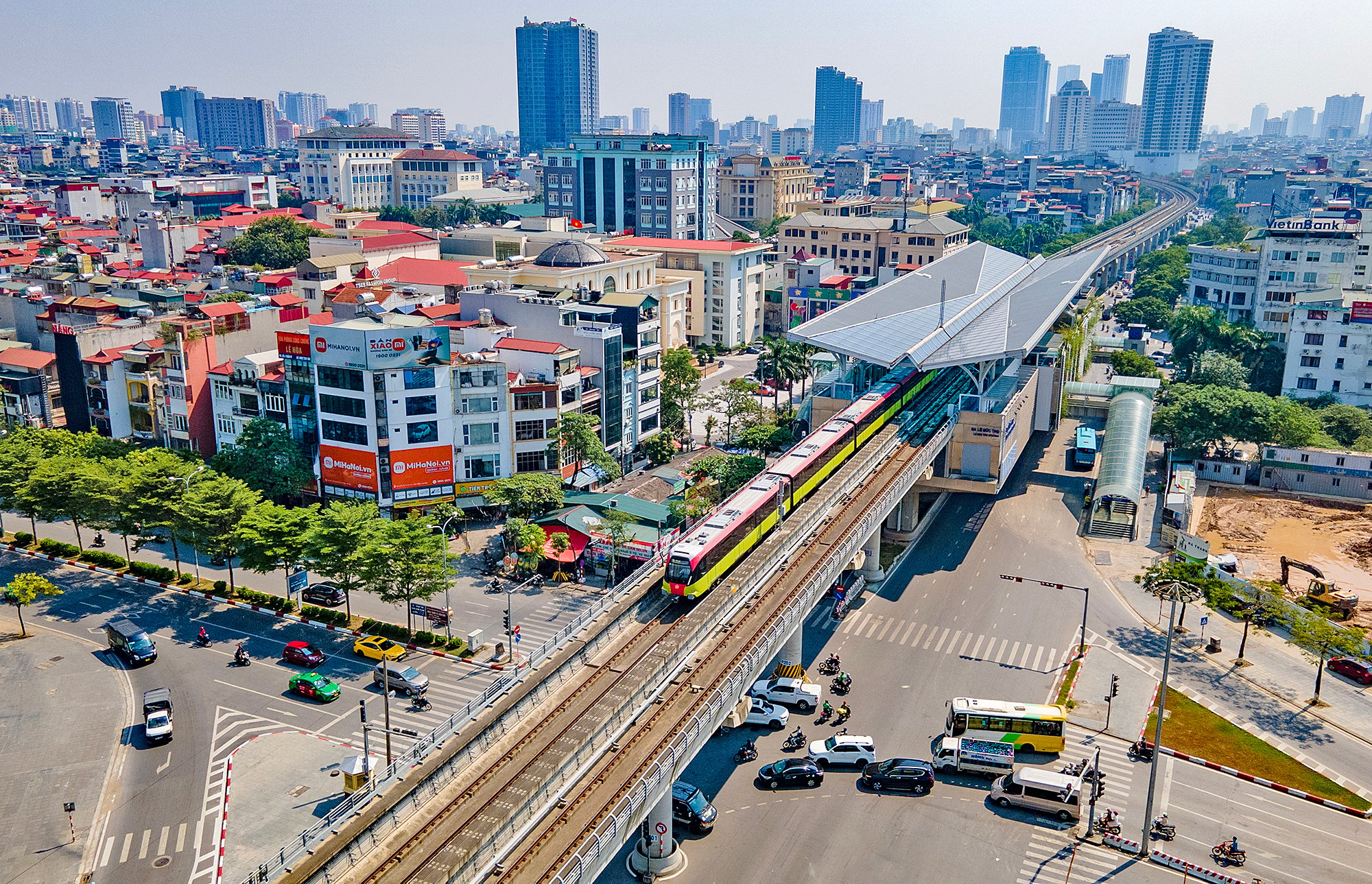
Mechanisms are needed to attract investment in railway infrastructure (In the photo: Nhon - Hanoi Station urban railway line). Photo: Ta Hai.
Vietnam SuperPort™ is a multimodal logistics port covering 83 hectares in Vinh Phuc province . This port is positioned as a key transshipment hub along the Lao Cai - Hanoi - Hai Phong - Quang Ninh railway line.
"Developing the logistics industry in conjunction with transportation infrastructure, especially railway infrastructure, will contribute to improving national logistics capacity and strengthening Vietnam's ability to integrate into the global supply chain," Dr. Yap affirmed.
Mr. Yap also argued that, although investing in railway infrastructure has a high initial investment and a potentially long payback period, it is a sustainable strategy.
However, Mr. Yap Kwong Weng also acknowledged that there are still many obstacles, especially in investment incentive policies. According to him, incentive policies such as tax exemptions and reductions, loan support, and simplified investment procedures need to be more flexible and consistent so that businesses can access them more easily.
Sharing the same view, Ms. Nguyen Thi Thu Thao, Head of Public Relations and Shareholder Relations at Gemadept Joint Stock Company, said that connecting railways with seaports has been discussed for many years and has always been a desire of those working in logistics.
Having railway lines directly to ports enhances operational efficiency and creates a competitive advantage for port and logistics businesses. Therefore, the State needs to implement policies to guide and facilitate the maximum utilization of resources from all economic sectors, focusing on investing in the synchronized development of transportation infrastructure in key economic zones.
Specifying breakthrough policies
According to Mr. Duong Hong Anh, Deputy Director of the Vietnam Railway Department, the current Railway Law already includes provisions on mobilizing investment resources for the development and exploitation of railway infrastructure. However, these policies have largely failed to be effective in practice.
In the draft Railway Law (amended) recently submitted to the Government, the Ministry of Transport has codified policies into specific, groundbreaking regulations to create a legal framework for railway development.
Specifically, the draft has amended and supplemented regulations to maximize the mobilization of resources for the development of railway infrastructure, with the State budget playing a leading role; encouraging all organizations and individuals to participate in investing in the development of railway infrastructure through various contract forms (BT, BOT, BTO, BLT, BTL...).
Regarding the mobilization of local resources, the draft Law allows localities to use their budgets to participate in compensation, resettlement support, and investment in the construction of certain national railway infrastructure projects.
The regulations on land development in the vicinity of railway stations (TOD model) are supplemented to maximize the utilization of resources for railway infrastructure development and to specify the responsibilities of stakeholders in the implementation.
Notably, provincial People's Committees are authorized to adjust the land use functions of areas surrounding railway stations to exploit land resources and the added value derived from the land.
The provincial People's Council decides to use local budgets to implement independent public investment projects for compensation, support, and resettlement in accordance with the planning of the area surrounding the railway station, in order to create land for auction to develop the urban area.
The revenue generated from the exploitation of land in the vicinity of local railway stations will be fully deposited into the provincial budget.
The government specifies the percentage of revenue generated from the exploitation of land in the vicinity of national railway stations to be shared between the central budget and the provincial budget.
Attracting private capital reduces the burden on the state budget.
Another noteworthy point, according to Mr. Duong Hong Anh, is that the draft amended Railway Law includes provisions on leasing and transferring for a limited period the right to exploit railway infrastructure assets invested by the State.
According to experts, this regulation will help increase private sector participation in the railway industry, improve operational quality, reduce financial pressure on the State, and ensure control over public assets.
In fact, the time-limited transfer model helps the State maintain control over critical infrastructure. After the exploitation period expires, the State can reassess the effectiveness and adjust policies or find new partners.
In particular, the State can still intervene if the operating enterprise fails to meet quality requirements or violates contracts. This is an effective solution for the sustainable development of Vietnam's railway industry.
Not only businesses but also local authorities are waiting for the legalization of mechanisms and policies for investment in railway infrastructure to attract investors.
According to a representative from the Hue City Department of Transport, the plan includes a branch railway line connecting to the Chan May - Lang Co Economic Zone, forming a railway station and TOD (Transit-Oriented Development) model in the Phu My and Chan May areas. Therefore, mechanisms are needed to mobilize non-budgetary investment resources to implement these plans.
Ho Chi Minh City People's Committee Vice Chairman Bui Xuan Cuong also stated that by 2035, the city aims to complete 7 metro lines (355km), and by 2045, 10 lines (510km). This does not include the research and implementation of extending metro line 1 to Dong Nai and Binh Duong provinces.
"To implement this, Ho Chi Minh City hopes to have regulations on the development of TOD (Transit-Oriented Development) as well as the deployment and management of revenue sources in metro and railway areas...", Mr. Cuong said.
Source: https://www.baogiaothong.vn/co-che-dot-pha-hut-von-dau-tu-ha-tang-duong-sat-192250227223306976.htm

































































Comment (0)