

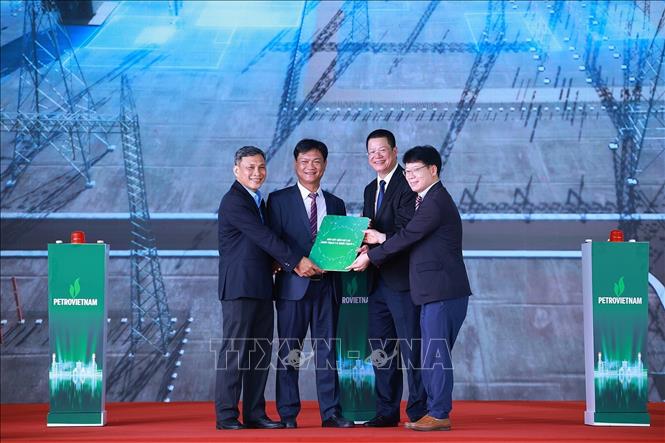
What special significance does the official inauguration and commissioning of Vietnam's first LNG power plant hold for the investor, sir?
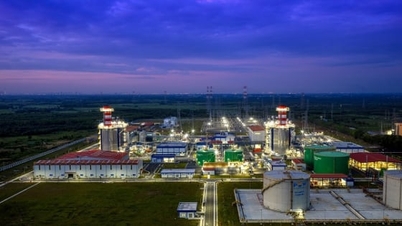
This is a key national project approved by the Government in early 2019, the first LNG power plant in Vietnam, marking a very strong energy transition and fulfilling the Prime Minister 's commitment at COP26 in 2021. This is the clearest evidence that Vietnam is beginning to take steps using LNG in its transition to green and clean energy, aiming for net zero emissions by 2050.
When implementing this project, what are the biggest advantages and challenges, sir?
In terms of advantages, PV Power has received strong support from the Government, ministries, and agencies, especially the Ministry of Industry and Trade and Petrovietnam, in terms of mechanisms, and the support of the People's Committee of Dong Nai province in land clearance and leveling materials - issues that are crucial to the project's progress.
However, the implementation of the Nhon Trach 3 & 4 power plant project faced numerous challenges unprecedented in Vietnam. This LNG power plant project was the first to require financing without a government guarantee or a guarantee from Petrovietnam . Furthermore, Vietnam had only traditional and renewable energy sources, while LNG was a completely new field with no specific mechanisms in place. Therefore, everything from negotiating power purchase agreements and securing financing to environmental commitments significantly impacted the project's implementation.
In reality, PV Power had to demonstrate three core points to lenders and international export credit institutions (ECAs): Firstly, that LNG power is a crucial energy transition for Vietnam. Secondly, that the project is financially viable. Thirdly, that it is an LNG power project with the strictest environmental regulations in Vietnam currently, and arguably the best at the present time.
We have worked with international credit institutions such as SACE (Italy), SERV (Switzerland), KSURE (Korea), SMBC (Japan), ING (Netherlands), Citi (USA), and Vietcombank (Vietnam). Ultimately, these institutions all came to the conclusion that this is a project of great importance to Vietnam's energy transition, consistent with the Prime Minister's commitment, and ensuring the overall effectiveness of the project.
However, the issue of guaranteeing a minimum electricity output (Qc) is entirely new. LNG is not entirely dependent on Vietnam's policies because LNG prices fluctuate according to the world market. Therefore, Vietnam needs a synchronized and flexible mechanism that ensures both national interests and harmonizes the interests of investors.
Currently, the government allows the application of the Quality Control (QC) rate at 65% for 10 years. Recently, the Prime Minister and the Ministry of Industry and Trade submitted to the National Assembly a plan to raise the QC rate to 75% for 15 years, but this matter still requires further clarification.
We believe that the two biggest challenges in implementing LNG power projects today remain environmental and capital. But thanks to the tremendous efforts of PV Power, along with the close support of ministries and agencies, we have overcome all challenges and completed the project on schedule.
According to the National Power Development Plan VIII, Vietnam has approximately 15 LNG power projects, but in reality, these projects are currently progressing very slowly. In your opinion, what is the biggest bottleneck?
Currently, Vietnam has over 22,000 MW of LNG power capacity, mainly concentrated in PV Power, Vietnam Electricity Group, Petrovietnam, and foreign investors. However, only PV Power, with its own financing arrangements, has been able to implement the Nhon Trach 3&4 project. Meanwhile, foreign investors are still "waiting and seeing" because the 65% quality control rate over 10 years is not enough to convince banks to lend. Furthermore, investors are requesting a non-capacity off-take mechanism, similar to BOT (Build-Operate-Transfer). This is an issue that the Government and the National Assembly are currently considering very carefully.
Between now and 2030, at least 7-8 LNG projects need to come online. However, with the current mechanisms in place, coupled with the scarcity of equipment for LNG power plants worldwide—from GE of the US and Siemens of Germany to Mitsubishi of Japan—this presents a significant challenge. Many countries in the Middle East and North America have already placed large orders for equipment, meaning that orders placed now would not be received until 2029. Therefore, achieving the goal of bringing LNG projects online before 2030 is a very difficult task.
With PV Power, we are implementing projects such as the Ca Mau 1&2 expansion, Quynh Lap 1, Quang Ninh… and are working with relevant parties to arrange funding and secure equipment commitments.
However, the biggest challenge that foreign investors are most concerned about is the mechanism for guaranteeing minimum purchase prices and the legal validity of the commitment.
Sir, is it reasonable to apply a high Qc ratio when hydropower output is higher and cheaper?
2025 is a very special year for hydrology. Vietnam's electricity growth is just over 4%, with hydropower exceeding its target by 20 billion kWh, driving down the overall market electricity price. This poses a significant challenge for LNG power investors, because when the overall electricity price falls, the financial viability of LNG projects will be affected.
Currently, hydropower plants are still allowed to calculate Qc, and since hydropower prices are lower than market prices, the lower the Qc of hydropower plants, the more profitable they are. Conversely, thermal power plants need a higher Qc for better results.
When Nhon Trach 3 & 4 become operational, what are PV Power's expectations?
Nhon Trach 3 & 4 will officially enter the electricity market from January 1, 2026. This is not a formal inauguration ceremony, but a 100% completed and synchronized project, with an acceptance council, granted an electricity operation license, and approved for commercial operation (COD). The project will contribute approximately 1,000 billion VND in taxes to Dong Nai province and increase local revenue by approximately 25,000 billion VND, equivalent to nearly 1 billion USD. The biggest challenge for Nhon Trach 3 & 4 is that PV Power must negotiate LNG prices with PV GAS and LNG exporters to secure the most competitive prices.
Regarding the output mobilized in 2026, the Nhon Trach plant, with a capacity of 1,624 MW, operating 6,000 hours/year, will produce approximately 9.7 billion kWh. After deducting self-consumption and average power decline, this will leave about 9.3 billion kWh. However, with a Qc of 65%, the minimum output in 2026 will only be around 6 billion kWh.
The Vietnam Petroleum Association has proposed a Direct Power Purchase Agreement (DPPA) mechanism for LNG power projects, allowing power producers to sell electricity directly to large electricity consumers, bypassing EVN, in order to resolve the "bottleneck" in negotiating electricity prices, gas prices, and Qc. What is your view on this mechanism?
The DPPA mechanism has been issued but is incomplete. Currently, the new mechanism allows renewable energy investors with a power generation capacity of over 10 MW to sell directly to customers. However, many mechanisms still need to be supplemented. For example, for an investor with a 20 MW capacity, how should the surplus electricity be sold? What is the payment mechanism? What are the transmission fees?
However, a very favorable condition for the DPPA mechanism is that export-oriented industries such as textiles and garments urgently need ESG sustainable development certification and CO2 emission reduction. In addition, Vietnam's development orientation is towards developing large data centers, artificial intelligence, semiconductor electronics, etc., which are industries that require a large and stable power supply.
The Ministry of Industry and Trade is currently drafting a new DPPA mechanism, and I believe that the new mechanism will meet market needs. Regarding the Nhon Trach 3 & 4 LNG plant, there is no legal prohibition against participating in the DPPA, but with a large output of approximately 9.3 billion kWh/year, PV Power needs large industrial customers or large-scale data centers, and the price is entirely negotiable.
Thank you very much, sir!
Source: https://baotintuc.vn/kinh-te/co-che-mua-ban-dien-truc-tiep-dppa-co-go-duoc-nut-thatdien-lng-20251214150155968.htm
































































Comment (0)