

The bribery scandal at K Hospital: Is it just one bad apple spoiling the bunch?
Is the case of doctors and nurses at K Hospital being accused of accepting bribes from patients just an isolated incident, or is it a serious problem that the healthcare sector needs to confront and thoroughly address?
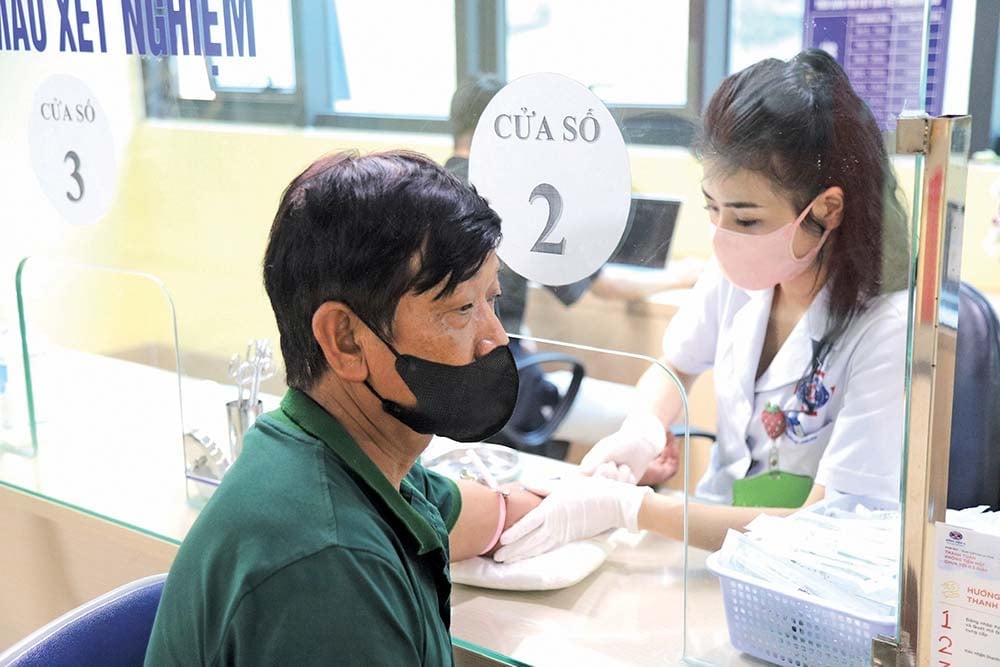 |
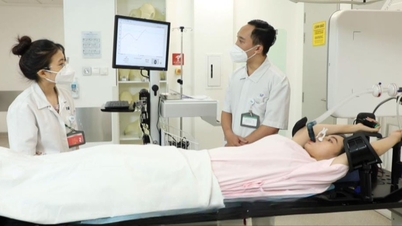
| The patient had a sample taken for testing at K Hospital. |
Domino Effect
Public opinion is buzzing over the incident where citizens "denounced" the attitude and conduct of medical staff at K Hospital.
Specifically, in mid-August 2024, the TikTok account Dau Thanh Tam posted clips reflecting various issues at K Hospital, including allegations that patients had to pay a "bribe" of 200,000 VND for each radiotherapy session.
Immediately, K Hospital issued a statement saying that Ms. Tam's actions were insulting and defamatory to the hospital's medical staff , and added that the hospital had invited the police to investigate the matter.
Following the statement from K Hospital, on August 22nd, numerous videos continued to appear on social media accusing patients of having to pay money for radiotherapy at this hospital, otherwise they would face difficulties.
In a video clip, a woman named D.TH (from Mai Son, Son La ) wearing a patient gown with the name of K Hospital printed on it said: "I slipped the money into a piece of paper and gave it to the doctor, and a little while later, the doctor called me in for an examination." She stated that the amount of money she slipped into the paper to give to the medical staff was 500,000 VND, but she only received the paper back.
In another clip, the account holder TL (from Pho Yen, Thai Nguyen) recounts how he cared for his father for a considerable period at K Hospital's Tan Trieu branch.
According to Mr. TL, the hospital scheduled his father's appointment for 6:00 AM. The family prepared all the necessary documents and arrived at 5:30 AM, but when called in, they were met with difficulties by the technicians. He went outside to ask for information and was told that here, patients undergoing radiotherapy must pay 100,000-200,000 VND to be treated.
The situation described above, if it exists, is unacceptable, because cancer patients are already considered to be in dire straits when facing a life-threatening disease.
According to published data, approximately 2,000 cancer patients require radiotherapy each day at K Hospital. Due to insufficient equipment, only about 1,000 people receive treatment. If this number is multiplied by the alleged "bribes" paid to receive radiotherapy, the resulting figure is substantial.
"Bribery" money can range from a few tens or hundreds of thousands of dong, but some people claim they had to pay much more, such as 500,000 dong to one million dong, or even several million dong. Some even say that to get their family members treated or operated on quickly, they had to spend up to tens of millions of dong.
This is not the first time that medical staff at K Hospital have been accused of accepting bribes from patients and their families. In 2016, a similar incident also sparked public discussion. The issue of bribery is not new; it has always been a simmering problem in the medical field, and now many patients are once again expressing their outrage.
Take decisive action to address this "cancerous growth."
Following the widespread accusations, at a meeting with the Ministry of Health on August 23rd, instead of outright denying the allegations as stated in the previous press release, Professor Dr. Le Van Quang, Director of K Hospital, stated that if the hospital receives any complaints from patients regarding inappropriate behavior by medical staff, the staff member in question will be temporarily suspended from work for one to two weeks for verification and clarification. If any misconduct by a medical staff member is discovered, disciplinary action will be taken.
Regarding the issue of bribes in the medical field, many opinions suggest a distinction should be made between receiving bribes before and after treatment. Patients are in so much pain, and doctors accepting money before treatment is problematic. However, after curing the patient, the patient giving a thank-you gift is a different matter altogether.
Is it acceptable to give envelopes of money after treatment as an act of gratitude from patients to doctors and nurses for the hard work and tireless efforts of the medical team in saving patients' lives?
According to many compassionate doctors, if patients are truly grateful to their doctors, they will find a suitable gift with sentimental value. Receiving small but meaningful gifts that express gratitude and appreciation from patients is incredibly valuable to anyone working in the medical field. But above all, it must be a gift from the patient's heart, not from suggestion, demand, or coercion.
The incident at K Hospital is currently under investigation by the authorities, but the issue of "bribes" in the medical field remains a long-standing problem. Should it be understood as a legitimate act of gratitude from patients to doctors and medical staff, or as a patient's desire to use money to "buy" assurance, enthusiasm, and responsibility from medical professionals? This is a difficult question that only doctors, medical staff, and healthcare workers themselves, based on their practical experience, can answer accurately.
In my opinion, the "bribery" scandal at K Hospital, which is currently causing a stir in public opinion, is merely the outward manifestation of an inadequate management mechanism, where people have no other choice at a public healthcare facility.
Some have questioned whether it is necessary for all cancer patients to be transferred to Cancer Hospital, or whether they could be divided by specialty to receive treatment that matches the expertise of other medical facilities nationwide.
Furthermore, the Ministry of Health needs to seriously work with K Hospital on management mechanisms to close loopholes that force patients to pay "bribes." It needs to be clarified whether this facility has sufficient machinery, equipment, and medicine to serve patients; if not, priority should be given to resolving difficulties in the bidding process for the hospital, because the plight of cancer patients is truly heartbreaking.
According to Professor Dr. Le Quang Cuong, former Deputy Minister of Health and Permanent Vice Chairman of the National Medical Council, the case at K Hospital highlights the need for a comprehensive overview and evaluation of the tiered healthcare system, aiming to improve the quality of healthcare at the lower levels to prevent the current situation where people flock to higher-level facilities, causing overcrowding and pressure.
In particular, the key to reducing the number of patients in general and cancer patients in particular is to do a good job of prevention. “Under any circumstances, prevention in the healthcare system must be given special importance, because prevention is always more effective and less expensive than treatment. One dollar spent on prevention will save 100 dollars on treatment,” Professor Dr. Le Quang Cuong emphasized.




![[Photo] National Assembly Chairman Tran Thanh Man successfully concludes his participation in IPU-152](https://vphoto.vietnam.vn/thumb/1200x675/vietnam/resource/IMAGE/2026/04/18/1776502638199_vna-potal-chu-tich-quoc-hoi-ket-thuc-tot-dep-chuong-trinh-tham-du-ipu-152-8709975-jpg.webp)








































































Comment (0)