

Implementing the Prime Minister's direction that before the Lunar New Year 2026 (January 31, 2026), the reconstruction of nearly 1,900 houses that were completely collapsed or washed away must be completed, at the regular Government Press Conference held on the afternoon of December 6, Chief of Office of the Ministry of Construction Nguyen Tri Duc affirmed that although there are only 60 days left to complete the set goal, up to now, the Ministry of Construction has completed the model system of flood-proof houses and has infrastructure solutions for the Central region.

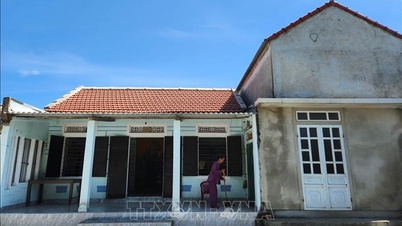
Regarding the design of flood-proof houses, Mr. Nguyen Tri Duc informed that since 2014, the Prime Minister has issued Decision No. 48/2014/QD-TTg on policies to support poor households in building houses to prevent and avoid storms and floods in the Central region, with the scope of application in 13 provinces and cities in the North Central region and the Central Coast (before the merger) including: Thanh Hoa, Nghe An, Ha Tinh, Quang Binh, Quang Tri, Thua Thien Hue, Quang Nam , Quang Ngai, Binh Dinh, Phu Yen, Ninh Thuan, Binh Thuan.
In Circular 16/2014/TT-BXD guiding Decision 48, the Ministry of Construction requested localities to study and design at least 3 typical storm and flood shelter house models that ensure minimum criteria on area and quality, ensuring storm and flood prevention, and organize the introduction of design models for people to refer to and choose, not requiring households to build according to the model design. In addition to the model design, localities have specific instructions for cases of renovation and raising floors to make storm and flood shelter houses. Implementing the above regulations, localities have designed and announced at least 3 models, some localities have up to 6-8 models (Hue, Thanh Hoa ). These housing models are all posted on the Information Portal of the local Department of Construction.
At the same time, the Ministry of Construction assigned the National Institute of Architecture to research and deploy a system of safe housing designs for natural disaster prevention and control in the period 2007-2023 and published on the National Institute of Architecture's Information Portal, including 176 models that can be used immediately for localities, including models: typical houses in natural disaster areas (Central and Southwestern regions); houses resistant to storms, flash floods, landslides; rural houses by region; houses adapting to climate change and rising sea levels (details in the attached appendix).
The Chief of Office of the Ministry of Construction affirmed that the above models were built on the basis of research on natural conditions, cultural practices, and natural disaster characteristics in areas affected by natural disasters; ensuring compliance with current technical regulations and standards that are eligible for application. Many localities have put these design models into use as the main reference document, serving as guidance on design, housing renovation and building programs to support housing to prevent storms and floods (Dak Lak, Ha Tinh, Quang Tri, Phu Yen before the merger).
In addition, for 6 localities (before the merger) including: Thanh Hoa, Quang Binh, Thua Thien Hue, Quang Nam, Quang Ngai, Ca Mau participated in the Project Component 1 - Support for building storm and flood resistant houses under the Project "Enhancing resilience to the impacts of climate change for vulnerable coastal communities in Vietnam" funded by the Green Climate Fund GCF through the United Nations Development Program UNDP, integrating funding to add storm resistance features for poor households eligible for support under Decision No. 48.
Households registering to participate in Project Component 1 are advised to choose one of the house models provided by the Department of Construction. These house models have been examined by the Institute of Construction Science and Technology IBST (Ministry of Construction), approved for implementation by UNDP, the Department of Housing and Real Estate Market Management, and the local Department of Construction. In addition, the Project's safe house construction experts have given 10 technical notes that need to be ensured in the construction of storm-resistant houses.
Through the implementation, the houses according to the above sample designs are safe and resistant to storms and floods. However, in recent years, storms and floods have occurred in most areas across the country with much more complex and dangerous levels, so there is a need for new storm and flood prevention house designs that are suitable for the actual situation.
Therefore, the Ministry of Construction requests the People's Committees of the provinces to direct the Departments of Construction and relevant agencies to coordinate with the National Institute of Architecture (Ministry of Construction) to review the terrain characteristics of each region to apply and select the design model according to the instructions in Official Dispatch 234/CD-TTg dated November 30, 2025 of the Prime Minister on launching and implementing the "Quang Trung Campaign" to rapidly rebuild and repair houses for families whose houses were damaged by recent natural disasters in the Central provinces. The implementation needs to be closely linked with construction planning, rural planning, regional planning, ensuring long-term safety, not just immediate handling.
Regarding the consultation and proposal to build infrastructure projects for the Central region to respond to natural disasters, Mr. Duc said that, based on the National Master Plan, in 2021, for the first time, the Ministry of Transport (now the Ministry of Construction) deployed the organization of synchronous national sector planning for 5 transport sectors (road; maritime, inland waterway; railway; aviation) to ensure maintaining the advantages of each mode of transport in maximizing the efficiency of exploitation of the entire transport system of the whole country.
The climate change and sea level rise scenarios of the specialized ministries have also been updated in these plans and are the basis for assessment, research and planning of goals and solutions for environmental issues. Accordingly, one of the important goals throughout the 5 plans is sustainable development associated with environmental protection, natural disaster prevention and response to climate change. The plans also provide "Solutions on environment, science and technology".
According to the 5 approved plans for the Central and Central Highlands regions, there are 11 expressways with a length of nearly 1,500 km and 24 main national highways with a length of over 4,400 km to help connect important economic corridors. For aviation, the Central and Central Highlands regions are planned to have 14 airports. The maritime sector is also planned to have 14 seaports including 89 wharf areas and ports with 208 wharves with a total length of 36,923 m. Along with that, inland waterways are planned to have 27 water transport routes with a length of 1,263 km. Railways have 1,332 km belonging to the North-South railway line.
Regarding the specific characteristics of the aviation sector, the Ministry of Construction is currently studying to add planning for two more airports in the Central region to strengthen emergency support and rescue work in the Central and Central Highlands regions.
Regarding investment, the industry has always promptly and effectively implemented the Party and Government's directives in proactively promoting investment and development of transport infrastructure to improve transport capacity, promote connectivity between regions across the country and between transport modes, serving the needs of socio-economic development, contributing to GDP growth as well as maintaining traffic connections when natural disasters occur.
According to the Chief of Office of the Ministry of Construction, up to now, the Central and Central Highlands regions have completed investment in about 1,193 km of highways, expected to complete about 1,466 km by the end of 2025; continue to exploit the North-South railway line; exploit 11/14 planned airports, and are implementing investment in 2 airports; a number of maritime routes, waterways and ports have also been invested in according to the plan, put into use to promote investment and exploitation efficiency.
The process of putting into operation investment projects for construction of traffic works has shown that the technical solutions based on the assessment and analysis of hydrological, oceanographic and climate data series are basically reasonable. Most of the projects will have a long-term operation period (over 50 years) to ensure the sustainability of the infrastructure system and promote investment efficiency.
However, due to unusual changes in the weather, in recent times, our country, especially the Central region, has had to endure many strong storms, heavy rains, and floods, causing local incidents in some locations such as some road sections being flooded due to flood peaks exceeding historical levels or landslides affecting transportation.
The Ministry of Construction has proactively carried out urgent tasks to overcome incidents, promptly repair and restore infrastructure to ensure continuous and smooth traffic; at the same time, proactively coordinated with relevant ministries, branches and localities in rescue, supporting people to soon return to normal life after natural disasters, contributing to ensuring social security.
Since the beginning of 2025, Vietnam has experienced particularly serious natural disasters; especially in the Central region, which has had to endure consecutive high-level storms, heavy rains, and floods that have broken historical records many times, causing heavy damage to people and putting the forecasting, warning systems and the timely response capacity of the rescue system in great challenge.
According to meteorological experts, when anomalous natural disasters break the rules, it is necessary to switch to impact-based weather forecasting. Therefore, the stages of data collection, assessment, calculation and forecasting of hydrological and climatic data... in the planning, establishment and approval of investment projects also need to change the approach, model and calculation method to ensure scientific and practical suitability.
Natural disasters have exceeded historical thresholds, so the Ministry of Agriculture and Environment needs to quickly change response scenarios, as a basis for sectors and fields to update and propose climate change adaptation solutions suitable to the specific characteristics of each field - the Ministry of Construction proposed.
Regarding Planning, immediately after the National Assembly passes the Resolution on the National Master Plan according to the new socio-economic development targets, the Ministry of Construction will organize the preparation of adjustments to the National Sectoral Planning of 05 areas. Accordingly, it will update the latest climate change and sea level rise scenarios announced by the Ministry of Agriculture and Environment to prepare the Strategic Environmental Assessment.
During the appraisal or consultation process for investment project policies, the Ministry of Construction also requires investors to base on the latest climate change and sea level rise scenarios of the Ministry of Agriculture and Environment, the series of hydrological and climate data collected including 2025 to calculate and propose technical solutions to ensure safety, sustainability, and maximize the efficiency of investment in exploitation and use of resources.
In addition, in response to increasingly severe and unusual natural disasters, the Ministry of Construction proposed that there should be in-depth and thorough research, ensuring scientific basis for planning comprehensive solutions from planning, infrastructure, land, dykes, drainage, etc.; there should be close coordination and drastic participation of ministries, branches and localities to ensure synchronization and sustainability, contributing to adapting to climate change, mitigating the consequences of natural disasters, and ensuring people's welfare.
Source: https://baotintuc.vn/thoi-su/da-hoan-thanh-mau-nha-chong-lu-cho-mien-trung-20251206163919468.htm

![[Photo] 60th Anniversary of the Founding of the Vietnam Association of Photographic Artists](/_next/image?url=https%3A%2F%2Fvphoto.vietnam.vn%2Fthumb%2F1200x675%2Fvietnam%2Fresource%2FIMAGE%2F2025%2F12%2F05%2F1764935864512_a1-bnd-0841-9740-jpg.webp&w=3840&q=75)



![[Photo] National Assembly Chairman Tran Thanh Man attends the VinFuture 2025 Award Ceremony](/_next/image?url=https%3A%2F%2Fvphoto.vietnam.vn%2Fthumb%2F1200x675%2Fvietnam%2Fresource%2FIMAGE%2F2025%2F12%2F05%2F1764951162416_2628509768338816493-6995-jpg.webp&w=3840&q=75)















































































Comment (0)