

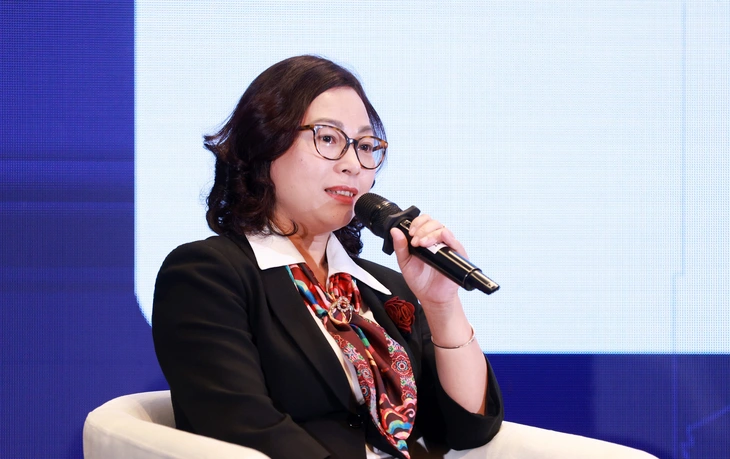
Ms. Tong Thi Hanh, Director of the Department of Housing and Real Estate Market Management, Ministry of Construction - Photo: B.NGOC
Regulating investor profits
At the Forum on Building a Healthy and Sustainable Real Estate Market by 2025, Ms. Tong Thi Hanh, Director of the Department of Housing and Real Estate Market Management, Ministry of Construction, said that to identify whether there is a phenomenon of house price inflation or not, the core thing is to clearly identify the factors that make up the real estate selling price.
According to Ms. Hanh, the selling price structure is mainly made up of two main components: land price - that is, the cost of land use rights and the cost of investing in building housing projects.
This cost includes construction materials, labor, taxes and allocated infrastructure costs.
To get the final selling price, it is necessary to add the cost price with the selling cost and the incidental costs.
Therefore, Ms. Hanh believes that we must have an objective view of the market when the reality is that the increase in construction materials directly affects real estate prices.
"There are two markets, the primary market is directly related to the profits of investors. From there, there needs to be a policy to regulate profits to harmonize between project investors and home buyers.
The secondary market is strongly influenced by the role of intermediary organizations. To determine whether there is price inflation or not, we must control the primary selling price, cost price, and transaction price in the primary market, and then control the price in the secondary market," Ms. Hanh commented.
To control housing prices, Ms. Hanh said the Ministry of Construction and other ministries and branches have been implementing synchronous solutions to limit price inflation.
There are three core elements, the first is information transparency. Currently, a decree on a national database on real estate is being developed with the spirit of transparency in supply sources, transparency in real estate prices, especially transparency in the primary market, from which the secondary market can be controlled.
The second is to control and sustainably develop the real estate market. To do so, we must look at inventory to identify which segments are lacking.
In addition, the Ministry of Construction is coordinating with relevant units towards establishing a State-managed real estate transaction center in an electronic environment, with the participation of relevant agencies such as land, tax, and finance.
Third, for secondary market regulation, credit, financial and tax policies are extremely important and require appropriate intervention.
More importantly, when controlling the market, we must look at the segment structure and inventory. Currently, we have a surplus of high-end segments, but a serious shortage of real estate suitable for people's income and social housing. Therefore, we need to focus on developing segments suitable for people's income, Ms. Hanh emphasized.
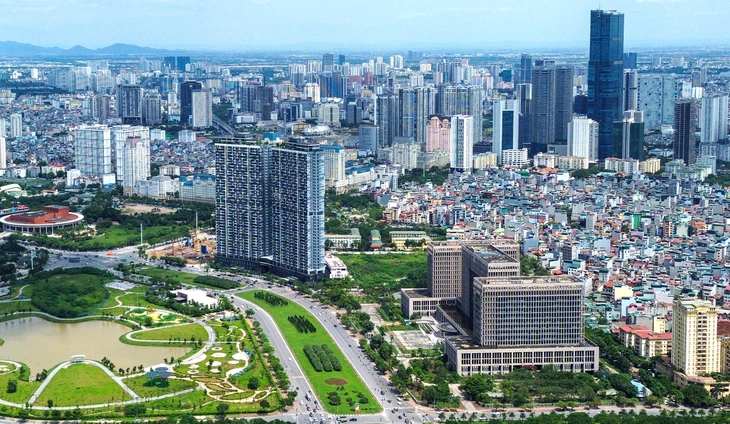
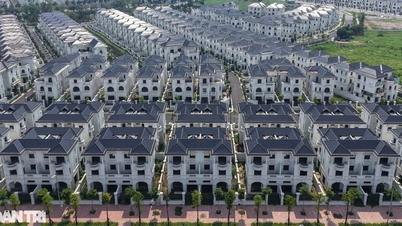
The prolonged shortage of housing supply has pushed up house prices in recent times - Photo: HONG QUANG
Overcoming supply shortages
According to Mr. Vu Sy Kien, Deputy Director of the Department of Land Management, Ministry of Agriculture and Environment , land price accounts for about 30% of the cost, while apartment real estate accounts for less than 10%.
However, many projects have paid land use fees for a long time, completed in 2020 but will not be sold until 2023 - 2024, so the impact of land price fluctuations is not necessarily the biggest factor, especially for social housing which is exempt from land use fees.
So according to Mr. Kien, the core cause of land fever and speculation, inflating real estate prices is the prolonged shortage of supply.
To address the prolonged shortage of supply and the problem of land allocation in planning, the Ministry of Construction and other ministries and branches have taken drastic actions.
The Government has passed Resolution 171 to remove obstacles related to the Land Law and other regulations, helping to increase land supply for projects.
In addition, the Ministry of Agriculture and Environment also submitted to the Government Resolution 66.3 to handle legal problems related to land.
Source: https://tuoitre.vn/dai-dien-bo-xay-dung-noi-gi-ve-hanh-vi-thoi-gia-nha-tren-thi-truong-bat-dong-san-20251206093037589.htm
![[Photo] 60th Anniversary of the Founding of the Vietnam Association of Photographic Artists](/_next/image?url=https%3A%2F%2Fvphoto.vietnam.vn%2Fthumb%2F1200x675%2Fvietnam%2Fresource%2FIMAGE%2F2025%2F12%2F05%2F1764935864512_a1-bnd-0841-9740-jpg.webp&w=3840&q=75)

![[Photo] National Assembly Chairman Tran Thanh Man attends the VinFuture 2025 Award Ceremony](/_next/image?url=https%3A%2F%2Fvphoto.vietnam.vn%2Fthumb%2F1200x675%2Fvietnam%2Fresource%2FIMAGE%2F2025%2F12%2F05%2F1764951162416_2628509768338816493-6995-jpg.webp&w=3840&q=75)







































































Comment (0)