

Continuing the agenda of the 8th session of the 15th National Assembly , this afternoon, November 27th, under the chairmanship of Deputy Speaker Nguyen Duc Hai, the National Assembly discussed in the plenary session the draft Law on Special Consumption Tax (amended).
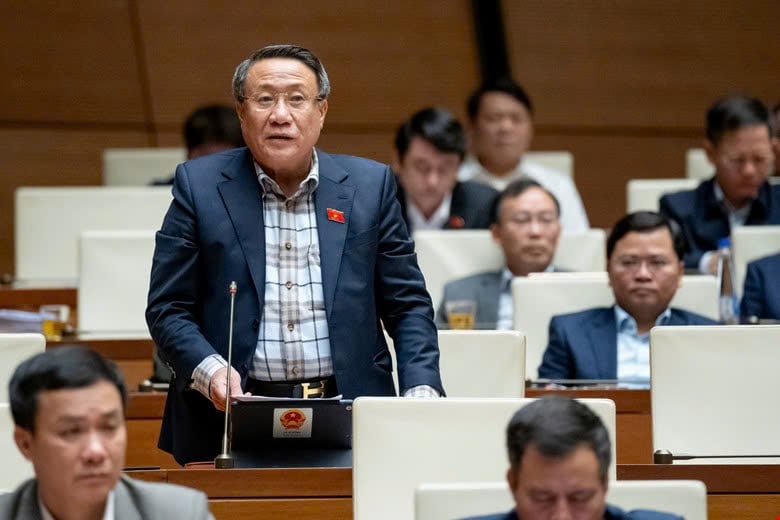
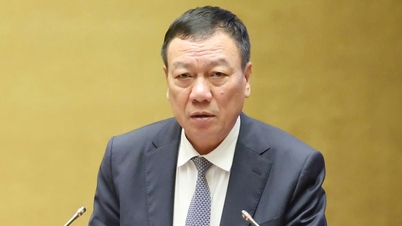
National Assembly representative and Acting Chairman of the Quang Tri Provincial People's Committee, Ha Sy Dong, speaks at the National Assembly on the afternoon of November 27th - Photo: CN
Participating in the discussion, National Assembly representative Ha Sy Dong, Acting Chairman of the Quang Tri Provincial People's Committee and member of the National Assembly's Finance and Budget Committee, offered some opinions on the application of special consumption tax (SCT) to the production of specialized automobiles, air conditioners, and petroleum products.
Representative Ha Sy Dong analyzed that the production of specialized vehicles such as ambulances, money transport vehicles, prisoner transport vehicles, and other specialized vehicles currently faces many obstacles regarding excise tax policies.
Specifically, to manufacture ambulances, businesses must use a 9-seater or 12-seater vehicle as input, without interior fittings. These "input materials" vehicles are subject to excise tax, with a tax rate that can reach up to 50%. Manufacturers, when purchasing these "input materials," have already paid the tax through the purchase price of the vehicle.
After converting these commercial vehicles into ambulances and selling them, the products are exempt from excise tax. Businesses are not allowed to deduct or claim a refund of input excise tax. As a result, the production costs of ambulances in Vietnam increase by 35-40%. With an ambulance price of approximately 1 billion VND per vehicle, the government is currently collecting about 250-300 million VND in excise tax per ambulance.
According to the delegates, this would increase healthcare costs and reduce patients' access to services. They also emphasized that only fully imported ambulances could avoid the special consumption tax. This would stifle domestic production and cause significant damage to the applied mechanical engineering industry. Therefore, they proposed that the National Assembly consider a mechanism for deducting or refunding the special consumption tax already paid on input to support the domestic specialized vehicle manufacturing industry.
Regarding air conditioners, Representative Ha Sy Dong stated that this item has been subject to excise tax since 1998 at a rate of 20%, which was reduced to 10% in 2008. Previously, air conditioners could be considered a luxury item, but now they have become essential goods, serving daily life.
The delegate analyzed: Numerous studies have proven that maintaining a suitable room temperature has a very positive effect on improving intellectual productivity. This is especially significant for Vietnam, given our current orientation towards developing a knowledge-based economy. Perhaps Vietnam is the only country in the world that imposes excise tax on air conditioners. Other countries control air conditioners based on two other aspects: firstly, controlling the refrigerant used, and secondly, controlling electricity consumption.
Vietnam has regulations controlling refrigerants, aiming to reduce import quotas for refrigerants that negatively impact the ozone layer and contribute to the greenhouse effect. In addition, regulations on energy efficiency for thermal power plants are also in place, with a growing focus on increasing minimum energy efficiency standards.
Therefore, the delegates affirmed that continuing to maintain the special consumption tax on inflator heaters is no longer appropriate and should be abolished to reduce costs for consumers and businesses.
Regarding petroleum products, delegate Ha Sy Dong emphasized that currently, these products are burdened with two types of taxes that restrict consumption: excise tax and environmental protection tax. This is an uncommon tax method in the world, as countries usually only apply one of these two taxes.
Gasoline and diesel fuel are not luxury goods, and the main objective of excise tax in this case is environmental protection. Therefore, Representative Ha Sy Dong proposed studying the abolition of excise tax on gasoline and diesel fuel, while adjusting the environmental protection tax rate to better align with the goals of controlling consumption and protecting the environment.
Cam Nhung - Thanh Tuan
Source: https://baoquangtri.vn/dai-bieu-quoc-hoi-ha-sy-dong-tham-gia-thao-luan-ve-du-thao-luat-thue-tieu-thu-dac-biet-sua-doi-190025.htm

![[Photo] Prime Minister Pham Minh Chinh holds a phone call with the CEO of Russia's Rosatom Corporation.](/_next/image?url=https%3A%2F%2Fvphoto.vietnam.vn%2Fthumb%2F1200x675%2Fvietnam%2Fresource%2FIMAGE%2F2025%2F12%2F11%2F1765464552365_dsc-5295-jpg.webp&w=3840&q=75)


































































Comment (0)