

If you experience rapid heartbeat, dizziness, headache, and profuse sweating in the hot weather, you are likely suffering from heatstroke or heat exhaustion and need immediate cooling measures.
On May 19th, Dr. Dang Hoang Diep, from the Emergency Department of the Central Hospital for Tropical Diseases, stated that heatstroke and heat exhaustion can cause fatigue, dizziness, headaches, and potentially lead to stroke. If not treated promptly, patients may suffer irreversible neurological damage, multi-organ damage, or death.
What is heatstroke or sunstroke?
Heatstroke is a condition where the body's temperature rises due to exposure to high ambient temperatures or excessive physical activity, exceeding the thermoregulatory center's ability to regulate temperature, leading to a disruption in the body's ability to control temperature. Heatstroke can progress. It develops into heatstroke (heat exhaustion).
Heatstroke, also known as heat shock, is a condition characterized by severe hyperthermia (>40°C) accompanied by dysfunction of the nervous, circulatory, and respiratory systems due to the effects of hot weather or excessive physical activity.
Heatstroke commonly occurs in the afternoon when there are high levels of infrared radiation, combined with working in environments with high temperatures, humidity, and poor ventilation. Sunstroke usually happens at midday during intense heat, with high levels of ultraviolet radiation, combined with working in hot, humid conditions and poor air circulation.
Manifestations
Mild initial signs of heatstroke or heat exhaustion include rapid heart rate, rapid breathing, flushed skin, possibly sweating, accompanied by dizziness, lightheadedness, headache, and nausea. More severe symptoms, if not treated promptly, include hypotension, neurological dysfunction including altered consciousness, agitation, delirium, confusion, seizures, and coma.
Excessively high body temperature can cause severe electrolyte imbalances, disruption of homeostasis, and potentially bleeding (conjunctival hemorrhage, hematuria) due to coagulation disorders. In more severe cases, it can lead to multiple organ failure and death.
Agent
According to doctors, children and the elderly are more susceptible to heatstroke due to their poor thermoregulation and adaptation to hot weather. In addition, factors such as poor adaptation to the climate, exercising and working in hot environments, wearing inappropriate clothing (too thick, tight, non-waterproof, heat-absorbing), and dehydration without adequate water intake can cause heatstroke and shock.
People who are taking certain medications that reduce sweating, such as diuretics, beta-blockers, anticholinergics, ethanol, or antihistamines, or who have fever, hormonal disorders, or obesity, are also more susceptible to heatstroke or heat exhaustion.
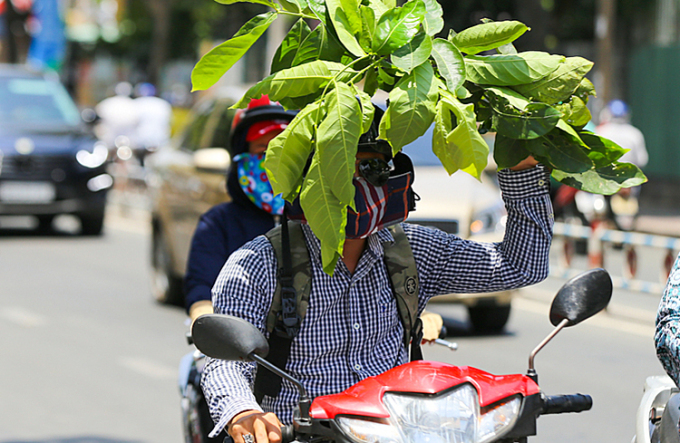
Saigon residents in the sweltering heat, April 2023. Photo: Quynh Tran
Treatment
Approximately one hour after the onset of severe heatstroke or heat exhaustion symptoms is the "golden hour" for emergency treatment. Therefore, initial first aid at the scene is crucial.
First, move the patient to a cool, well-ventilated place (a shady spot, a cool vehicle, or a cool house), and call for emergency assistance. While waiting for emergency services, clear the airway, perform artificial respiration, and chest compressions if the patient is unconscious and has no pulse. Immediately apply cooling measures to lower body temperature and measure body temperature if a thermometer is available.
Remove the patient's clothing and apply warm compresses, then use a fan to increase evaporation. The patient should lie on their side or be supported with their arm on a knee so that the skin surface can receive as much airflow as possible. Apply cold compresses or ice packs to the armpits, groin, and neck. Give plenty of water or electrolyte solution if the patient is conscious and able to drink.
Finally, the patient is transported to the hospital. The transport process continues to be cooled to lower the patient's temperature.
Prevention
Doctors advise that when going out in hot, sunny weather, you should cover your body by wearing loose, light-colored clothing, a wide-brimmed hat, and using sunscreen. Drink plenty of water, even if you don't feel thirsty. You can drink water with a little salt, oral rehydration solution (ORS), or fruit juice, but avoid sugary sodas and energy drinks.
Avoid working for extended periods in direct sunlight or in hot environments. Avoid strenuous physical activity. Take regular breaks after every 45 minutes to an hour of continuous work in hot conditions, resting in a cool, well-ventilated area for 10-15 minutes.
Always ensure you are fully equipped with sun and heat protection gear such as protective work clothing, safety helmets, wide-brimmed hats, and sunglasses. Create a cool and well-ventilated working environment, especially in factories, tunnels, and furnaces.
When moving from a hot, sunny environment to a shady place, the body sweats profusely, causing a rise in body temperature. Taking a shower immediately after showering can cause a sudden and dangerous change in body temperature, potentially leading to a stroke.
During hot weather, drink plenty of water and eat cooling foods, including vegetables and fruits rich in potassium such as jute leaves, spinach, water spinach, and tomatoes. Wear loose, breathable clothing that allows sweat to evaporate easily. Never leave children or anyone else in a parked car with the engine off in hot weather, even for a short time, as the temperature inside the car can rise by more than 11 degrees Celsius in just 10 minutes.
Thuy Quynh
Source link
![[Photo] “Red Journey” 2026: Vietnamese Youth Continue Building the Bridge of Friendship Between Vietnam and China](https://vphoto.vietnam.vn/thumb/1200x675/vietnam/resource/IMAGE/2026/04/20/1776629730866_4055880775670638308-9618-4200-jpg.webp)





























































































Comment (0)