

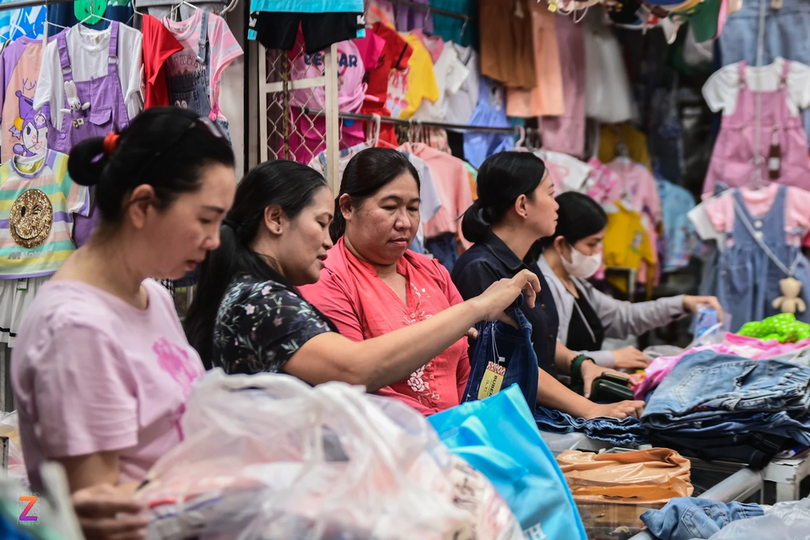
The Ministry of Finance recently submitted to the Ministry of Justice a dossier for appraisal of the draft Law on Personal Income Tax (amended). In it, the drafting agency proposes amendments and improvements to the regulations on the method of calculating tax on business income of resident individuals.
According to Article 10 of the current Personal Income Tax Law, individuals engaged in business activities pay personal income tax at a percentage of their revenue for each field and industry of production and business.
Revenue is the total amount of money from sales, processing fees, commissions, and service provision generated during the tax period from the production and business activities of goods and services.
In cases where an individual business owner cannot determine their revenue, the competent tax authority will determine the revenue in accordance with the provisions of the law on tax administration.
To implement the policy of abolishing the lump-sum tax system from January 1, 2026, the draft Law adds a method for calculating tax on business income of resident individuals with annual revenue exceeding the level stipulated by the Government, which is determined by multiplying taxable income by a tax rate of 17%.
In this context, taxable income is determined by the revenue from the sale of goods and services minus the expenses related to production and business activities during the tax period.
This regulation is equivalent to the corporate income tax regulations for small and medium-sized enterprises currently stipulated in the Corporate Income Tax Law No. 67/2025/QH15, which applies a tax rate of 17% to businesses with total annual revenue from over 3 billion VND to no more than 50 billion VND.
For individual business owners whose annual revenue falls below the government-set threshold, the current Personal Income Tax Law will maintain the tax calculation method based on a percentage of revenue.
The Ministry of Finance also proposed adjusting the tax rates on certain income derived from the provision of digital content products and services related to entertainment, video games, digital films, digital photos, digital music, and digital advertising.
Law No. 71/2014/QH13 amending and supplementing a number of articles in tax laws and guiding documents on taxation (effective from January 1, 2015) stipulates that individuals conducting business with revenue exceeding 100 million VND/year shall pay personal income tax at a rate based on revenue according to each industry, field of production, and business.
Accordingly, the tax rates are as follows: distribution and supply of goods: 0.5%; services and construction without material procurement: 2% (except for property leasing, insurance agency, lottery agency, and multi-level marketing agency activities: 5%); manufacturing, transportation, services related to goods, and construction with material procurement: 1.5%; and other business activities: 1%.
During the implementation process, some opinions suggested that the personal income tax rate on revenue needed to be recalculated and adjusted to suit the characteristics of certain types of income and specific business activities, such as the provision of digital information content products and services related to entertainment, video games, digital films, digital photos, digital music, and digital advertising.
Currently, individual income from these activities is regulated like other income sources (applied according to percentages based on revenue for each of the aforementioned sectors). However, these are income sources with unique characteristics that require appropriate tax rates to ensure equality among taxpayers, consistency within the tax policy system, and to ensure the effective role of personal income tax policy in regulating and redistributing income within the tax system.
The Ministry of Finance proposes a tax rate of 5% on certain income derived from the provision of digital content products and services related to entertainment, video games, digital films, digital photos, digital music, and digital advertising.
Source: https://baohatinh.vn/de-xuat-ca-nhan-kinh-doanh-co-tong-doanh-thu-tren-3-ty-dong-chiu-thue-17-post295054.html





































































Comment (0)