

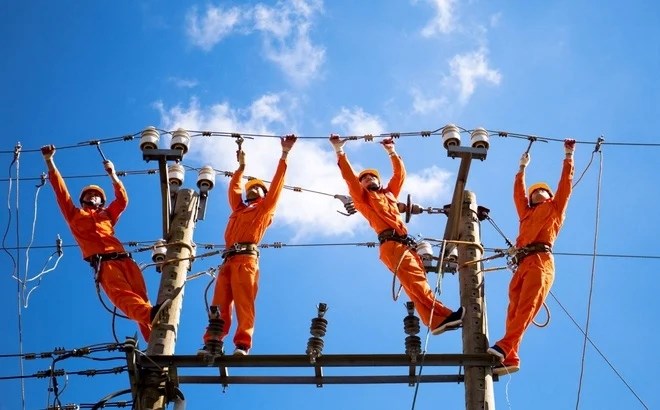
It needs to be studied thoroughly.
At the Price Steering Committee meeting, the Ministry of Industry and Trade proposed adjusting electricity prices this year to reflect fluctuations in input costs and to help Vietnam Electricity Group (EVN) have the resources to pay investors in power plants.
Speaking to Lao Dong newspaper, a representative from the Price Management Department of the Ministry of Finance stated that, for electricity, there were two price adjustments in 2023, based on decisions by EVN and under the management and supervision of competent state agencies, with increases of 3% and 4.5% respectively.
The impact assessment of electricity price adjustments is thoroughly conducted within the price management scenarios of the Prime Minister's Price Management Steering Committee to ensure both inflation control and support for socio-economic development.
According to the Price Management Department, overall for the year, due to the impact of EVN's price adjustments and increased electricity demand during Tet and the hot summer months, the price index for household electricity increased by 4.86%, contributing 0.16 percentage points to the overall CPI increase.
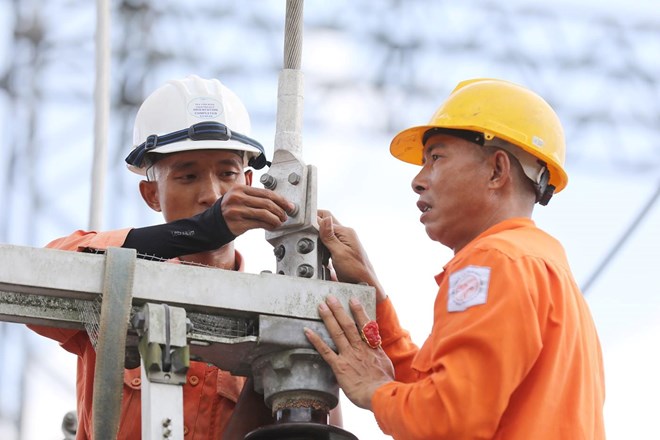
Speaking to Lao Dong newspaper, Professor Vo Dai Luoc, former Director of the Institute of Economics and Politics, said that increasing electricity prices is necessary to compensate for losses, but EVN needs to be transparent in its electricity purchase and sale prices and business results to avoid negatively impacting public sentiment.
Regarding electricity price increases, according to Professor Vo Dai Luoc, the increase should be below 5%, within the authority of EVN (Vietnam Electricity). This increase would be sufficient for EVN to resolve its accumulated losses while avoiding widespread impact on the public.
Regarding the timing of the electricity price increase, Mr. Luoc stated that there would absolutely be no increase in electricity prices during the hot season (from May to July) to avoid a sudden surge in electricity bills, which would cause customer dissatisfaction. Therefore, the electricity price increase will be scheduled for October this year.
However, Mr. Ngo Duc Lam, former Deputy Director of the Institute of Energy, emphasized that accelerating power generation projects instead of raising prices is the fundamental solution for the electricity sector, rather than using price increases to address EVN's losses. Therefore, the proposal to increase electricity prices needs to be carefully studied.
According to expert Lam, electricity prices need stability to minimize adverse impacts on macroeconomic stability and social welfare, because electricity prices are different from other products such as gasoline, which are immediately affected by world prices and do not require frequent adjustments.
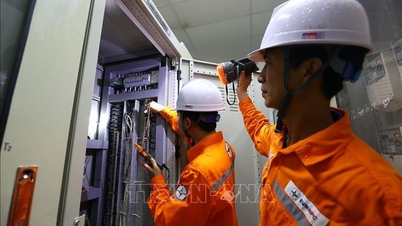
EVN recommends that customers save electricity.
Meanwhile, Mr. Vo Quang Lam, Deputy General Director of Vietnam Electricity Group (EVN), said that EVN's tasks for 2024 include a series of issues that the Ministry of Industry and Trade and the Government are particularly interested in, the most fundamental of which is ensuring electricity supply.
"EVN has identified three key areas: ensuring electricity supply, developing and maintaining power sources and the power grid, and encouraging electricity saving mechanisms," an EVN leader said.
Regarding supply assurance, Mr. Lam stated that EVN currently holds 37% of the power generation structure, and the group's power plants have been thoroughly instructed to always ensure continuous operation, water storage, sufficient coal, and to prepare scenarios for early repair and maintenance of machinery.
The remaining more than 63% of electricity sources currently belong to other corporations such as the Vietnam Coal and Mineral Corporation (TKV), the Vietnam Oil and Gas Group (PVN), and private partners in wind, solar, and biomass power. EVN is also coordinating with them to request that they prepare supply scenarios to prevent electricity shortages.
Regarding power generation and grid development, the Deputy General Director of EVN stated that before 2016, EVN was more involved in this field, but currently, there are not many new investment projects, so power generation and grid development remain limited.
While new investments in power generation and grids depend on financial capacity, take a long time, and are difficult to implement immediately, solutions for saving electricity and using it efficiently can be implemented right away and benefit both the power industry and the country.
Most importantly at this time, EVN leaders emphasized that the corporation wants all its customers to participate in the electricity saving plan, with the largest group being industrial and construction customers and household consumers.
Source
![[Photo] Closing Ceremony of the 10th Session of the 15th National Assembly](/_next/image?url=https%3A%2F%2Fvphoto.vietnam.vn%2Fthumb%2F1200x675%2Fvietnam%2Fresource%2FIMAGE%2F2025%2F12%2F11%2F1765448959967_image-1437-jpg.webp&w=3840&q=75)
![[Photo] Prime Minister Pham Minh Chinh holds a phone call with the CEO of Russia's Rosatom Corporation.](/_next/image?url=https%3A%2F%2Fvphoto.vietnam.vn%2Fthumb%2F1200x675%2Fvietnam%2Fresource%2FIMAGE%2F2025%2F12%2F11%2F1765464552365_dsc-5295-jpg.webp&w=3840&q=75)







































![[OFFICIAL] MISA GROUP ANNOUNCES ITS PIONEERING BRAND POSITIONING IN BUILDING AGENTIC AI FOR BUSINESSES, HOUSEHOLDS, AND THE GOVERNMENT](https://vphoto.vietnam.vn/thumb/402x226/vietnam/resource/IMAGE/2025/12/11/1765444754256_agentic-ai_postfb-scaled.png)




































Comment (0)