

A test paper with a score of 9.5 has appeared.
As of July 9th, 34 provinces and cities nationwide are urgently carrying out the grading of the 2025 high school graduation exams. According to the plan, the grading will be completed and the data sent to the Ministry of Education and Training no later than July 10th. It is expected that the exam results will be announced by the examination boards nationwide at 8:00 AM on July 16th.
Of all the subjects in the exam, only the literature exam was graded by teachers from the local province; the remaining multiple-choice exams were graded by machine.
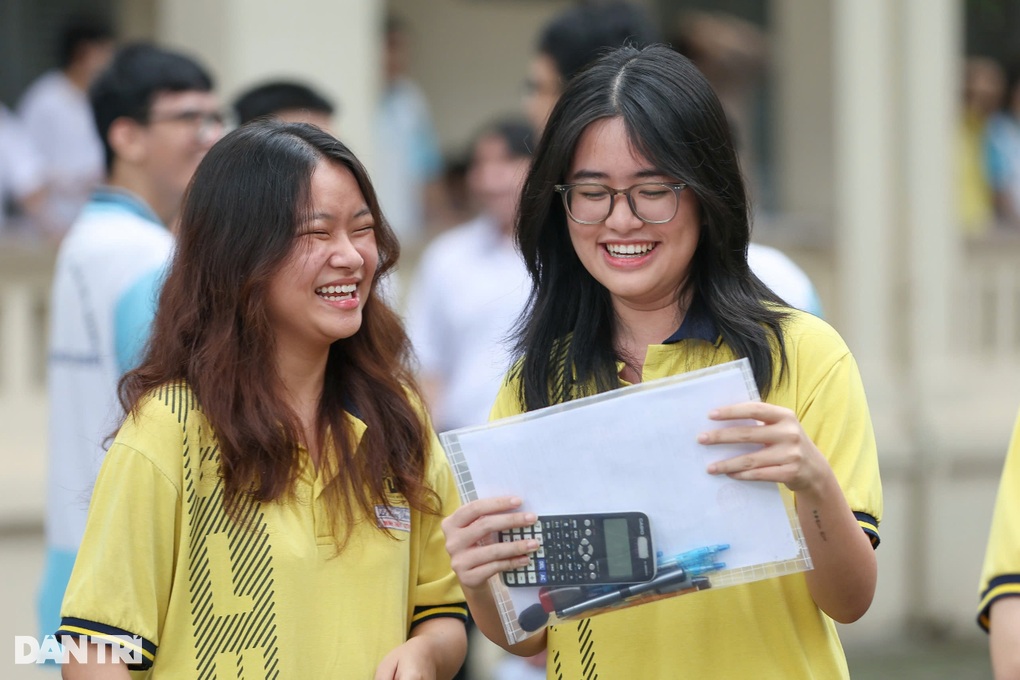
Candidates taking the 2025 high school graduation exam in Ho Chi Minh City (Photo: Trinh Nguyen).
According to some judges from Hung Yen, although Hung Yen and Thai Binh were merged on July 1st, the judging process took place from the end of June, so the two judging panels continued to be held at two different locations as before.
The teacher said he was surprised that the quality of the students' work was better than expected.
"Before grading, I was quite concerned that the exam's structure had changed, becoming more open-ended and clearly incorporating current events, which might overwhelm first-time candidates taking the new curriculum. However, after grading, overall, it didn't pose much difficulty for students who had a solid grasp of the material, and few students received excessively low scores," this examiner said.
According to this judge, the social commentary section is an opportunity for students to score points if they show interest in current events regarding the process of merging provinces and cities, or if they can touch upon ideas about love and attachment to the land they live on, love for their country, etc. This demonstrates the students' ability to apply their knowledge flexibly and think critically.
Among the papers judged by this panel, there were also entries that received a score of 9 points.
A judge in Ho Chi Minh City also stated that they were instructed to grade the Literature exam according to the answer key and grading guidelines of the Ministry of Education and Training, and that there had been discussions and agreements on the grading method throughout the process.
In particular, attention should be paid to evaluating the content of candidates' papers in an open-ended manner, encouraging creativity and critical thinking and reasoning abilities, avoiding imposing judgments. Any shortcomings or problems that arise should be promptly identified and reported for adjustment and resolution, in order to ensure the best interests of the candidates.
For essays with original ideas, different expressions, or different approaches from the answer key, the examiners will consider the persuasiveness of the essay to award points fairly.
The judge noted that, overall, the grading process saw papers scoring above 9 points, with some even reaching 9.5 points.
The judges noted a clear difference between this year's exam and previous years: candidates wrote more concisely because the question itself set a word limit, reducing the use of formulaic essays.
A new feature in this year's grading is that judges will deduct points for essays with many errors (in expression, spelling, word usage, and sentence structure).
Scores of 9 are no longer as common as they used to be, but they're not rare either.
A teacher involved in grading exams in a northern province also stated that this year there won't be a "flood of 9s" in the literature subject like in 2024, but there will still be quite a few. The most common score will be in the range of 6-7 points.
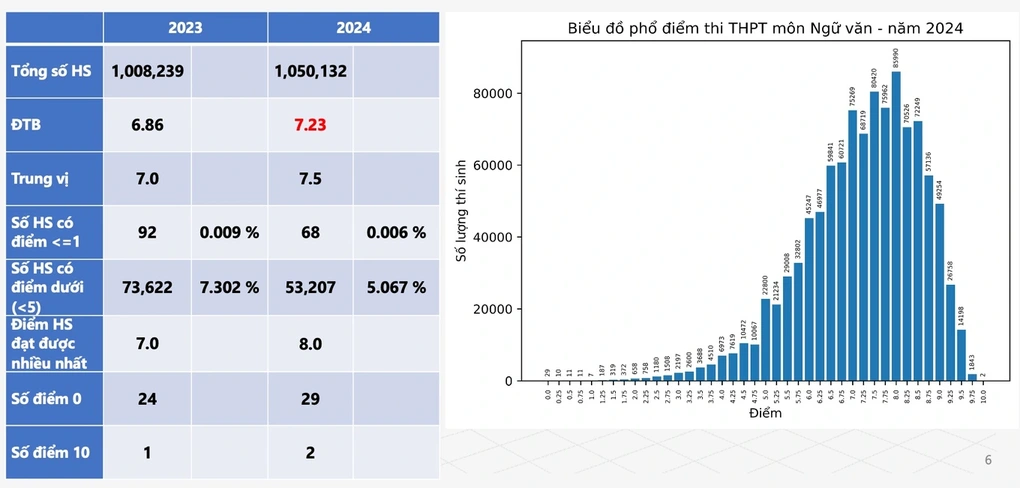
Score distribution for the 2024 high school graduation exam in Literature (Source: Ministry of Education and Training).
Responding to the controversy surrounding the open-ended questions and closed-ended answers, the female teacher stated that the answers published by the Ministry only provide a framework of required learning outcomes, not "rigid" content that candidates must include in order to receive points.
"There's only one correct answer, but students' responses are incredibly varied. Some candidates completely equate the social commentary topic with the merger of provinces and cities."
Some candidates saw a connection between love for a specific region and love for the homeland. Each essay also offered a different explanation of the idea that "every region of one's homeland is also the region of the nation," this person said.
Regardless of the perspective, the goal of this essay is not to find out who wrote more accurately, or who had a broader, more comprehensive viewpoint, but rather to assess the skill of solving an argumentative essay problem.
"Candidates can propose different approaches and methods for discussing the issue, offering different explanations, as long as they are reasonable and convincing," the female teacher said.
The female teacher added that on the first day of grading, the examiners randomly selected a set of papers to grade collectively and discuss the answers. These collectively graded papers served as a reference for the individual papers graded later.
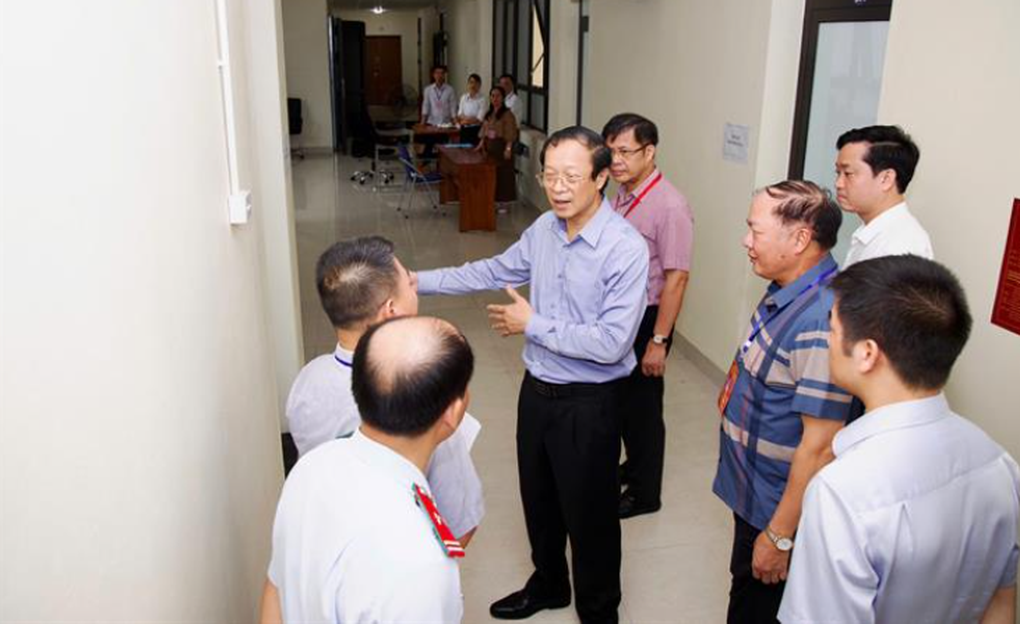
Deputy Minister of Education and Training Pham Ngoc Thuong inspects the exam grading process in Bac Ninh (Photo: MOET).
This year's essay grading system is also quite new, no longer counting points for each idea. The essays are evaluated on both content and wording, focusing on writing style, ensuring coherence and logical expression. If an essay contains too many spelling or grammatical errors, points will be deducted.
"In the 2018 general education curriculum, students learn about correcting grammatical errors in texts. This is an important skill to prevent students from making writing mistakes. Therefore, the literature exam also requires candidates to have this communicative skill," the teacher explained.
According to the female teacher, the reading comprehension section in this year's literature exam will not have many perfect scores. The reason lies in the "unusual" question number 5. This question never appeared in the sample exam and was a surprise to both students and teachers. She believes that only candidates with strong literary appreciation skills will be able to fully solve this question.
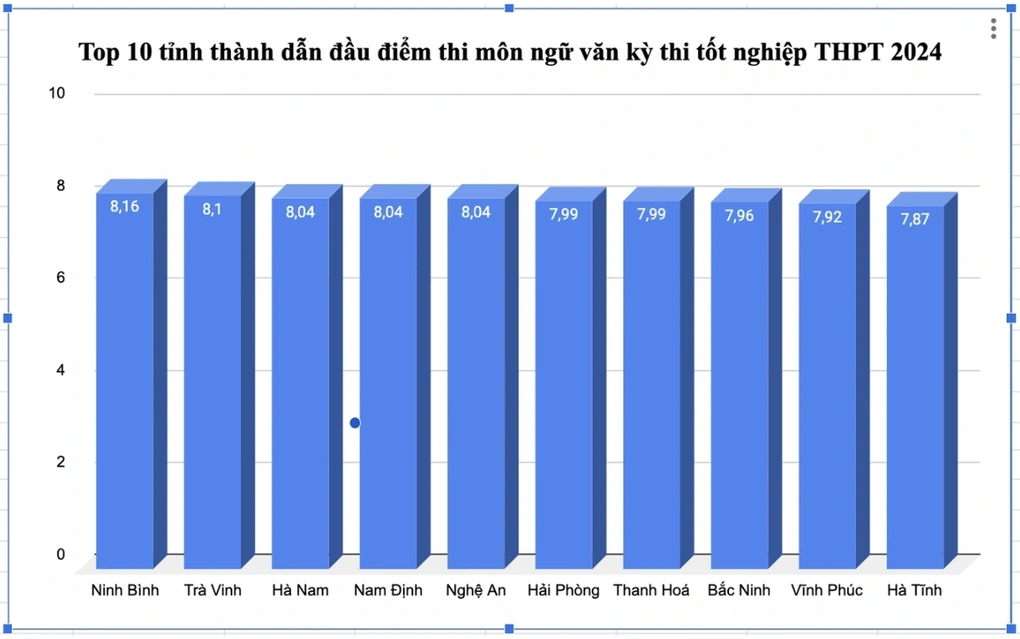
Top 10 provinces and cities leading in Literature exam scores in the 2024 High School Graduation Exam (Chart: Hoang Hong).
In 2024, scores in the literature exam increased dramatically, second only to civics. Out of 1 million test-takers, more than 90,000 achieved a score of 9 or higher in literature.
Specifically, based on the old administrative boundaries, two candidates from Nam Dinh and Dong Thap provinces scored a perfect 10.
Next, there were 1,843 candidates with a score of 9.75, 14,198 candidates with a score of 9.5, 26,758 candidates with a score of 9.25, and 49,254 candidates with a score of 9. The total number of candidates with a score of 9 or higher is 92,055.
The "flood of high scores" in the literature subject also contributed to the unusually high number of valedictorians in the C00 group, with 19 people. Of these, 13 candidates are students from Bac Ninh province.
According to calculations, for every 10 students from Bac Ninh, 1 student scored 9.5 or higher in Literature.
Along with Bac Ninh, one in four candidates in Tra Vinh also achieved a score of 9 or higher in Literature, helping the province "jump" from 51st to 2nd place nationwide in terms of high scores in this subject in the 2024 high school graduation exam.
Source: https://dantri.com.vn/giao-duc/diem-thi-ngu-van-tot-nghiep-thpt-2025-lieu-co-xuat-hien-mua-diem-9-20250709061824450.htm


![[Photo] Closing Ceremony of the 10th Session of the 15th National Assembly](/_next/image?url=https%3A%2F%2Fvphoto.vietnam.vn%2Fthumb%2F1200x675%2Fvietnam%2Fresource%2FIMAGE%2F2025%2F12%2F11%2F1765448959967_image-1437-jpg.webp&w=3840&q=75)


![[Photo] Prime Minister Pham Minh Chinh holds a phone call with the CEO of Russia's Rosatom Corporation.](/_next/image?url=https%3A%2F%2Fvphoto.vietnam.vn%2Fthumb%2F1200x675%2Fvietnam%2Fresource%2FIMAGE%2F2025%2F12%2F11%2F1765464552365_dsc-5295-jpg.webp&w=3840&q=75)












































![[OFFICIAL] MISA GROUP ANNOUNCES ITS PIONEERING BRAND POSITIONING IN BUILDING AGENTIC AI FOR BUSINESSES, HOUSEHOLDS, AND THE GOVERNMENT](https://vphoto.vietnam.vn/thumb/402x226/vietnam/resource/IMAGE/2025/12/11/1765444754256_agentic-ai_postfb-scaled.png)





































Comment (0)