

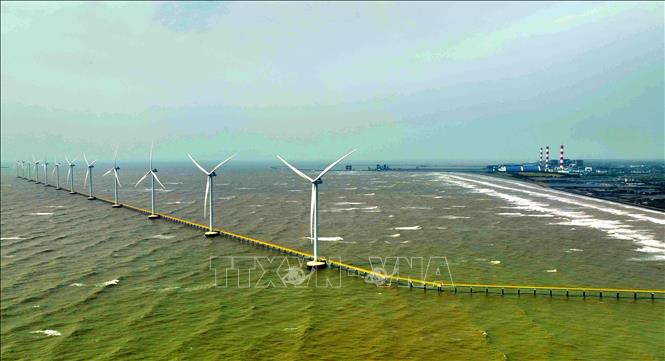
The event aims to create a scientific forum for researchers and experts to exchange and share international experiences and Vietnam's practices in the process of implementing the "0" net emission target that Vietnam committed to at the COP26 Conference.
The workshop includes four thematic discussion sessions, focusing on important pillars of green transformation such as climate policy adjustment, energy policy, finance, climate, green finance and international cooperation. With the participation of many prestigious experts and scientists, the event is expected to bring new perspectives and suggest many practical policy recommendations for Vietnam in the next phase.
In his opening speech at the workshop, Dr. Nguyen Song Tung, Director of the Institute of Human Geography and Sustainable Development, emphasized that after COP26, countries around the world have entered a period of strong implementation of climate plans, in which the goal of achieving net zero emissions by mid-century is considered the central orientation. Policy adjustments have therefore become an urgent requirement, not only in the energy sector, the key pillar of the emission reduction process, but also in the fields of industry, agriculture , transportation, finance, trade and foreign affairs.
Many countries have enacted climate laws, established carbon market mechanisms, promoted public investment in renewable energy, reformed fossil fuel subsidies, promoted carbon capture and storage technology, and integrated climate goals into national development strategies. Models such as Japan's green growth strategy, Indonesia's balanced energy transition, Singapore and Thailand's integrated economic model based on biotechnology, circular economy and green economy (BCG), or Europe's carbon trading system show diverse and referential approaches.
According to Dr. Nguyen Song Tung, studying international experiences will help Vietnam identify effective conversion models, determine tools and conditions suitable for the domestic context. The discussion sessions will suggest more important scientific issues, making practical contributions to the research orientation and policy-making process to effectively implement the climate commitments that Vietnam made at COP26.
Dr. Do Ta Khanh, Deputy Director of the Institute of Human Geography and Sustainable Development, Head of the project, said that the research "Adjusting policies of countries around the world to implement commitments at COP26 and implications for Vietnam" was deployed from February 2025 and is expected to be completed in May 2027. This is a task under the KC.06 Program, aiming to provide scientific arguments for building policies to respond to climate change and implement Vietnam's commitment to net zero emissions.
This workshop was organized as an important professional activity of the topic, aiming to collect more international experience and evaluate policy adjustments of countries after COP26. From 19 submitted articles, the Organizing Committee selected 9 typical reports revolving around four major topics including energy transition, emission reduction policy, finance, carbon market and green economic model. The academic exchange and comments from experts will help the topic complete the analytical framework, identify effective policy models and draw out appropriate application conditions for Vietnam. The workshop results are also an important basis for the research team to build a thematic report and propose policy recommendations in the next phase.
Dr. Pham Thi Tram, Deputy Director of the Institute of Humanities and Sustainable Development and Dr. Nguyen Hong Quang, Institute of Asia-Pacific Studies (Vietnam Academy of Social Sciences) said that Thailand's experience shows that implementing commitments at COP26 is only effective when accompanied by synchronous policy adjustments, especially in the fields of energy, transport, industry and agriculture. Thailand has promoted investment incentives for emission-reducing technology and infrastructure, encouraged businesses to participate in the transition through green financial mechanisms, carbon markets, taxes and carbon credits, and promoted solar power, wind power, biofuels and electrification of transport, especially the development of electric vehicles.
According to the two experts, these are experiences worth considering for Vietnam in the process of concretizing the net zero emission target. Vietnam needs to soon complete the legal framework, design appropriate support packages to reduce conversion costs for businesses, combine market tools with mandatory regulations on inventory and emission reduction. Along with that, it is necessary to increase the development of renewable energy, encourage the use of agricultural by-products as an energy source, invest in carbon capture, storage and use technology, thereby gradually forming a green and sustainable growth model.
During the discussion sessions, delegates focused on analyzing the policy adjustment experiences of many countries in implementing commitments at COP26, especially Japan, Thailand, Indonesia and Singapore. Japan is considered a comprehensive green transition model with a synchronous legal framework, GX-ETS carbon pricing mechanism, issuing climate transition bonds and mobilizing about 150 trillion yen for emission reduction projects; Thailand pursues the goal of carbon neutrality by 2050, promoting the renewable energy roadmap, developing carbon markets, carbon taxes and 30@30 electric vehicle policies (the goal is that by 2030, 30% of domestically produced vehicles will be electric vehicles), Indonesia implements the Just Energy Transition Program towards phasing out coal, expanding international cooperation and attracting finance for renewable energy. Some other countries such as Singapore and India focus on carbon taxes, mandatory carbon markets and strong incentives for clean technology.
Based on international experience, delegates suggested that Vietnam should build a long-term legal framework with clear emission reduction targets; expand green finance mechanisms; develop domestic carbon markets; promote solar power, wind power, and green hydrogen; and at the same time, strengthen international cooperation to acquire technology, resources, and modern climate governance models. This is considered an important foundation for Vietnam to effectively implement the target of net zero emissions by 2050.
Source: https://baotintuc.vn/chinh-sach-va-cuoc-song/dieu-chinh-chinh-sach-thuc-hien-cam-ket-cop26-20251205143338743.htm
![[Photo] 60th Anniversary of the Founding of the Vietnam Association of Photographic Artists](/_next/image?url=https%3A%2F%2Fvphoto.vietnam.vn%2Fthumb%2F1200x675%2Fvietnam%2Fresource%2FIMAGE%2F2025%2F12%2F05%2F1764935864512_a1-bnd-0841-9740-jpg.webp&w=3840&q=75)

![[Photo] Cat Ba - Green island paradise](/_next/image?url=https%3A%2F%2Fvphoto.vietnam.vn%2Fthumb%2F1200x675%2Fvietnam%2Fresource%2FIMAGE%2F2025%2F12%2F04%2F1764821844074_ndo_br_1-dcbthienduongxanh638-jpg.webp&w=3840&q=75)















































































Comment (0)