

(NB&CL) At Thuong Lam wharf, I didn't haggle with the Gam River when climbing Khuoi Nhi waterfall. I said: "After climbing the mountain, watching the waterfall and the stream, then standing still and holding my breath while the fish lick my feet, the feeling of the fish licking my feet is like getting a massage at a brightly lit spa in the city."
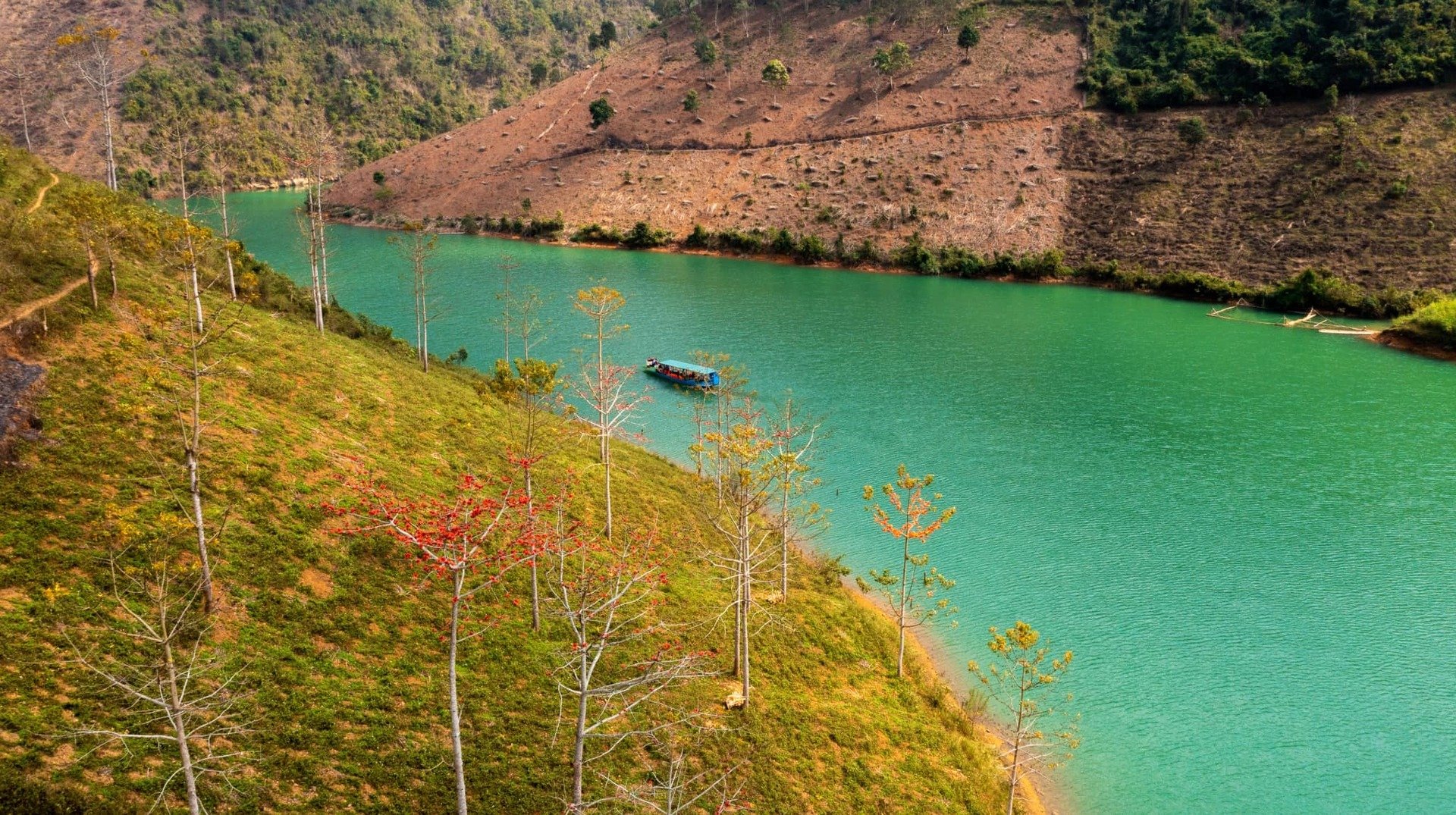
Crossing the stream beneath Khuoi Nhi waterfall, then to Khuoi Sung, and not having to overcome several slippery, moss-covered slopes to reach Na Khuon, one finds a village at the foot of the mountain with only seven houses. These seven families were recently displaced from the riverbed to the mountains. They cleared the land, planted corn and peanuts, and raised livestock, living comfortably in this magical countryside with its 99 enchanting mountains.
Here you can see mountains upon mountains. There are 99 mountains here, and legend says that 99 birds once perched on each mountain. When the lead bird flew away, there was no 100th mountain, and so the flock flew away. The birds flew to Hanoi , so that beloved Hanoi could become the capital today. The villagers still enthusiastically tell stories about the mountains, so I wouldn't dare bargain with the Gâm River. I spend a day traveling through rivers and streams but a whole week exploring the mountains; the Gâm River surely won't be angry with me.
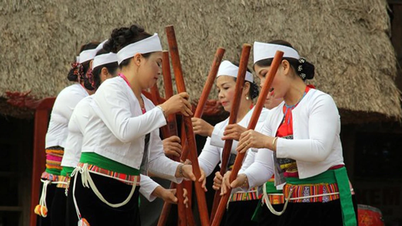
Six days in Na Dong or Na Thuon, I went to Khuoi Nhi in the evening to watch the bamboo dance, then listened to the Hmong people's zither and flute, a melancholic yet beautiful melody, like the moon rising and hanging obliquely on the mountainside. The next morning, I skipped breakfast to cycle to Na Thuon to meet my niece Thuy to plant corn and chat about the Covid days. The Thuong Lam boat dock was deserted of tourists . The boats were moored there for the afternoon and night, looking desolate. The villagers' houses were piled high with sacks of corn and rice, which they used daily; if they couldn't eat it all, they used it for livestock. They raised fat chickens, ducks, and geese, but if no one bought them at the market, they used the surplus to feed pigs. The ducks and geese were getting old; they'd roast them for Tet (Lunar New Year). As for the pork – would they roast it, smoke it, grill it, or freeze it for the spring? The villagers hadn't decided yet.
I stood in the middle of the field, lost in thought, when I noticed the acacia trees at the foot of the mountain shedding their golden leaves, and flocks of warblers chirping to each other right next to the rapeseed flower garden. The peace and quiet were so profound that the corn planters continued planting their corn, and the warblers and finches swooped down to the rapeseed garden, scattering their seeds among the flowering corn, thus creating a staggered crop cycle.
The bright red plow was diligently tilling the soil, loosening it. In Na Dong, I asked a drunk boy for directions. I learned his name was Vien, and he put down his flour mill to show me the way to a villager's orange orchard. He was drunk but ran barefoot to show me the way. Vien said , "I'm Nong Van Vien, I'll show you the way, ma'am." He staggered, his speech slurred, but still tried to say, "I'll take some really beautiful pictures for you in the orange orchard." The path to Mr. Van Ngon's orange orchard wasn't far; it was lined with bamboo and small ponds. Along the path were palm groves with their leaves swaying, the locals growing palms and using them to roof their kitchens, pigpens, and buffalo sheds. In the cold, they knew how to protect their livestock. Chickens crowed at the end of the orchard. Flocks of ducks and geese grazed in the ponds, surrounded by swaying bamboo. Mr. Van Ngon's orange orchard was quite large.
The warmth and hospitality of the locals truly touched the hearts of every visitor. Here, houses are never locked, there is no theft, no drug addicts, no drugs, and never any burglaries. The people here accept poverty to preserve and protect the forest. Mr. Nguyen Van Hien, who is knowledgeable about the forests and mountains of Tuyen Quang, told me, "The environment here is pristine. Although the district still has four extremely poor communes, the people accept poverty rather than destroy the forest."
The orange orchard owner offered me oranges, but I wasn't in the mood to eat them; instead, I went to visit the beautiful, ripe orange grove. Mr. Van Ngon said that if it weren't for the Covid pandemic, tourists would have come in large numbers. They would buy oranges and take pictures of the orchard and the lush green mountains. According to Dr. Ngo Kieu Oanh: "The people in Thuong Lam are not poor, especially in the communes of Na Dong, Na Thuon, and Na Liem. The forest has provided them with a comfortable life because the local people know how to preserve and protect the forest and maintain a green, clean, and beautiful environment." Ms. Oanh is also working on a project to green the environment by planting medicinal plants, raising bees, and livestock farming. Local products from Lam Binh will be expanded, including shiitake mushrooms, bamboo shoots, honey, and various traditional medicinal herbs.
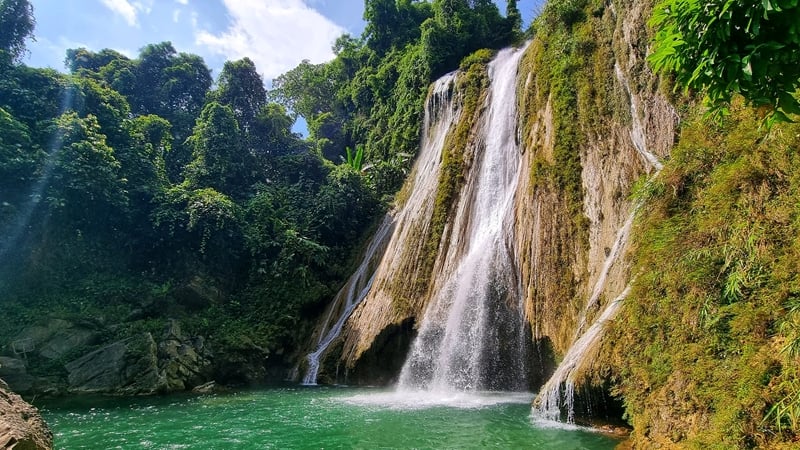
Khuoi Nhi Waterfall is as beautiful as a soft silk ribbon, an ideal stopping point for tourists traveling upstream on the Gam River. Photo by Nguyen The Luong.
There are many homestays here, with overnight stays costing 80,000 VND per person. Meals range from 50,000 to 100,000 VND for lunch and dinner, depending on your preference for delicious dishes. The most special dishes in Thuong Lam are grilled catfish and "pak pi" (a type of salad made with banana blossoms mixed with minced meat and various forest herbs). You won't want to swallow it all because of the fragrant aroma and the sweet taste of the banana blossoms.
If you're looking to savor the flavors and aromas of the mountains and forests, the food here is always a top-notch treat for discerning travelers. The meals here are served on trays lined with banana leaves, without plates; a meal of 6 to 7 dishes is simply presented on the tray. After climbing mountains and visiting streams, sitting down to enjoy a meal on a banana leaf tray is incredibly delicious. All the fatigue from the long journey disappears. If you don't believe me, come to Lam Binh, nearly 400 kilometers from Hanoi. If you're going into the mountains, ask the locals for directions; they're very helpful.
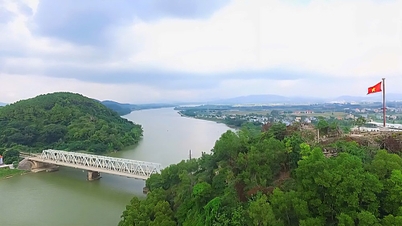
Coming to Tuyen Quang, you'll face the Gam River and the ancient forests, where there are lakes, rivers, streams, and majestic mountains. Lam Binh is the most remote and highest place. In this mountainous region, with its stilt houses and fireplaces, you'll see and hear the Then folk songs and the melodious Hmong flute. Campfire nights will bring you closer to the land and the green forest, a peaceful happiness returning to the traveler after many worries are soothed, tranquility returns, and happiness returns on the threshold of spring.
Hoang Viet Hang
Source: https://www.congluan.vn/doi-mat-voi-song-gam-post331242.html

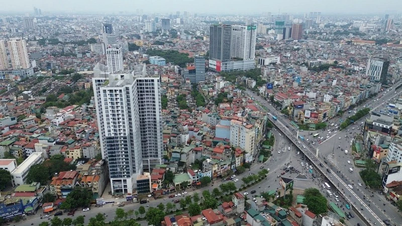
![[Image] Hanoi's urban life under the challenge of a "scorching hot" environment](https://vphoto.vietnam.vn/thumb/1200x675/vietnam/resource/IMAGE/2026/05/25/1779706979265_nang-nong-t5-2026-minh-duy-7-4636-jpg.webp)





















































































Comment (0)