

Stepping into a Toyota dealership and spending billions of dong to buy a Land Cruiser or Prado, the prices are clearly listed by the dealership, but customers still can't find a vehicle if they lack the "bribe" of 500-800 million dong.
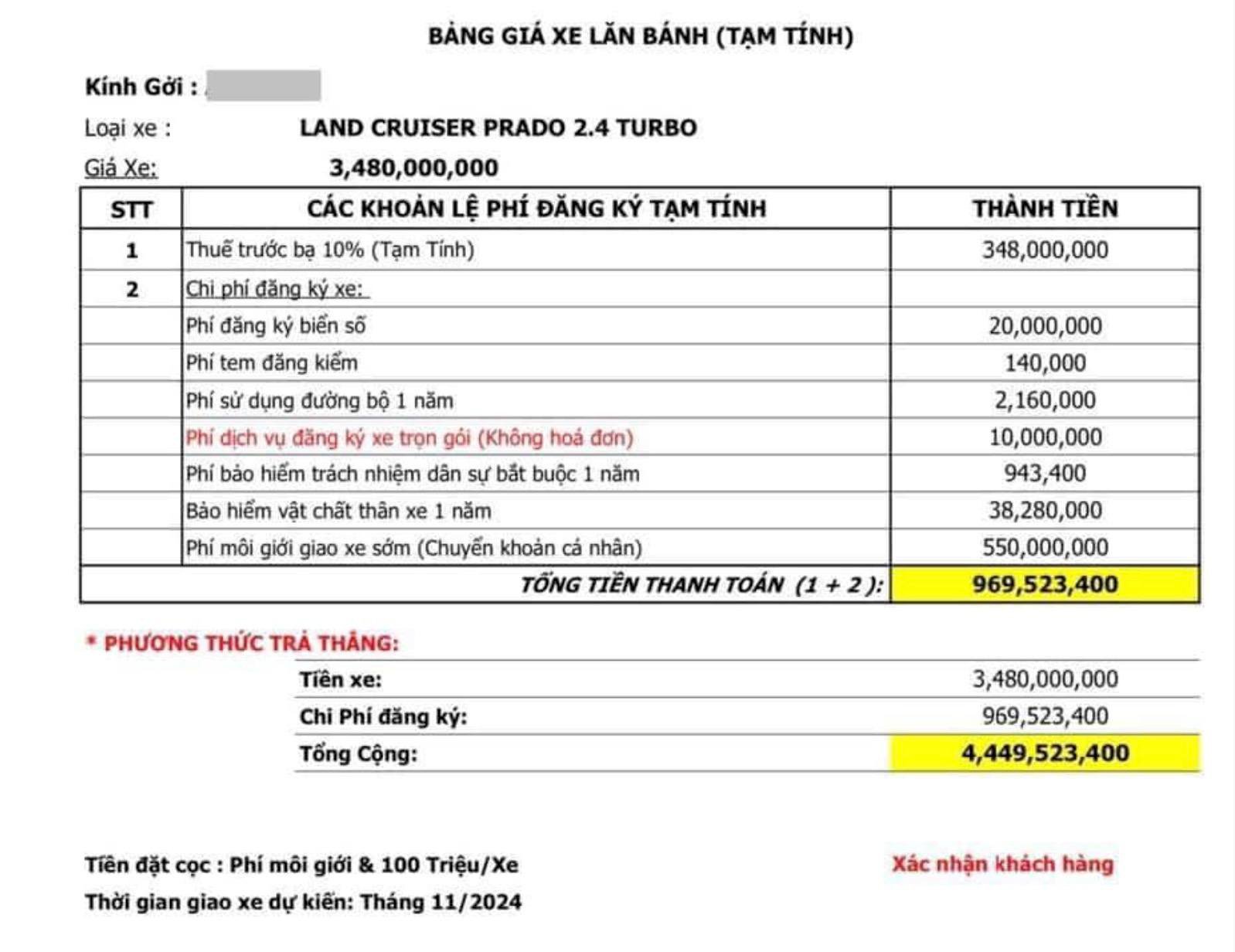
A vehicle delivery fee spreadsheet showing an "early delivery brokerage fee" of 550 million VND - Photo: TTO
Tuổi Trẻ newspaper has published a series of investigative articles on the " underworld " of selling luxury Toyota cars. It sounds like a joke, but it's true, and it's happening at many Toyota dealerships in Vietnam, especially with imported models like the Land Cruiser 300.
Reporters from Tuoi Tre newspaper visited dealerships in Ho Chi Minh City and observed that many car models were being sold at prices significantly higher than their listed prices.
The "bundled extras" phenomenon is nothing new with popular car models. To get the car sooner, customers may have to buy additional accessories, from window tinting and floor mats to expensive body kits. These "bundled extras" costs are fully invoiced.
However, with the Toyota Land Cruiser, the transaction required cash "bribes," without receipts or paperwork. Where that money went, and to whom it ended up, remains a mystery.
Meanwhile, Toyota Vietnam's response remained simple: the company always adheres to the principle of "first come, first served," and there is no policy of forcing customers to pay extra. If there is a problem, just call the hotline, and the company will "handle it promptly."
In its response to Tuoi Tre newspaper, Toyota Vietnam acknowledged that the Land Cruiser and Prado are globally popular models with high demand, resulting in insufficient supply. However, the company did not elaborate on the specifics, only promising to "do its best" to improve the situation.
Therefore, many people wonder if this shortage is just an excuse for dealers to raise prices, or if the manufacturer is simply turning a blind eye to this situation?
In the Vietnamese automotive market, price fluctuations based on supply and demand are nothing unusual. However, customers having to pay hundreds of millions of dong in cash without receipts just to get their cars sooner is no longer a normal market.
The press and social media have been buzzing for years about customers having to pay hundreds of millions of dong in bribes to buy this car model, yet the company is still waiting for customer feedback via... hotline.
Agency staff instruct customers not to transfer "bribes" to the company but to transfer them to individuals or receive cash, refusing to provide invoices for these hundreds of millions of dong. Is this a sign of tax evasion and avoidance of detection by authorities?
Lawyer Tran Xoa (director of Minh Dang Quang Law Firm) calculated that with 750 million VND in "bribes" per vehicle, the amount of tax lost could reach 225 million VND, enough to warrant criminal prosecution.
Many automotive experts observe that in Japan or the US, it's rare to see people "paying extra to get their car sooner" with Toyota. So why is it different in Vietnam?
Is the automaker exploiting the Vietnamese people's preference for Toyota vehicles to disregard an unusual distribution model? Toyota's brand reputation, which it has painstakingly built, is now being damaged by incidents like this.
Consumers need manufacturers to take more concrete action regarding price controls, transparent distribution, and strict penalties for dealers who violate regulations.
Otherwise, the price to pay will not only be consumer frustration but also a stain on the reputation of a major brand. Let's not allow the practice of paying hundreds of millions of dong in "bribes" to buy cars to become a bad "custom" in the Vietnamese market.
Source: https://tuoitre.vn/dung-de-chi-tien-lot-tay-mua-xe-thanh-le-20250328074218494.htm















































































Comment (0)