

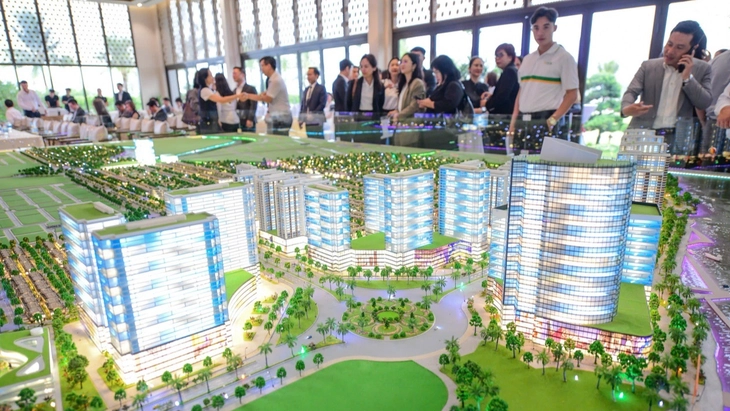
Visitors exploring and learning about an apartment project - Photo: QUANG DINH
At its 5th session in mid-November, the Ho Chi Minh City People's Council continued to approve a list of 63 pilot land plots for implementing pilot projects in accordance with Resolution 171 of the National Assembly . Prior to this, the Ho Chi Minh City People's Committee had also announced its approval for 54 companies to implement pilot projects on 54 land plots that had been approved by the City People's Council.
The fact that the land plots have been approved by the City People's Council for pilot projects is highly anticipated by investors. This is because the time businesses spend waiting for obstacles to be resolved is measured in terms of money and concrete opportunities.
Launch the project as soon as obstacles are removed.
Showing a "document acknowledging receipt of application and scheduled date for results" issued by the Public Administration Service Center of the Ho Chi Minh City Department of Agriculture and Environment, Mr. Duong Quoc Bao, Head of the Project Management Board of the investor of My Phu residential area (Phuoc Long ward, Ho Chi Minh City), said that the company had just been approved by the city to implement the project on 54 land plots for which applications for land use purpose change had been previously submitted.
The Department of Agriculture and Environment has also submitted a document advising the City People's Committee to issue a decision on allocating land for the project to the enterprise. "We have submitted a complete application to the Department of Construction to obtain permission to begin construction. We have already prepared the site, manpower, materials, etc., for the project..."
"We hope that the relevant authorities will quickly resolve the necessary procedures so that we can focus on accelerating the project's construction progress," Mr. Bao said.
According to records, in 2017, the My Phu residential area project received approval from the People's Committee of Ho Chi Minh City for investment policy and for the investor to be My Phu Real Estate Investment and Business Co., Ltd.
The project covers an area of over 4.8 hectares, including approximately 1.5 hectares of residential land and over 3.3 hectares of rice paddy land requiring conversion. It will include two apartment blocks with an estimated population of over 3,000 people and a total investment of nearly 1,600 billion VND. The project implementation period is 4 years.
However, according to Mr. Bao, due to some difficulties, the enterprise has not been able to implement the project within the above timeframe and has requested an extension. In 2024, when the project was launched, it encountered a regulation that only allows the transfer of residential land for commercial housing projects, while more than two-thirds of the project's area is agricultural land.
"Therefore, upon hearing that the City People's Council is urgently implementing Resolution 171 of the National Assembly to remove obstacles for projects involving agricultural land, we are very happy and eagerly awaiting the day to implement the project," Mr. Bao shared.
Similarly, the land plot for the LaChateau 2 commercial housing project (Ward 16, former District 8) of Le Thanh Company, with a scale of 27 floors and 500 apartments, was also approved by the Ho Chi Minh City People's Council in the second phase of the list of 63 pilot land plots. Speaking with Tuoi Tre newspaper , Mr. Le Huu Nghia, General Director of Le Thanh Company, said that the project land plot covers an area of approximately 4,500 square meters, of which 500 square meters is residential land and the remainder is agricultural land.
"Hearing that the City People's Council has approved the pilot project for the company's land plot, I am very happy and am taking steps to implement the project soon...", Mr. Nghia said.
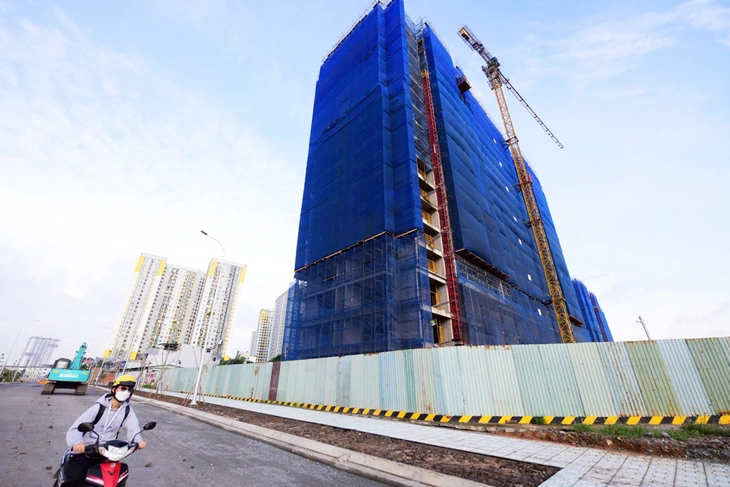
An apartment project is under construction in Binh Duong - Photo: QUANG DINH
Attracting trillions of dong in investment, people have more houses.
Following two rounds of approvals by the Ho Chi Minh City People's Council of 117 land plots for pilot projects by investors, Ho Chi Minh City will have an additional 1,409 hectares of land available for commercial housing projects with a total estimated investment of 260,055 billion VND.
Thus, in the coming years, the increasing number of housing projects will serve the housing needs of the city's residents and contribute to urban development and socio-economic development in the locality.
It is expected that in December, the City People's Council will continue to approve more land plots for pilot projects. Speaking with Tuoi Tre newspaper, Mr. Nguyen Hoai Thanh, Deputy Head of the Economic, Infrastructure and Urban Planning Department of Phuoc Long ward, said that the ward strongly supports the pilot resolution and will create favorable conditions for the My Phu residential area project to be implemented smoothly.
"During the working process and meetings with the Department of Agriculture and Environment regarding the inclusion of the project land in the list for approval by the City People's Council, the ward leaders consistently expressed their support. Currently, the My Phu residential area project has completed site preparation and construction preparation; it is only waiting for the procedures to be completed before construction can begin immediately," Mr. Thanh informed.
In the commune, there is also a plot of land larger than 5.4 hectares approved for the New Urban Construction Company Limited to carry out a pilot project (phase 1 with 54 plots of land). Mr. Truong Thai Ngoc, Chairman of the People's Committee of Binh Chanh commune, said that the project has dragged on for quite a long time, affecting the legitimate rights and interests of the people, such as not being allowed to build or renovate houses; and not being granted certificates of land use rights and ownership of assets attached to the land.
In particular, the lack of investment and upgrading in transportation infrastructure has affected the lives and daily activities of the people. Now that the city has approved the investor to carry out the project on this land, it will create favorable conditions for the investor to start implementation soon.
According to Mr. Ngoc, the early implementation of the project will contribute to solving the housing problem, meeting the housing needs of people in the area, creating stable residential communities, generating job opportunities and economic development for the region.
"Along with that, many social infrastructure projects such as schools, playgrounds, and transportation systems have been upgraded, creating conditions for people to have a better living environment, contributing to local economic development and gradually fulfilling the criteria to help Binh Chanh commune strive to become a ward by 2030," Mr. Ngoc hoped.
Lawyer BUI QUOC TUAN (Ho Chi Minh City Bar Association):
Don't let land resources become "frozen".
Previously, both the 2003 and 2013 Land Laws allowed economic organizations to receive land transfers, capital contributions, and lease agricultural land use rights to implement non-agricultural production and business projects in accordance with planning.
However, in early 2015, the 2014 Housing Law came into effect, stipulating that economic organizations must own 100% of the land for housing projects. This caused many projects to stall because most investors had to acquire agricultural/non-agricultural land to have enough area to implement their projects. To resolve this issue, the National Assembly issued Resolution 171, a pilot program valid for five years.
After a five-year pilot program, will businesses continue to be allowed to negotiate land use rights for projects? If not, businesses will face obstacles again.
While land policy plays a crucial role in unlocking and mobilizing social resources for development, it requires careful consideration by relevant authorities and, in the long term, stability of land policy to prevent land resources from becoming "frozen".
There needs to be more flexibility when considering the conditions for increasing the residential land area.
Speaking to Tuoi Tre newspaper, Mr. Le Hoang Chau, Chairman of the Ho Chi Minh City Real Estate Association, said that the regulations in Resolution 171 have removed obstacles for many housing projects.
However, according to Mr. Chau, Resolution 171 also stipulates that the total area of residential land in pilot projects (including existing residential land and land planned for conversion to residential land) shall not exceed 30% of the additional residential land area during the planning period (compared to the current residential land use status) according to the land allocation and zoning plan in the approved provincial planning for the period 2021-2030.
Meanwhile, in cases where businesses do not have or do not have enough land for their projects and have not received investment approval, meaning there is no detailed project plan, there is no basis to determine the percentage of additional residential land in the project.
Therefore, Mr. Chau suggested that the Department of Agriculture and Environment should be more flexible when considering the conditions for additional residential land area when selecting land for pilot projects.
"Allowing pilot projects is merely an initial permit for businesses to continue acquiring agricultural/non-agricultural land of sufficient area for the project, or for businesses that already possess sufficient land, including agricultural/non-agricultural land, to convert to residential land for project implementation...", Mr. Chau commented.
Continue reviewing land plots for pilot implementation.
According to the 2024 Land Law, economic organizations must own or acquire 100% of residential land before they can develop commercial housing projects. This creates difficulties for investors who own a portion of agricultural land that has not yet been converted to residential land, or who are acquiring agricultural land or non-agricultural land that is not residential land.
Resolution 171 of the National Assembly and Decree 75 guiding the resolution, effective from April 1, 2025, allow businesses to receive land transfers and convert land use purposes from various types of land such as agricultural land and non-agricultural land other than residential land, provided that it conforms to the planning.
After Resolution 171 came into effect, the former Binh Duong province completed the approval of a list of more than 200 land plots permitted for pilot projects.
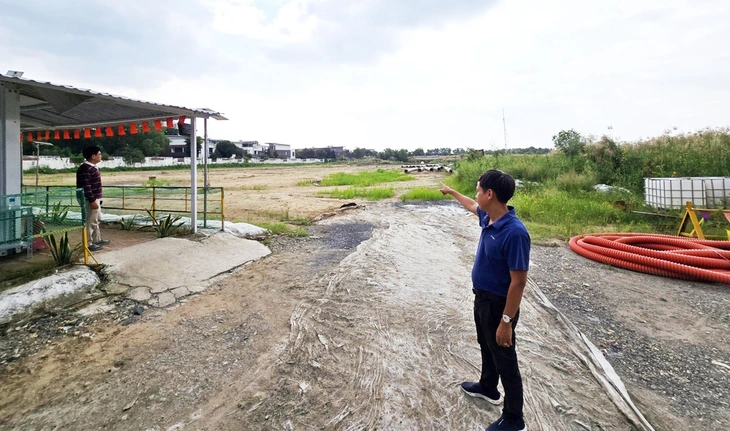
Mr. Duong Quoc Bao, Head of the Project Management Board of the My Phu residential area investor (Phuoc Long ward, Ho Chi Minh City), stands in front of the project land awaiting construction - Photo: AI NHAN
Following the merger, the Ho Chi Minh City People's Committee issued Decision 1338 to review and assess the conditions and criteria for compiling a list of land areas slated for pilot projects in the former Ho Chi Minh City and former Ba Ria - Vung Tau areas.
The city also established a task force to conduct the review, headed by the Director of the Department of Agriculture and Environment. Of the 442 land plots registered by businesses, after two rounds of review and evaluation, the task force submitted and the City People's Council approved 117 land plots for pilot projects.
Accordingly, 62 land plots in the former Ho Chi Minh City area and 55 land plots in the former Ba Ria - Vung Tau area have been designated for pilot projects. The Department of Agriculture and Environment stated that it is currently leading the review and assessment of the conditions and criteria for compiling a list of land plots intended for pilot projects, in order to further advise the Ho Chi Minh City People's Committee to submit the list to the City People's Council for approval at subsequent sessions.
Source: https://tuoitre.vn/duoc-go-vuong-nguon-cung-can-ho-o-tp-hcm-se-tang-manh-202512102338474.htm









































































Comment (0)