

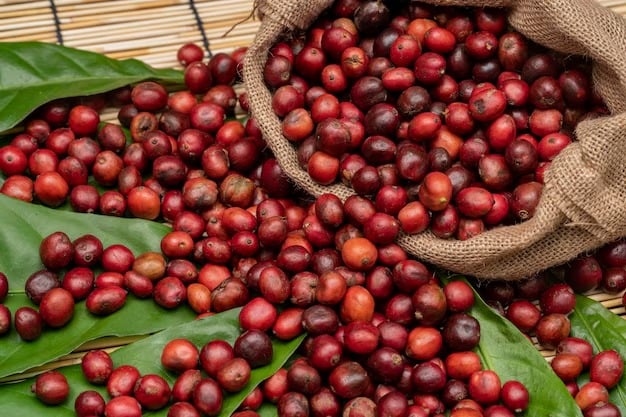
On the London floor, the price of robusta coffee futures contract for January 2026 delivery decreased by 36 USD/ton (-0.82%) to 4,315 USD/ton, while the futures contract for March 2026 delivery decreased slightly by 7 USD/ton to 4,212 USD/ton.
Meanwhile, on the New York Stock Exchange, the price of Arabica coffee futures for December 2025 delivery fell 1.8 US cents/pound (-0.43%) compared to the previous session, to 403.75 US cents/pound. The contract for March 2026 delivery fell 1 cent/pound to 372.45 US cents/pound.
According to Barchart and Bloomberg , robusta coffee prices are under pressure as information from the Vietnam Coffee and Cocoa Association (Vicofa) said that Vietnam's coffee exports are still on the rise, with 10% of robusta output harvested, and forecasts of drier weather will help the harvest progress in Vietnam accelerate this month.
Meanwhile, the decline in arabica was somewhat limited by the strengthening of the Brazilian real, which hit a two-week high against the USD, reducing the selling momentum from Brazilian coffee producers.
Lower-than-average rainfall in Brazil also supported coffee prices. Somar Meteorologia said Monday that Brazil’s largest arabica growing region, Minas Gerais, received just 20.4 mm of rain in the week ended Nov. 28, or 39% of the historical average.
Falling ICE coffee inventories are also supporting prices. Tariffs imposed by the US on coffee imports from Brazil have led to a sharp decline in ICE inventories.
ICE-monitored arabica stocks fell to a 1.75-year low of 398,645 bags on November 20, while ICE robusta stocks fell to an 11-month low of 4,115 lots on Wednesday.
According to Bloomberg , climate change is making it more difficult to grow Arabica in Brazil. Therefore, Brazilian farmers are switching to Robusta, a coffee variety that is more heat-resistant and disease-resistant. This shift is reshaping the structure of coffee production in this South American country.
Brazil’s robusta production is growing rapidly. In the past three years, robusta has grown at an average rate of nearly 4.8% per year. Notably, this crop year, robusta production increased by nearly 22% and reached a record high.
Vietnam is currently the world's largest robusta producer, but Brazil is catching up and could surpass the Southeast Asian country thanks to its well-organized supply chain, Bloomberg reported , citing analysts at Rabobank.
With the increased supply of robusta from Brazil, the world coffee market will change. If coffee prices continue to rise, consumers will tend to switch to robusta because of its more affordable price. This shift in consumption will directly affect the demand and price of robusta coffee in the long term.
Source: https://baoninhbinh.org.vn/gia-ca-phe-hom-nay-412-gia-tiep-tuc-giam-robusta-thap-nhat-1-tuan-ruoi-251204062536569.html




















![[Photo] Parade to celebrate the 50th anniversary of Laos' National Day](/_next/image?url=https%3A%2F%2Fvphoto.vietnam.vn%2Fthumb%2F1200x675%2Fvietnam%2Fresource%2FIMAGE%2F2025%2F12%2F02%2F1764691918289_ndo_br_0-jpg.webp&w=3840&q=75)





















![[VIMC 40 days of lightning speed] Hai Phong Port determined to break through, reaching the target of 2 million TEUs by 2025](https://vphoto.vietnam.vn/thumb/402x226/vietnam/resource/IMAGE/2025/12/04/1764816441820_chp_4-12-25.jpeg)



















































Comment (0)