


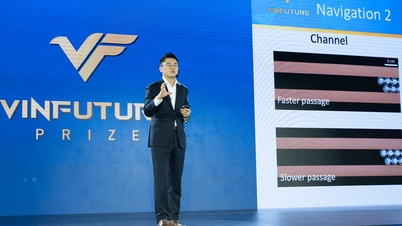
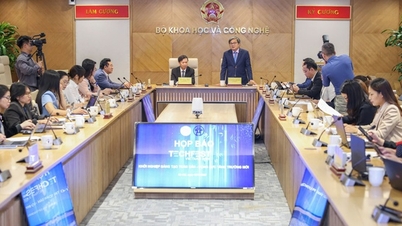
Professor Tran Trung Dung shared at the seminar.
Sharing at the discussion "Advances in Disease Detection, Diagnosis and Treatment" within the framework of VinFuture 2025 Science and Technology Week, Prof. Tran Trung Dung said that in his role as an orthopedic surgeon, he has encountered many difficult cases of trauma, arthritis, bone cancer... requiring amputation or extensive surgery and with little success. Current statistics show that about 30% of patients with amputation indications due to cancer have refused surgery. Although this is considered a life-saving option, it also leaves lifelong psychological and physical scars on the patient. Many patients and their families do not accept the removal of body parts, so reconstruction is very important.
In recent years, world medicine has developed bone regeneration techniques using individually designed metal implants. However, the cost of these techniques is so expensive that most patients do not have access to them.
Professor Dung also recounted a story 6 years ago when he treated a complicated case of bone cancer, the patient invaded the femoral head and pelvis. At that time, he had to print a 3D hip joint and pelvis for implantation abroad, but it was not suitable so he had to have another surgery.
How to solve this problem?
In 2024, the Center for 3D Technology in Medicine at Vinuni University was established. Many bone cancer patients had to undergo pelvic and hip interventions to be supported. Many 3D printing cases created new bones, implanted for patients, and could measure and create precise shapes for grafting to patients using 3D printed materials.
“The sternum, jawbone… can all be 3D printed. In the future, this is an opportunity for doctors and technicians to come up with comprehensive solutions for patients with bone problems,” said Mr. Dung.
Sharing more specifically about this breakthrough, Professor Dung said that 3D printing technology provides surgical solutions for patients that doctors could not do before. For example, with pelvic bone cancer, patients cannot have surgery because of the risk of permanent disability.
To date, Vinmec doctors have performed surgery to completely replace the damaged bone with personalized 3D printed material. After 2 years, the patient has recovered motor function and has not experienced significant complications. Thanks to that, the patient's quality of life after surgery has been improved.
About 1,000 cases have been supported, bringing hope of "reviving" the lives of many patients both at home and abroad. Among them is the case of a 7-year-old bone cancer patient who faced the risk of having his leg amputated, but doctors performed an accurate reconstruction of the femur structure so that the child could walk normally later.
With these successes, 3D printing technology is considered a turning point in bone cancer surgery. However, Professor Dung emphasized that bone cancer treatment is not "surgery and it's done". In fact, the world now uses the concept of "solution" instead of "treatment" because it requires the combination of many technologies, including: Precise surgery using simulation and 3D printing; chemotherapy; gene technology; stem cell research; sample banks for post-operative analysis...
Solving the cost barrier problem
According to calculations, in the US and Europe, the price of a 3D printed product for bone regeneration surgery can be up to 30,000 to 60,000 USD depending on the complexity. This is a huge cost compared to the ability to pay of most patients in Vietnam, even with insurance. Currently, patients in Vietnam have applied this technology with 100% support from the charity fund.
To reduce costs, Prof. Dung believes that it is necessary to reduce design time. This is being realized with the help of AI. Previously, an engineer had to spend 2-7 days to design an implant based on complex image data. With the support of AI today, the time can be reduced to less than 2 hours, even just 1 hour with basic details. Thus, labor costs will also be significantly reduced.
In addition, Vinmec Hospital will deploy an inter-hospital connection model to design and print multiple implants at the same time. Specifically, 3D printing has the characteristics of machine depreciation costs, materials and operating costs that are almost unchanged whether printing 1 or 20 products in the same printing session. Therefore, when hospitals cooperate and send design files to the 3D printing center, the cost is divided into many products, which will help reduce the cost of each implant significantly.
The third factor is that the design model is located in the hospital, which helps increase efficiency and reduce operating costs. Accordingly, doctors and engineers can still perform 100% of the process including design - simulation - testing on-site without going through foreign companies, with high service prices. Thanks to that, the cost of creating 3D implants in Vietnam can be only a fraction of that of centers in Europe.
Mr. Dung also proposed that the legal framework in this field in our country is still lacking. Health insurance does not currently cover the cost of treatment with 3D printing. The Ministry of Health has stepped in and is inviting experts to participate in building standards and processes in 3D printing technology. When the legal framework is complete, health insurance can cover this field, which will open up great opportunities for patients, helping to bring costs back to a reasonable level.

Professor Tran Trung Dung.
Vinmec team has cooperated with the Center for 3D Technology in Medicine to use special 3D technology to care for bone cancer patients. 3D printing technology in medicine brings miraculous values and impacts to patients. Thanks to this technology, hospitals can use surgical instruments that fit the anatomy of Vietnamese people at a price many times lower than imported products from the US or Europe.
Of which, we successfully performed about 200 surgeries, supported 1,000 cases... In addition, we have interdisciplinary coordination with domestic hospitals, with oncology specialists, engineers, technicians from Japan, Korea, the United States... to cooperate in research on material science such as impant and 3D... Currently, we are continuing to collect clinical data to compare with research to find new directions, new and optimal solutions for the future.
Thu Huong
Source: https://daidoanket.vn/cong-nghe-in-3d-cua-nguoi-viet-khong-co-doi-thu-o-dong-nam-a.html


![[Photo] Cat Ba - Green island paradise](/_next/image?url=https%3A%2F%2Fvphoto.vietnam.vn%2Fthumb%2F1200x675%2Fvietnam%2Fresource%2FIMAGE%2F2025%2F12%2F04%2F1764821844074_ndo_br_1-dcbthienduongxanh638-jpg.webp&w=3840&q=75)














































![[VIMC 40 days of lightning speed] Hai Phong Port determined to break through, reaching the target of 2 million TEUs by 2025](https://vphoto.vietnam.vn/thumb/402x226/vietnam/resource/IMAGE/2025/12/04/1764816441820_chp_4-12-25.jpeg)




















































Comment (0)