

On the afternoon of November 26, the Hanoi People's Council issued a resolution regulating the implementation of the Low Emission Zone, according to which motorbikes and scooters will be banned from circulating during the time frame in the area within Ring Road 1 from July 1, 2026.
Ho Chi Minh City also plans to pilot a low-emission zone (LEZ) in the city center from 2026 to limit commercial cars below Euro 4 standards or service motorbikes below Euro 2 standards. Along with that, the city plans to convert 400,000 gasoline motorbikes of technology drivers to electric vehicles.
Many technology drivers are not ready to switch to electric vehicles.
Be Group representative affirmed support for the policy of implementing Low Emission Zone (LEZ) of the Government and Hanoi City, and committed to ensuring smooth service for drivers and customers.
This technology car company said that it is technologically ready, fully owning core technologies such as coordination algorithms, digital maps, spatial data and smart routing systems for each type of vehicle. This ability allows Be to automatically update regulations restricting gasoline vehicles by time frame/area and optimize pick-up and drop-off points, keeping the travel experience uninterrupted.
To enhance connectivity, Be Group actively expands cooperation with public transport systems, including Metro, buses and transit vehicles. This helps create maximum convenience for passengers when traveling between areas outside and within the LEZ.
In particular, the company focuses on supporting drivers - the group most affected by this change. Support programs include preferential loans, consulting and in-depth training on new regulations, as well as vehicle operating skills in restricted areas.

From July 1, 2026, Hanoi will pilot low-emission zones in some areas within Ring Road 1 (Photo: Tran Thanh).
At the forum "Digital transformation of the Ministry of Industry and Trade " held on December 3, a representative of Grab Vietnam said that the roadmap to ban gasoline vehicles from Ring Road 1 in Hanoi is "quite urgent" because the charging infrastructure has not met the needs of technology drivers.
Ms. Dang Thuy Trang, Director of External Relations of Grab Vietnam, stated that 62% of the company's drivers are not ready to switch to electric vehicles due to the lack of charging stations. According to her, for drivers, vehicles are the main source of income and they have to optimize every minute of work. Refueling only takes 2-3 minutes, while charging an electric vehicle takes 30 minutes to several hours, which means drivers have to stop generating income while waiting.
Grab proposed that the roadmap to limit gasoline vehicles in the center of Hanoi should be based on the principle of partially completing the electric vehicle ecosystem before applying administrative orders. This ecosystem must include shared charging station infrastructure, maintenance networks and green financial policies to support drivers.
Policies need to ensure consistency, feasibility and effectiveness.
Sharing with Dan Tri in August about the project to replace 400,000 gasoline motorbikes of technology drivers with electric vehicles in Ho Chi Minh City, a Grab representative said the company fully supports this conversion policy.
However, the technology car company recommends that the policies should ensure consistency, feasibility and effectiveness, avoiding negative impacts on people's livelihoods and daily activities.
According to Grab, the vehicle conversion project for service drivers needs to be placed within the overall strategy of reducing emissions and converting to clean energy for the entire city.
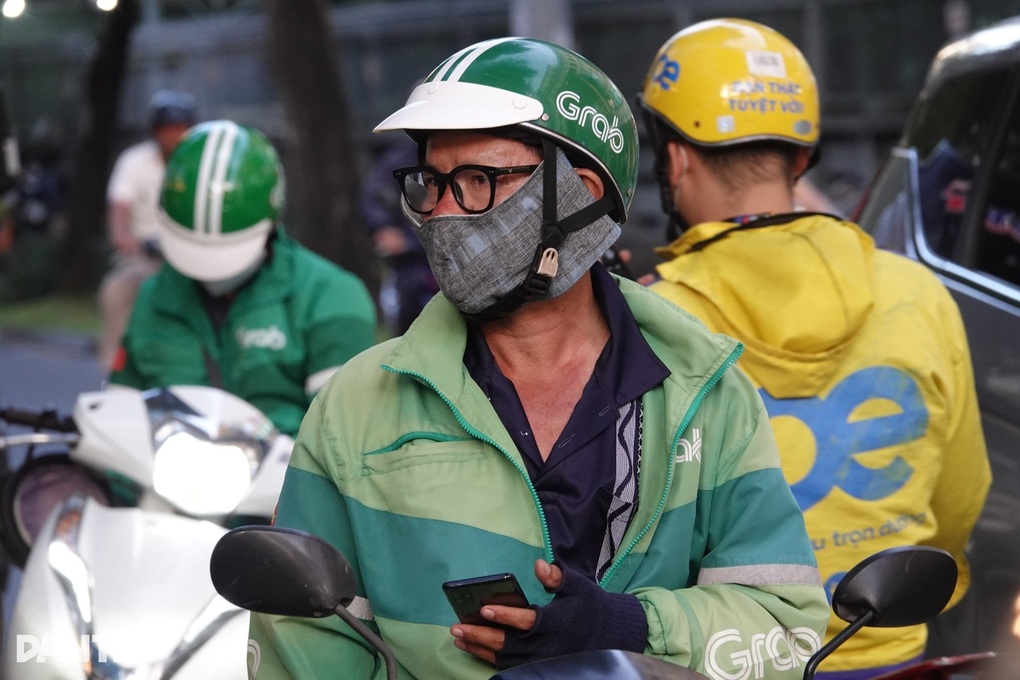
A recent study shows that the number of technology motorbike drivers in Ho Chi Minh City alone is about 400,000 people (Photo: Nguyen Vy).
"The project also needs to assess the current situation and add some specific goals on developing a comprehensive clean energy vehicle ecosystem, not just focusing on the number of converted vehicles. At the same time, it is necessary to conduct a comprehensive impact assessment, especially for the technology and delivery driver community, to be able to come up with effective and practical solutions," said a Grab representative.
This technology car company believes that the project is assessing the feasibility of the policy quite highly, when only taking into account the cost savings of some electric car drivers compared to gasoline car drivers as a basis for paying for electric cars in installments. Meanwhile, the project has not mentioned or resolved the concerns of electric car users in general and of technology and delivery drivers in particular.
For example, concerns about initial investment costs (high vehicle prices) and the diversity of vehicle supply sources; concerns about the quality and suitability of electric vehicles in service operations; concerns about the safety of electric vehicles; concerns about the lack of support infrastructure, "suspending vehicles" if the vehicle has problems that cannot be repaired, directly affecting the driver's livelihood; concerns about difficulties in accessing financial support sources...
According to this technology car company, the project needs to provide a feasible, fair, and humane vehicle conversion roadmap for basic, low-income labor groups in society.
"The overly hasty transition time regulation may prevent many people from switching their vehicles to participate (in the context that the electric vehicle support ecosystem is not ready), indirectly creating barriers to job opportunities and income for hundreds of thousands of people," he shared.
Therefore, car company representatives believe that the transition roadmap needs to be designed in the direction of implementing strong support and priority policies for public transport systems, public charging systems, and clean fuel vehicles for at least 5 years, before implementing administrative measures.
According to a survey by a business of more than 8,300 technology car drivers in Ho Chi Minh City, nearly 80% of drivers have never experienced electric cars; 62% said they are not ready to switch vehicles; only about 1/3 said they can charge electric cars overnight at home.
Regarding the cost of investing in electric vehicles, up to 68% of drivers said they could only pay installments of less than 2 million VND/month to buy a new electric vehicle.
Source: https://dantri.com.vn/kinh-doanh/ha-noi-cam-xe-may-xang-theo-gio-vao-vanh-dai-1-hang-xe-cong-nghe-noi-gi-20251205160025837.htm

![[Photo] Cat Ba - Green island paradise](/_next/image?url=https%3A%2F%2Fvphoto.vietnam.vn%2Fthumb%2F1200x675%2Fvietnam%2Fresource%2FIMAGE%2F2025%2F12%2F04%2F1764821844074_ndo_br_1-dcbthienduongxanh638-jpg.webp&w=3840&q=75)



































































































Comment (0)