


K+ officially stops operating early next year (Photo: ST).
Recently, K+ sent an email to pay TV partners informing them that it will stop broadcasting from January 1, 2026.
The announcement includes urging pay TV partners to pay off their contracts through the sale of English Premier League (EPL) rights packages.
"K+ sent us an email to inform us that they are ceasing operations. Currently, there are not many customers for the Premier League package and we have informed them that we will stop broadcasting this tournament from January 1, 2026.
We have a plan to compensate customers with other channels for those who pre-paid for Premier League packages," said a leader of a pay TV company.
The news that K+ is withdrawing from the market is no longer a rumor of withdrawal or restructuring, but a decision to end operations, closing a long chapter of the Vietnamese pay TV market.
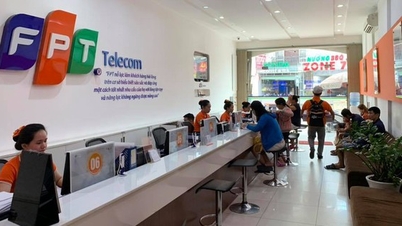
Some sources said thatFPT Telecom, rumored to be the "successor" to hold the copyright of the English Premier League (EPL), is opening up new expectations.
However, if we look directly at the story of K+, we are forced to ask: Can the newcomer avoid the mistakes of its predecessor, when the "common enemy" is still there?
The ending is foretold by the telling numbers
K+ withdrawal does not happen overnight. It is the result of a prolonged "bleeding" process without anti-inflammatory drugs.
Financial data shows that K+'s accumulated loss by mid-2025 has approached VND5,500 billion, with deeply negative equity.
Although revenue remains at 1,000 - 1,200 billion VND/year, the loss of several hundred billion VND each year has proven one fact: Relying solely on subscription revenue to offset huge copyright costs is an impossible task.
Canal+ Group has admitted the difficulties in the Vietnamese market. And in fact, the decision to leave is an inevitable consequence when the financial balance problem reaches a dead end. But why does a unit holding the "ultimate weapon" of the Premier League suffer losses?
"Watching for free"
The core reason for K+'s departure is not necessarily due to direct competitors, but rather the uncontrolled explosion of pirated websites and illegal broadcasting platforms.
For the past decade, K+ has had to fight alone against the mafia. While K+ had to spend a huge amount of money to buy the copyright of EPL, a series of pirated websites only needed an Internet connection to distribute that content for free.
The difference in experience between pay TV and pirated web is increasingly narrowed by technology, making it easier for users to compromise. As the mentality of "why pay for something you can watch for free" prevails, the value of the monopoly model is eroded to its core.
K+ is caught between two pincers: On one side is escalating copyright costs, on the other side is the ability to recover capital being suffocated by copyright infringement.
The challenge of latecomers
The news that FPT Telecom may hold the copyright of EPL from 2026 brings a breath of fresh air. Unlike K+, which is purely a content business, FPT Telecom has the advantage of being a telecommunications network operator that owns a strong Internet infrastructure and OTT ecosystem.

FPT Telecom is said to be the unit that will hold the copyright of the Premier League instead of K+ (Photo: ST).
According to observers, the strategy of making EPL the "trump card" in combo packages (Internet + Television) is a wise move to retain customers and optimize cash flow.
However, changing the TV copyright holder does not mean changing the nature of the market. If FPT Telecom or any other unit takes over EPL without changing the copyright protection environment, the risk is still there.
The lesson from the K+ story shows that it is difficult for businesses to completely solve the problem of copyright infringement without the synchronous support from the management agency. In the context of sanctions and technical tools not being strong enough to prevent illegal websites, even large businesses will face many challenges when participating in this market.
The withdrawal of K+ is a big loss in terms of market diversity, but also an opportunity to restructure the rules of the game. 16 years of K+ ended in a loss of trillions because it could not overcome copyright infringement and changes in user behavior.
The game for latecomers is not just about competing for market share, but also about survival to reshape the culture of paying for digital content in Vietnam. If the problem of "free viewing" cannot be eliminated, the question "Who will be the next victim after K+?" is only a matter of time.
Source: https://dantri.com.vn/cong-nghe/k-dung-buoc-thi-truong-truyen-hinh-tra-tien-va-van-nan-vi-pham-ban-quyen-20251205134030264.htm

![[Photo] 60th Anniversary of the Founding of the Vietnam Association of Photographic Artists](/_next/image?url=https%3A%2F%2Fvphoto.vietnam.vn%2Fthumb%2F1200x675%2Fvietnam%2Fresource%2FIMAGE%2F2025%2F12%2F05%2F1764935864512_a1-bnd-0841-9740-jpg.webp&w=3840&q=75)

![[Photo] Cat Ba - Green island paradise](/_next/image?url=https%3A%2F%2Fvphoto.vietnam.vn%2Fthumb%2F1200x675%2Fvietnam%2Fresource%2FIMAGE%2F2025%2F12%2F04%2F1764821844074_ndo_br_1-dcbthienduongxanh638-jpg.webp&w=3840&q=75)

























































































Comment (0)