

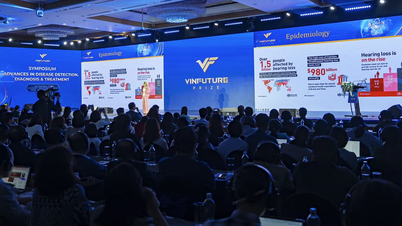
VinFuture 2025 Science and Technology Week took place from December 2 in Hanoi and will end with an exchange with the winners of the VinFuture 2025 Awards on December 6. This is a major scientific event of the year, bringing together many prominent names and brilliant minds with great contributions to the world.
The week includes 7 main activities: inspirational speeches, Science for Life talks; VinFuture future exploration dialogue series; The Touch of Science exhibition, VinFuture award ceremony; exchange with the VinFuture 2025 award winners; VinUni - Leadership Forum: Higher Education Innovation Conference.
The highlight of the event is the VinFuture 2025 Awards Ceremony, which took place on the evening of December 5 at the Hoan Kiem Theater ( Hanoi ). This is an event to honor outstanding scientific works that have had a positive and sustainable impact on millions, even billions of people around the world.
At the VinFuture 2025 Science and Technology Week, hot areas discussed included artificial intelligence (AI), robotics, health sciences, environment and sustainable development.
AI is the national "intelligent infrastructure"
Speaking at the seminar “AI for humanity: AI Ethics and Safety in the new era” within the framework of VinFuture 2025 Science and Technology Week, Deputy Minister Bui The Duy affirmed that Vietnam's vision does not stop at viewing AI as a mere applied technology, but AI is becoming an essential infrastructure similar to electricity, telecommunications or the Internet.

Deputy Minister of Science and Technology Bui The Duy speaks at the seminar (Photo: Organizing Committee).
Deputy Minister Bui The Duy said that Vietnam will announce an updated AI Strategy and AI Law, marking an important step forward in turning artificial intelligence into essential infrastructure such as electricity, roads, schools, and stations, serving the goals of economic development and digital sovereignty.
Vietnam is also urgently building a national AI supercomputing center, developing an open data ecosystem and AI infrastructure towards autonomy.
The goal is to make AI a universal “intelligent assistant” for everyone. This is expected to create a leap in social productivity, giving ordinary people the ability to access knowledge and solve problems that were previously only available to high-ranking leaders.
Potential from "swarm" robots, no need for complex AI
At the Inspirational Speech event: "Breakthrough technology of the future" within the framework of VinFuture 2025 Science and Technology Week, Professor Ho-Young Kim (Seoul National University, Korea) shared a completely new concept "spontaneous physical intelligence".

Professor Ho-Young Kim, Seoul National University, Korea, shares new robot technology at VinFuture Science and Technology Week (Photo: Organizing Committee).
In the era of humanoid robots and artificial intelligence (AI), humanity is facing a big problem of energy costs and control complexity. Professor Ho-Young Kim has brought a completely different perspective: Let the robot body "think" for itself.
At Seoul National University's lab, artificial systems are designed to form intelligent behavior entirely through physical interactions between the robot and its surroundings, rather than rigid programming.
The biggest advantage of spontaneous physical intelligence is that it eliminates the need for complex software and expensive processors.
By shaping materials and interactive surfaces, scientists are ushering in a new era – where robots are not only smart thanks to their silicon “brains,” but also smart thanks to their physical “bodies.”
Robots are "transforming" thanks to the combination of new materials and AI
On December 4, within the framework of VinFuture Science and Technology Week, the seminar “Robots and Intelligent Automation” brought together many leading experts from around the world and Vietnam to discuss the trends shaping the future of robots.
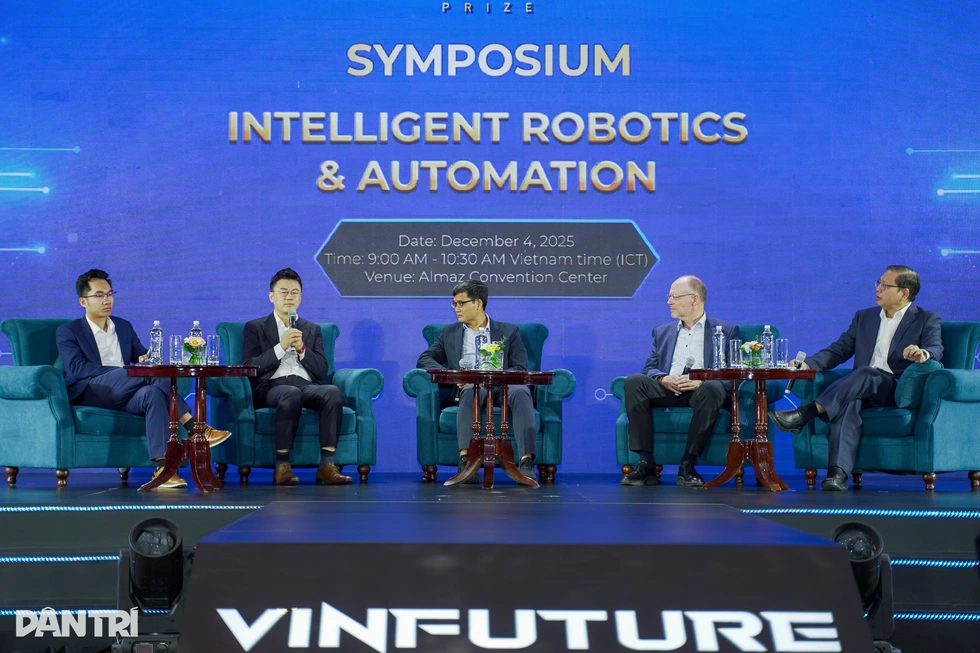
Experts share about the future of humanoid robots at the seminar (Photo: Minh Nhat).
Leading experts from around the world and Vietnam have painted a panoramic picture of the historic shift in the robotics industry: The combination of soft materials and artificial intelligence.
No longer rigid machines in industrial iron cages, robots are gradually becoming "softer", smarter and ready to enter human living spaces.
Professors have mentioned the use of soft materials such as polymers to build robots. Unlike silicon or metal, soft polymer materials have outstanding advantages: abundant supply, low cost, light weight and the ability to change structure flexibly.
This allows for the creation of robots that are highly biomimetic, can safely interact with humans, and can perform delicate tasks that rigid robots cannot.
If soft materials help robots be physically flexible, then new generation AI models are helping them transform their thinking, allowing them to move from "single-task" robots to "multi-task" robots to perform more tasks.
Experts say that while specialized robots are better suited for factories, humanoid robots are the best choice for residential environments. Our world (staircases, doorknobs, tools) is designed for humans; therefore, a humanoid robot will fit in easily and work best.
Turning the dream of the century into reality and opportunities for Vietnamese farmers
Attending the VinFuture Science and Technology Week, the world's leading scientists brought a breakthrough solution that can completely change the farming practices of millions of smallholder farmers. That is the technology of asexual reproduction through seeds (Synthetic Apomixis).
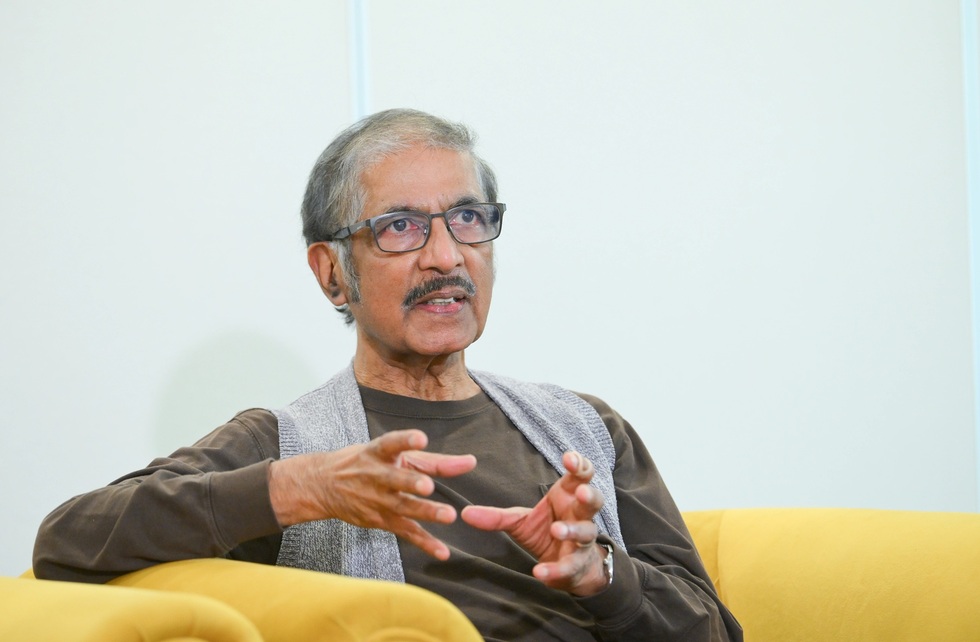
Professor Venkatesan Sundaresan, co-author of the revolutionary research, shared with reporters on the sidelines of VinFuture Science and Technology Week (Photo: VinFuture).
In the context of complex climate change and increasing pressure on food security, creating crop varieties that are both high yielding and resilient is not enough.
The biggest challenge lies in how to maintain those superior characteristics over generations without forcing farmers to spend money on buying new seeds each season.
Unlike the tissue culture method (which produces seedlings identical to the mother plant but is difficult to preserve, transport and expensive), this technology allows plants to self-clone during the seed production process. As a result, seeds obtained from the F1 generation will develop into seedlings (F2, F3, Fn...) with the same genetic makeup as the mother plant.
This helps to “fix” hybrid advantages. Farmers only need to buy seeds once and can save the seeds for the following seasons with the same yield and resistance.
This research has been successfully conducted on rice plants, so it can be applied directly to existing rice varieties in Vietnam. When farmers do not have to worry about the burden of annual seed costs, they will be able to cultivate with peace of mind, taking advantage of rice varieties that are more resistant to salt and drought.
The father of the HPV vaccine wants to help Vietnam "eradicate" cervical cancer
Within the framework of VinFuture 2025 Science and Technology Week, three leading scientists from the US National Cancer Institute (NCI) and the University of Texas, Professor Maura L. Gillison, Dr. John T. Schiller and Dr. Aimee R. Kreimer, openly shared about the "weapon" against cervical cancer - the HPV vaccine.

From left to right: Professor Maura L. Gillison, Dr. John T. Schiller and Dr. Aimee R. Kreimer came to Vietnam to attend the VinFuture Science and Technology Week (Photo: Organizing Committee).
Dr. John Schiller (US National Cancer Institute), one of the "fathers" of this technology, recalls the difficult period of continuously conducting animal tests with poor results; the turning point only came when the research team came up with a bold idea.
"Instead of just taking very small pieces of the viral protein as we traditionally did, we decided to take an entire protein and let it self-assemble into a virus-like structure (VLP). That was the key," Dr. Schiller shared.
This "simulated" structure tricks the immune system, causing the body to produce large amounts of antibodies that attach to and prevent the real virus from entering.
The biggest barrier to making HPV vaccines available to everyone is cost, as most vaccines are currently imported from developed countries.
Dr. John T. Schiller offers a hopeful outlook: “To reduce costs, we are advocating for vaccine production in middle-income countries.” For example, China and India have produced vaccines that meet World Health Organization (WHO) standards, significantly reducing costs.
In particular, the expert from the US National Cancer Institute made a strong commitment: "We are willing to help any units or manufacturing companies that wish to build factories or facilities to produce this vaccine in Vietnam."
Sharing the same view, Dr. Aimee R. Kreimer also expressed her willingness to cooperate with the Ministry of Health and Vietnamese government agencies to provide scientific data to support policy decisions to include HPV vaccine in the National Immunization Program.
VinFuture 2025 Science and Technology Week, taking place from December 2 to December 6 in Hanoi
With the theme “Together we grow - Together we prosper”, this year’s series of annual international events continues to affirm VinFuture’s mission in connecting knowledge, arousing the desire to serve and elevating Vietnam’s position as a center for promoting science and innovation in the world.
The highlight of the event was the VinFuture 2025 Awards Ceremony, which took place on the evening of December 5 at the Hoan Kiem Theater (Hanoi). This is an event to honor outstanding scientific works that have had a positive and sustainable impact on millions, even billions of people around the world.
This year, the award will be given to works that bring the value of "Together we grow - Together we prosper" to humanity, as the theme has set out, affirming VinFuture's mission of honoring intelligence, spreading humanity and serving life.
Source: https://dantri.com.vn/khoa-hoc/nhung-linh-vuc-nong-duoc-mo-xe-tai-tuan-le-khoa-hoc-vinfuture-2025-20251205110643691.htm


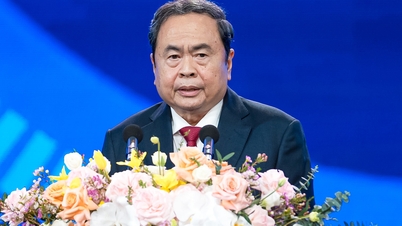
![[Photo] National Assembly Chairman Tran Thanh Man attends the VinFuture 2025 Award Ceremony](/_next/image?url=https%3A%2F%2Fvphoto.vietnam.vn%2Fthumb%2F1200x675%2Fvietnam%2Fresource%2FIMAGE%2F2025%2F12%2F05%2F1764951162416_2628509768338816493-6995-jpg.webp&w=3840&q=75)
![[Photo] 60th Anniversary of the Founding of the Vietnam Association of Photographic Artists](/_next/image?url=https%3A%2F%2Fvphoto.vietnam.vn%2Fthumb%2F1200x675%2Fvietnam%2Fresource%2FIMAGE%2F2025%2F12%2F05%2F1764935864512_a1-bnd-0841-9740-jpg.webp&w=3840&q=75)





































































Comment (0)